Tag: doula

  • The Myth of the Aging Placenta

    The Myth of the Aging Placenta

    Originally published in 2019, and updated in 2023 (see end of post for update)

    I am a birth educator. I also have a PhD in physiology of reproduction, and 20 years of research experience and I have a confession to make: I get REALLY irate when women get given poor quality evidence (or no evidence at all) in support of a recommendation for inducing labour.

    Whether I’m wearing my doula hat, or my scientist hat, I have to admit to getting really fed up with the growing epidemic of induction of labour for dubious reasons. This article is going to explore one of the most common stated reasons for induction of labour at term : The idea that labour should be induced before a certain point in pregnancy is reached because the ‘older’ placenta is not as efficient.

    I want to clarify one thing before we start: I am NOT anti induction, when it is justified by solid medical evidence and when a woman weighs up the evidence and decides that the risk of continuing the pregnancy is higher than the risk of inducing labour (like for example pre-eclampsia or reduced fetal movements, or when there are psychological reasons for the woman to choose to be induced).

    Over the last 15 years, between teaching antenatal classes and supporting women a a doula, I have heard and witnessed hundreds of stories of induction, the majority of which ended up being traumatic for the mother.

    In my area of work we often refer to this as the “car crash”, which goes something like this: 3 days of prostaglandin induction (often made more stressful because the woman cannot be with her family for much of the time), followed by 24 hours of syntocinon and a caesarean at the end for either fetal distress or “failure to progress” (if only women were told : We’re really sorry, we didn’t manage to get you into labour with our drugs, so now the only option is a cesarean, maybe women wouldn’t feel as traumatised as when they are labelled a failure. Language matters).

    I have listened and held women (and their partners) as they told me of their upset, their grief, their disbelief, lack of preparation and their feelings of failure.

    One of the top quoted reasons for inducing women when pregnancy goes beyond 41 weeks is the idea that the placenta somehow stops working after pregnancy reaches a certain number of weeks.

    The implication is that the placenta has a sell by date, like a piece of meat in the supermarket.

    Recently yet more papers have been published claiming as a fact that placentas “age”, “degrade” and “fail” in older mothers and after a certain number of weeks of pregnancy.

    I don’t normally like to write solely about science stuff these days. I like to write about how I feel about issues, and stick a few references in for people who want to read them. I spent 20 years doing scientific research in the academic and industry setting. I’ve moved on from this, I find most of the scientific world too dry and frankly, too blinkered.

    But I’m losing patience with this so-called science causing so much damage to women.

    I was very concerned a few weeks ago to watch a heated debate on social media about this topic; seeing many of my colleagues being gaslighted into believing the so-called science by people who claim to have all the answers, using jargon that they do not understand.

    I believe that my scientific background combined with my  experience as antenatal educator and doula gives me a unique, broad perspective on this topic.

    So it’s time to put my scientific hat back on, analyse the papers in question, and offer my rather alternative interpretation of the current evidence, so that women and birth workers can make truly informed decisions, not one-sided ones based on the opinions of a few so-called experts whose views are based on their existing belief and opinion rather than a considered weighing-up of the evidence in this area.

    I suggest you grab yourself a cup of tea, because this is going to be a long one!

    Before I start I want to make an important point: even experts in a field often disagree with one another.

    When I was working in the academic field during my PhD and 2 postdocs, working in a small niche area of biology research (clock genes, the genes which control rhythms, such as waking and sleeping), I published in fairly high ranking scientific papers, and became quickly perceived as an expert in my field. This led me to be invited as a guest speaker at conferences. I remember arguing until I was blue in the face about the interpretation of certain data with other experts in the field. It was done passionately, but it was entertaining, good humoured and fun. It happened because, as I will explain below, good scientists understand that science isn’t black and white.

    The conversations I see on social media about this research aren’t like this. I see experts pretending to have all the answers, presenting themselves as the only ones who have all the knowledge, and frankly bamboozling and bullying non scientists with jargon.

    In this particular case, they take the moral high ground, presenting themselves as saviours, as if stillbirths could be guaranteed to be prevented if only we induced all women at a certain number of weeks of pregnancy. They attack other people whose views are different, even when these people are equally or more qualified and hold PhDs in relevant fields.

    This isn’t right. This harms women, and this harms the people who are supporting them too.

    Even in science, things are never black and white. Nothing is guaranteed. There are many shades of grey. And pretending that things are this way isn’t science, it is delusion, and it is treating science as a dogma. If you want to find out more about this way of thinking, watch Cambridge scientist Dr Rupert Sheldrake’s banned TED talk on the topic.

    Now that’s out of the way, back to the subject at hand: do placentas really age? Do they stop functioning correctly towards the end of pregnancy? And most importantly, are they solely responsible for the (let’s remember, tiny) rise in stillbirth towards the end of pregnancy? These are the assumptions that currently underpin our induction policies.

    I feel I need to explain first that the risk of increased stillbirth at term, which is the main reason behind induction policy, is actually very small, rising from about 0.1% (1 in a 1000) at 40-41 weeks, to about 0.3% (3 in a 1000) at 42 weeks and about 0.5% (5 in a 1000) at 43 weeks (from this paper). The Cochrane review on induction beyond term , found that induction before 42 weeks reduced the risk of perinatal death from 0.3% to 0.03%, and that the authors of the review concluded that:

    ” A policy of labour induction compared with expectant management is associated with fewer perinatal deaths and fewer caesarean sections. Some infant morbidities such as meconium aspiration syndrome were also reduced with a policy of post-term labour induction although no significant differences in the rate of NICU admission were seen. However, the absolute risk of perinatal death is small. Women should be appropriately counselled in order to make an informed choice between scheduled induction for a post-term pregnancy or monitoring without induction (or delayed induction).”

    In practice I almost never see the part highlighted in bold being presented as an option to women (read my previous blog about it here)

    I would like to quote the seminal paper by the late Dr Fox “Aging of the placenta

    ” A review of the available evidence indicates that the placenta does not undergo a true aging change during pregnancy. There is, in fact, no logical reason for believing that the placenta, which is a fetal organ, should age while the other fetal organs do not: the situation in which an individual organ ages within an organism that is not aged is one which does not occur in any biological system. The persisting belief in placental aging has been based on a confusion between morphological maturation and differentiation and aging, a failure to appreciate the functional resources of the organ, and an uncritical acceptance of the overly facile concept of “placental insufficiency” as a cause of increased perinatal mortality.”

    Whilst I am fully aware that this paper is dated, having being published in 1997, and that much more research has been carried out since, I still believe his conclusion stands, the last sentence in particular.

    I’ve heard many maternity care providers coerce expectant mothers to accept induction (remember, if you feel coerced, this isn’t consent) to the cries of “your placenta is failing right now”. Yet, even today, we do not know what accounts for the tiny rise in neonatal mortality after 40 weeks.

    There seems to be a strong desire to prove the causality between placental aging and the increase in stillbirth and this desire is guided by a positive drive, which is to reduce stillbirth.

    I empathise with this drive better than you know, because my younger brother was stillborn so I fully understand the devastating effects the death of a new baby has on a family.

    But for the moment it’s just this: a theory.

    And anyone can invent a theory about anything, but that doesn’t make it true.

    We need to find a balance between the real statistics and women’s wishes for a positive birth experience. Because there is no doubt from the evidence in this area that, as long as mother and baby are well, it is better for all involved for labour to start on its own.

    Because we mustn’t forget that inductions can be very traumatic for women and they can cause fetal distress in babies.

    It’s quite simple, really: let the mothers decide what they want. And for this, they need real facts and numbers, not emotive coercion.

    First, a bit of history

    How did the whole concept of placental failure ever come about?

    In her book “Inducing labour, making informed decisions” , Dr Sara Wickham explains that this theory came about first via the work of Ballantyne who described a wasting condition of the newborn in 1902, followed by Runge in 1958 who coined the term placental insufficiency. This became known as the Ballantyne-Runge syndrome, and led to the assumption of a relationship between the length of pregnancy and placental failure.

    Dr Wickham goes on to explain that this theory has never been proven and that there is no evidence behind it. She explains that, while we know that some women’s placentas do sometimes fail to provide sufficient nutrients for their baby, this doesn’t mean that all women’s placentas routinely fail at a certain point in time.  Further evidence of how much those who are challenging this theory really do care about the wellbeing of babies can be seen where Dr Wickham notes in her talks that the concern is not just about preventing unnecessary inductions for women who do not need them. By trying to make standardised, population-level recommendations (or a ‘one size fits all’ approach), we not only lead many women to have inductions that they do not need, but we may also fail to identify and help the small number of babies who truly do need help but at a point earlier than the current population-level cut-off point for induction.

    Even in the papers claiming that there is a relationship between the length of pregnancy and the state of the placenta, when you dig into them, the conclusion reached is always that there is a “possible link” rather than a proven one.

    And as I explained before, experts in the field do not agree with one another. In her book “Why induction matters“, Dr Rachel Reed quotes a couple of prominent papers, in particular a paper by Maiti et al which claims a direct link between placental aging and stillbirth, and a paper by Mazzurato et al ” Guidelines for the management of postterm pregnancy” which states that:

    Although the fetal, maternal and neonatal risks increase beyond 41 weeks, there is no conclusive evidence that prolongation of pregnancy, per se, is the major risk factor. Other specific risk factors for adverse outcomes have been identified, the most important of which are restricted fetal growth and fetal malformations. In order to prevent PT (Post term) and associated complications routine induction before 42 weeks has been proposed. There is no conclusive evidence that this policy improves fetal, maternal and neonatal outcomes as compared to expectant management.”

    The nitty gritty of the arguments behind the aging placenta theory

    Some of the technical terms I see bandied around a lot, and which bamboozle many of my colleagues because they do not understand their meaning, are morphological changes in the placenta such as apoptosis, autophagy, syncytial knots, reduction in telomere length and so on. In many papers, the authors claim that these are key features of aging, and observed in post-term placentas.

    Yet there is more than one interpretation of these morphological changes so often lauded as proof of a placental ‘sell-by date’. They do not automatically mean that there is a problem. In many ways, our understanding of this area is in its infancy, and we would do better to take a position of scientific humility while we try to determine the meaning of these findings.

    One of the most striking examples of a study which makes suggestions that aging of the placenta at term is a fait accompli is this study, with its sensational title: “Evidence that fetal death is associated with placental aging” by Maiti et al.

    I find one of the statements in this paper extremely concerning:

    ” The known exponential increase in unexplained intrauterine death that occurs >38 weeks of gestation may therefore be a consequence of aging of the placenta and decreasing ability to adequately supply the increasing needs of the growing fetus. This knowledge may impact on obstetric practice to ensure infants are born before the placenta ages to the point of critical failure

    I fear such a statement will be used to pressure yet more women into being induced earlier, without any concerns for their personal decision or well being. And yet, as I will keep saying, this is still an unproven theory and different experts have different opinions about whether it is true or not. The medical profession is based on the tenet of ‘first do no harm’ and my understanding is that this means that we should not intervene unless we have good evidence to support doing so.

    I will go through clarifying the differential interpretation of some of the changes observed in the placenta.

    One of the changes they observe in this paper is decreased autophagy. Autophagy is a kind of cellular recycling system. The authors infer that these changes are a proof of aging. Yes, autophagy decrease has been associated with aging in some studies. Some other authors, however, are suggesting that the reduction in autophagy in the placenta may be part of the process that actually starts labour and so it may be a normal and important part of a physiological process rather than a sign that something is ‘wrong’.

    Another placental change, quoted in the paper by Maiti cited above, is apoptosis (also known as programmed cell death). Apoptosis isn’t just a proof of senescence (aging). Apoptosis also happens during fetal development and during adolescence. It is as much as sign of change as it is a sign of ageing, and of course change and growth are very important at this time; the whole point of pregnancy is that the baby grows and changes

    “The role of apoptosis in normal physiology is as significant as that of its counterpart, mitosis. It demonstrates a complementary but opposite role to mitosis and cell proliferation in the regulation of various cell populations. It is estimated that to maintain homeostasis in the adult human body, around 10 billion cells are made each day just to balance those dying by apoptosis (Renehan et al., 2001). And that number can increase significantly when there is increased apoptosis during normal development and aging or during disease.”

    And during pregnancy

    “Trophoblast apoptosis is a physiologic event in normal pregnancy, increases with advancing gestational age and is higher in post- term pregnancies and therefore is considered as a normal process in the development and ageing of the placenta.”

    Again and again we see that the processes which are claimed by some to be evidence of aging could also be interpreted to be signs of the normal growth and change which are the very function of pregnancy.

    Syncytial knots (SNAs, an accumulation of cell nuclei (the centre of cells) inside placenta cells) are another change quoted as a proof of ageing:

    ” SNAs may form to structurally reinforce the placenta and minimise damage from shear stresses or other mechanical sources, reduce the proportion of nuclei in highly active vasculo-syncytial membranes or result from cell turnover in the placenta without an apoptotic trigger or shedding process. Ultimately, a better understanding of the processes leading to SNA formation will give insight into their significance in pregnancy complications.”

    So again, what we are seeing could just as well be an adaptation rather than a sign of ageing.

    Telomere length :

    “Telomeres, the DNA–protein structures located at the ends of chromosomes, have been proposed to act as a biomarker of aging. In this review, the human evidence that telomere length is a biomarker of aging is evaluated. Although telomere length is implicated in cellular aging, the evidence suggesting telomere length is a biomarker of aging in humans is equivocal. More studies examining the relationships between telomere length and mortality and with measures that decline with “normal” aging in community samples are required. These studies would benefit from longitudinal measures of both telomere length and aging-related parameters.”

    In this paper called “Questioning causal involvement of telomeres in aging” the authors state:

    “Multiple studies have demonstrated that telomere length predicts mortality and that telomeres shorten with age. Although rarely acknowledged these associations do not dictate causality. In addition, the causality hypothesis assumes that there is a critical telomere length at which senescence is induced. This generates the prediction that variance in telomere length decreases with age. In contrast, using meta-analysis of human data, I find no such decline. Inferring the causal involvement of telomeres in aging from current knowledge is therefore speculative and could hinder scientific progress.”

    What I find of particular interest, is that the authors of this paper also speculate that these cellular changes may form part of what starts labour:

    ” Placental senescence raises several important questions that need to be addressed experimentally. While fusion-induced senescence appears to be required for syncytiotrophoblast formation, it is likely that senescence of both fetal tissues and the maternal decidua play at least a part in determining timing of labour onset”

    So what if what is seen in the placenta and interpreted as a sign of aging, are in fact normal, healthy changes, which are a sign of healthy growth and development and which may also play a role in the start of labour?

    Another “older” sign of placental aging is calcifications. I’ve been guilty myself of believing people who told me it was a sign of ageing and it was good that the baby had been born because the placenta was “old”. I recently came across this blog (which has published references to back up all its claims):

    So while calcification of a placenta at term – around 39-42 weeks is part of the normal appearance of a full-term placenta and has no clinical significance in a healthy pregnancy, the appearance of significant calcification earlier in pregnancy is associated with risks to both the mother and baby. Just like we would be concerned about a very young person with wrinkles – it could be a sign of something significant happening (…) So, in essence, when a mother is healthy and full term, calcification and infarcts are normal features of a healthy placenta – just like your healthy mother has some wrinkles and a few grey hairs. 

    Yet another myth blown out of the water.

    In conclusion, whilst there is evidence of cellular changes in the placenta throughout the course of pregnancy, there still isn’t any solid evidence to prove that it is indeed aging rather than an adaptation, or that these changes are truly accountable for the tiny rise in stillbirth when pregnancies continue beyond 42 weeks.

    The concept of the aging placenta is still just that, a theory. Unfortunately the majority of the publications cited in this post fail to acknowledge this, and take this theory as proven.

    What worries me even more, is that no consultation of women’s view on the induction process usually takes place, and these publications will form the basis of the new NICE guidelines, then the local hospital guidelines, and therefore more and more women will be induced needlessly, and have negative or traumatising experiences.

    This is underpinning a current trend towards inducing women even earlier, at 39 weeks instead of the current 41 to 42 weeks.

    Evidence based birth has produced an excellent review of the literature on this topic.

    I hope that reading this blog will help families and their supporters make informed decisions.

    I also would like to encourage scientists and policy makers to stay curious about the wider picture and to engage more with pregnant women and their views on the induction process.

    Update August 2023

    Having reviewed more recent evidence since I published the blog in 2019, I still stand by what I wrote above. I cannot see anything in the more recent literature that has changed. What strikes is that all the research is looking at proving that placentas age, but no one is looking at it from another angle: the fact that it made simply be changes, a process of maturation, necessary as part of the birth process. This is a case of culture leading science. As Dr Sara Wickham says :

    our modern culture is not very tolerant of the concept of aging generally, especially in women, so it is not that surprising that we so easily accept the idea that the aging placenta is unwanted and problematic.”

    A review paper in 2020 called “A review of the Evidence for Placental Ageing in Prolonged Pregnancy“, whilst it makes a case for the so-called aging, also states this in the discussion:

    Given the close relationship between placental structure, cell processes and placental function these changes would be expected to lead to a reduction in placenta function. However, we have not been able to identify any studies which have examined this link.”

    My review of the latest evidence led me to find a paper called Aging of the Placenta, published in the journal Aging in 2022. The paper contained the following paragraph :

    As gestation progresses, the placenta undergoes senescence. Generally, this process is necessary to detach the placenta from the uterine wall following parturition, eventually allowing blood vessels to close (to prevent haemorrhage) and the uterus to regain pre-pregnancy size and shape”

    I researched this and found publications that show that the very processes that the publications that talk about aging describe: inflammation, apoptosis, may actually be part of the normal process the placentas need to do to detach.

    Therefore my suggestion that what is interpreted as aging may be a normal physiological and maturation process now has some evidence behind it.

    This also made me wonder: If we induce labour, may we be interfering with this maturation process, and would induction results in more difficulties birthing the placenta? Reading around this subject shows that induction of labour is a known risk factor for retained placenta.

    Feel free to signup to receive my newsletters by using the signup form at the bottom of this page


    A Note to Readers

    Thank you for reading my article on The Myth of the Aging Placenta. While I’m passionate about sharing evidence-based information on this topic, please note that I cannot provide personalised support or respond to individual questions in the comments section.

    For those seeking individualised guidance related to pregnancy and birth, whether you are pregnant or a birth professional, I offer individual mentoring sessions, as well as mentoring packages. During these sessions, I can offer more tailored information based on your specific situation.



  • The “untried penis”

    The “untried penis”

    Women sometimes get told that they cannot give birth at home with their first baby because they have an “untried pelvis”.

    What if we told men they couldn’t have sex at home the first time because they have an “untried penis”

    Just imagine a young couple going to see a health professional, to discuss their plan to have sex for the first time.

    Doctor: Hello please  come in, what can I help you with?

    Couple: Hello, we have been together for a while now, and we feel ready to start having sex.

    Doctor: That sounds about right, I will arrange for you to go to your local hospital.

    Couple: Actually we were hoping to have sex at home

    Doctor: At home!! For your first time?? This isn’t safe.

    Couple : Why? It’s quite a natural thing isn’t it?

    Doctor: Yes it’s a natural thing, but lots of things can go wrong, because you have an untried penis. When you’ve had sex at least once in hospital, and we know you can do it effectively and safely then we’re happy for you to have sex at home. But for your first time, it’s much safer to do it in the hospital

    Couple: What can go wrong?

    Doctor: Well we don’t know how long it will last, whether you’ll be able to get a strong enough erection, maintain it for long enough, that’s one thing. It can also be very strenuous for the two of you, so we will need to monitor your heart rate, temperature and blood pressure. People have heart attacks whilst having sex you know? And you are both nearly 25, the risk of heart attack doubles after 25. At least if you’re in the hospital there are doctors available to intervene quickly should anything bad happen.

    Couple: This sounds very worrying, but we really don’t like hospitals, the environment is cold and clinical, it smells of disinfectant, whereas at home we have the right atmosphere, smells, and all the comfort that we need.

    Doctor: Well you won’t need be there the whole time, you’ll get started at home anyway, we don’t really want you to come in until you’re past the established arousal stage. Plus it can be quite a messy affair, you don’t want to ruin your furniture, do you?

    Couple: So we will have to travel to the hospital, like, in the middle of it? Won’t this disrupt things?

    Doctor: A bit, especially if you come to the hospital too soon, before you have reached the established arousal stage. When you come in, an intimacy midwife will assess your arousal and the strength of your erection. If your erection isn’t big enough and you aren’t yet in the established arousal stage, we will send you home and tell you to come back later. But once you’re settled in the hospital, you should be able back into the swing of things quite quickly, especially as our staff is highly trained to support the intimacy process, and help you if you struggle. Also you need to know that nearly half of first time couples who are planning for home sex end up transferring to the Intimacy Unit anyway.

    Couple: We’ve had a tour of the hospital and we really don’t like the Intimacy Unit. The rooms are tiny, the beds are high and narrow, there are only bright lights and thin paper curtains, and no en-suite bathrooms.

    Doctor: well yes for your safety is paramount that we can see what you are doing, and access the bed quickly and easily, in case something goes wrong, you see. It’s also safer for you to be in the missionary position for that reason.

    Couple: This really puts us off,  and we’re worried we won’t be able to do it in there.

    Doctor : Don’t worry if you fail to progress, we have a lot of technology at hand to help complete the process, like Viagra and penis substitutes.

    I tell you what, since you’re both still kind of low risk, as long as you’re still under 25 by the time you have sex, we could let you go to our Natural Climax Centre, instead of the Intimacy Unit. It’s a home from home centre, with large rooms, double beds and mood lighting, and even one hot tub per room so you can get in the mood and relax. It looks more like a fancy B&B than a hospital! It’s staffed by experienced intimacy midwives, who are skilled in supporting physiological sex. So it will be just yourselves, a midwife, and a couple of reproductive students. They only use intermittent monitoring every 5 min during the established arousal phase. Of course if anything goes outside of the guidelines, we would suggest you transfer to the Intimacy Unit where we can monitor your heart rate continuously, as well as intervene with a penis substitute if you cannot finish by yourself. As I said before, as you have an untried penis, we don’t know which way it will go.

    Couple: Regardless of the hospital location, we feel that having lots of people we don’t know watching us will be inhibiting. And we don’t want students!

    Doctor: Oh don’t worry about that, all the staff are trained and completed used to it! They see it all the time, and you once you get back into the swing of things, you won’t be paying attention to what’s going on around you. Plus we are a teaching hospital, so we need to train our students.

    Couple: We were also hoping to do it at a spontaneous time…

    Doctor: Well yes, for low risk couples it’s ok to wait for sex to start spontaneously, but since you’re both nearly 25 your risk of heart attack is higher, so if we haven’t had sex by the time you are 25, we think it’s safer for you to come in at an agreed time so we can monitor your heart rate from the beginning, and intervene if needed. We start the process in the pre-intimacy ward, by giving you some Viagra orally, and if that doesn’t work we can give it to you via a drip which is more effective.

    Couple: OK, doctor, we want to do what’s safest and not put ourselves in danger, so we will go for what you suggest.


    Why did I write this?

    Comparing childbirth to sex isn’t new.

    The hormone that drives labour, Oxytocin, the hormone of love, is the same hormone that floods our system when we have fall in love or have sex, and because this hormone flows best in dark, private, unobserved conditions (think romantic diner atmosphere), it is generally understood that one needs a similar atmosphere to birth a baby that they needed to make the baby.

    Sadly modern obstetric units rarely provide the environment for birth to unfold easily. This has been explained extremely well both in Tricia Anderson’s Out of the laboratory: back to the darkened room and in Marsden Wagner’s Fish can’t see water articles

    In the book “the function of the orgasms” Michel Odent wrote a “Dear John” wedding night preparation letter from a woman to her fiancĂ©, where she talks about the wedding night educator she has been working with and the wedding night plan she has been writing.

    There is a particularly clever satire video which depicts an Italian couple trying to conceive in an hospital, it’s called “The performance“. There is another one in English called “Push”.

    I have this wonderful role play that was written by Jill Alderton & Jill Oliver, for a home Birth Conference. It depicts a couple going to see their GP because wanting to have sex at home. I have adapted and rewritten it with the untried penis scenario.

    Reading an article in the press today triggered me to write this new analogy.

    There was the following quote

    ” Why could Meghan not have a home birth?

    Meghan’s reported decision to abandon her home birth could have been down to an number of factors, an expert claimed.

    Consultant obstetrician and gynaecologist Peter Bowen-Simpkins, told the Mail: “When you have your first baby you essentially have an ‘untried pelvis’.

    “You don’t know what’s going to happen when the body prepares for labour and birth.

    “If a woman is on her second or subsequent baby and has had a normal delivery before then it’s likely there wouldn’t be any problem at all.

    “But you don’t know that’s going to be the case until you have your first baby.”

    I got very annoyed reading this, for several reasons.

    First, because it’s yet another example of what is wrong with the current maternity care culture in this country. It’s a fear based culture, one that treats birth like an accident waiting to happen.

    Second, because it’s a symbol of the patriarchal culture within the maternity system. Birth is a natural physiological function for women. For a male doctor to state “she has an untried pelvis” is implying that women cannot give birth well by default.

    It’s a bit like saying to a man who is getting ready for his wedding night “Here’s a dildo, just in case you can’t get it up-no pressure”

    Reading about the untried pelvis made me wonder what would happen if we told men who hadn’t yet had sex that they have an “untried penis”.

    So I decided to write about this, just to illustrate how supportive it would feel for men if they were told this.

    Now I need to give a disclaimer. I know birth and sex are different processes. I know that bad sex doesn’t have the same possible consequences as a birth that goes wrong.

    I’ve also been a doula and birth educator for long enough (I started working in this field over 10 years ago) and seen enough births to know that nothing is ever black and white, and that things can go wrong. I’m not naive. And I’m not suggesting everybody should birth at home.

    I am also a paid up member of the informed choices society so I am NEVER going to push homebirth on anybody,  and I’m as likely to fiercely help a woman to have an elective cesarean if it is what’s right for her that I am to support a woman to birth at home despite “high risk” factors.

    Also, language is important. The words we use can either inspire confidence (your labour is progressing really well) or cause anxiety and distress (you’re ONLY 3cm dilated).

    This is why I dislike the expression “untried pelvis” so much. Because it implies that it won’t work. That we will let you “TRY”. It’s not very encouraging is it?

    That’s why I wanted to make the analogy with the untried penis.


  • Sophie’s guide to choosing a rebozo

    Sophie’s guide to choosing a rebozo

    I often get asked how to choose a rebozo, so here is a guide based on my experience of using a wide range of rebozos lengths and styles. When I started using rebozos, I only had a standard sized open weave one. It worked well for me, and I used it to support many families through pregnancy and birth. Over the last 10 years I have developed my knowledge of rebozo use and worked with many different type of rebozos and fabrics.

    I have practised rebozo techniques and facilitated rebozo workshops with several hundred women (and a few men) of all shapes and sizes. As I started selling rebozos, I acquired a large number of different rebozos and other shawls/scarves from many different suppliers and countries. Whilst you can use any rebozo for pretty much anything, I have found that different rebozos have different qualities, and lend themselves to different techniques.

    Rebozos can be a bit like choosing a pair of shoes. You would choose different pairs of shoes to go hiking or to attend a wedding. Similarly, certain lengths or types of fabric lend themselves better to certain techniques.

    If you’re on the shorter side like me (I’m 5ft3, 1.60m), and want to be able to wear the rebozo like a scarf or shawl, then a standard length (2 m plus fringe) may work better than a 2.5m length (thought you can still wrap it several times around your neck).

    Despite being short, I sometimes support taller or larger people. After finding my standard rebozo length slightly too short for a particular technique during a birth, I started taking both a long and a short rebozo with me at births (sometimes they get covered in bodily fluids so it’s good to be able to replace it if needed).

    When I worked as a doula, I used to gift a rebozo to my clients as part of my doula package, this way I knew they were more likely to become familiar with it and use it, plus it would make a lovely thing to keep afterwards. I would teach the partner a bunch of support and relaxation techniques, as well as show the mother how to wrap her belly and hips. A standard length (2m) works well for most people. I once supported a petite pregnant woman to wrap her hips, and I brought an long 2.5m instead of a 2 m one by mistake, and there was so  much fabric around her hips when we practiced wrapping, making it feel cumbersome, so I brought her a shorter one at the next visit. However if the woman or her partner is tall then a longer rebozo might be more comfortable to use.

    If you are tall (over 5ft6, 1.67m) and you want to use your rebozo to do floor techniques (for example, to rock someone’s hips whilst they lie on the floor), then with a 2 m length you  will need to bend forward as you work, which can be uncomfortable.  A longer length (2.5m) might work better for you. Similarly, if the person you are supporting is very curvy, a short rebozo might not be long enough to cup the hips comfortably. Much of this is also down to personal preference and experience.

    As well as length, rebozos also come in different widths. I have seen some which vary from 50cm to 80cm in width.

    A width of 50 cm for example, might be a little too narrow to cup the average person’s hips if you are doing wrapping work such as closing the bones. A 60 to 70 cm width works better in my experience. Very wide rebozos can still be used comfortably, but they might be slightly more difficult to adjust if you want to focus on rocking a very specific part of the body, or if you are working with a very petite person. They also make great cosy shawls/blankets.

    As well as length, there are lots of different types of material, weaves and thickness etc. Having tried both cotton and acrylic rebozos, I personally prefer cotton, so I only stock cotton rebozos (apart from the rainbow rebozo from Guatemala which is a mix of cotton and synthetic fabric, but I love the look of this one). I personally don’t like the feel of 100% synthetic rebozos. I recently trained with Mexican midwife Naoli Vinaver and she advises against synthetic ones as they can produce static electricity.

    Open weave rebozos lend themselves very well to wrapping. The open weave means that they cup the body really closely, which is great for rocking and massage. When I trained with Mexican midwife Naoli Vinaver, she favoured these as well. They are also very grippy which means they stay tucked when wrapped around the body. They are my favourite rebozo for closing the bones. They are also thinner and pack smaller. The open weave can make them prone to pulls, so they are more fragile than closed weave rebozos, but thread pulls are easily pulled back into the weave by tugging on the fabric. For closing the bones I use 2m ones for the head, ribs, legs and feet, and 2.5 m ones for the shoulders and hips as they are the widest part of the body.


    Closed weave rebozos are both beautiful, grippy and sturdy. Most of them are soft straight away (though depending on the weaver some may need more than a wash and some use to soften the fabric, a bit like with a brand new babywearing woven wrap), and the closed weave makes them less prone to pulls and broken threads. They are slightly thicker than open weave rebozos. They are an all round versatile sturdy rebozo, and they make a good baby carrier too (here is a bunch of wrapping tutorials that shows you carries you can do with a 2.5m wrap). They are the kind of rebozo I like to take to a birth because of their sturdiness (this means that I do not worry about them getting damaged). I have one which has supported many births, and it still looks like new. I have these in both the standard and longer length (longer length is useful if supporting a larger or taller woman).

    Most rebozos come in standard length which is around between 1.8 and 2 (plus fringe). I think anything between 2 and 2.5 m/ up to 3m  will work for most people. The longer length can give more versatility.

    An alternative is to use babywearing wraps (shorter ones, 2.5 to 3.5 m, as the standard 4.6m length would be quite cumbersome to use).

    I have stopped selling rebozos online, and I recommend Japjeet’s shop, as she uses the same ethical suppliers I do. 

  • Why wrapping your hips can support wellbeing and alleviate pain

    Why wrapping your hips can support wellbeing and alleviate pain

    There is a simple secret I wish everybody knew! Wrapping your hips (and your belly) can help with many common ailments, from pelvic pain to period pain to back pain. Beyond the pain itself it is also very useful practice that you can use in your daily life when you feel the need for support and to help you feel centred/grounded.

    I learnt about the practice nearly 10 years ago when I learnt the art of using a Mexican scarf called a Rebozo to support women during birth. Since then I have been using it for myself in many different forms, using rebozos, woven belts and velcro wraps.  I’ve been using it during my period, and when I feel the need to be ‘together’ such as when facilitating workshops, or giving closing the bones treatments and healing sessions. I wrote a blog about the use of wrapping in the postnatal period, which includes video tutorials.

    In this post, I want to explain why wrapping isn’t only useful after birth. It’s a secret that should be taught to young girls when they reach their first periods, shown to use during the menstrual cycle, taught to every pregnant woman and new mother, and to older women too. Every time I teach this technique, everyone finds it wonderful. They put the rebozo around their hips, and they don’t want to take it off.

    My research has shown me that using a belt to keep the womb warm/for protection, is a universal practise. I even found evidence of the practice been a European ritual, via ancient Greece historian Odile Tresch, and recreated by French seamstress Nadege Feuillet.

    Why does wrapping helps?

    On a physical level, it holds bones, muscles and ligaments in place, which acts as scaffolding and allows your pelvis soft tissues to relax (a bit like putting your feet up after a long day standing up). It provides gentle support to the uterus. Wrapping your hips/pelvis makes you feel more stable and contained. It also provides a source of warmth which is comforting and healing.

    On an emotional level it makes you feel held and protected. It also helps to feel more present in one’s body return to the body, which can feel grounding and reduce stress. There is something about being wrapped that feels very primal, think baby in the womb, or baby being swaddled. I believe the calming effect is a mix of being able to feel the contours of one’s body, but also being reminded of the primal sensations of being in our mother’s womb.

    On a more spiritual level it helps you to feel grounded, returned to your centre, feel less ‘open’ and a gives sense of protection.

    When to use it?

    During your periods/throughout the menstrual cycle.

    I find wrapping my pelvis and/or belly or both during my period a great source of comfort. I crave warmth during that time, and the wrapping provides that. During my period I feel ‘open’ on an energetic level, and the feeling of being ‘closed’ by the wrap feels very good. I like to use one of my rebozos for this, but my favourite by far is using one of womb belts, which were woven on my request based on the design of the Colombian Chumbe belt, share with me by Colombian doula Laura Leongomez. I also like the Belly Blanket from Cherishing everything, which has a little pocket for a hot water bottle sewn in.

    During pregnancy

    Wrapping can help support the pelvis and provide much needed comfort when pregnant. It can also provide relief when you suffer from PGP (Pelvic Girdle Pain, also previously known as Symphysis Pelvic Dysfunction or SPD). Once, a pregnant woman bought a rebozo from me. The next day she sent me this message:

    I had ever heard of rebozo or using the shawls to wrap your hips and thought that anything was worth a try as I am in such horrendous pain. Since using the wrap I have been able to do shopping and walk around without crying in pain, it makes a huge difference, so easy to use, looks pretty and I love that I can use it during labour and after as a sling! Hannah

    Just bear in mind that whilst wrapping may provide relief, it will not treat the underlying condition. Seeing a good manual therapist such as an osteopath, a chiropractor or physiotherapist who specializes in pregnancy can do that. The pelvic partnership, a charity which provides support and information about PGP, says

    “Support belts can be helpful to manage symptoms between treatments by keeping your pelvis supported in the correct position and helping to stabilise it. However, if you wear one without first having your pelvic joint alignment checked, it is likely to aggravate your pain. If your joints are not properly aligned, pushing them together with a belt can cause more irritation and pain at the joints. If you experience more pain when you put it on, take it off and contact your manual therapist for advice and treatment. You usually need to remove a belt when you sit down as it can dig into the top of your legs and bump – belts are most effective when you are walking.”

    There are scenarios where wrapping will be a fantastic support when you cannot access a therapist or whilst waiting to see one. I made this tutorial when a pregnant doula friend missed her osteopath appointment due to attending a birth and couldn’t get out of bed the next morning. With the rebozo in place she was able to manage the discomfort until she got another appointment.

    Here’s another testimonial  about such a situation:

    During my 3rd pregnancy I had PGP from quite early on. By my third trimester I was in quite a lot of pain and I couldn’t get to my usual chiropractor or pregnancy yoga class due to the first lockdown. I asked Sophie and she suggested pelvic wrapping. It really helped me feel supported and less painful. I also found it really helpful to wrap in a warm wheat bag on the painful spot and that really made a big difference. I continued for the first couple of weeks postpartum as well while I was still recovering.  Tam West

    In the tutorial below I show you a simple way to wrap your hips with a rebozo

    Play

    People have reported the fact that wrapping their pelvis helped with back pain too.

    My Womb Belts which are the most effective form of pelvic support, and you can watch a video on how to use them here

    During the postpartum

    During the postpartum wrapping your pelvis or abdomen after birth will help support instable joints and muscles. I wrote a blog about it called The lost art of postnatal wrapping.

    When you feel unwell

    The feeling of containment and extra warmth wrapping provides can feel very comforting.

    Outdoors when the weather is cold

    I’m a year round wild swimmer, and I have found that wrapping my belly post swim in the colder months is a very good way to warm up. The same is true when spending a lot of time outdoors in the cold. When I told my mother about my use of Japanese Haramakis to keep my core warm, she explained that, where I grew up in Brittany, farmers often wore such kidney belts to keep warm when working outdoors. UK brand Nukunuku has a range of Haramakis. These do not provide firm support like a rebozo or belt, but they do keep the core warm.

    What can you use to wrap your hips and belly?
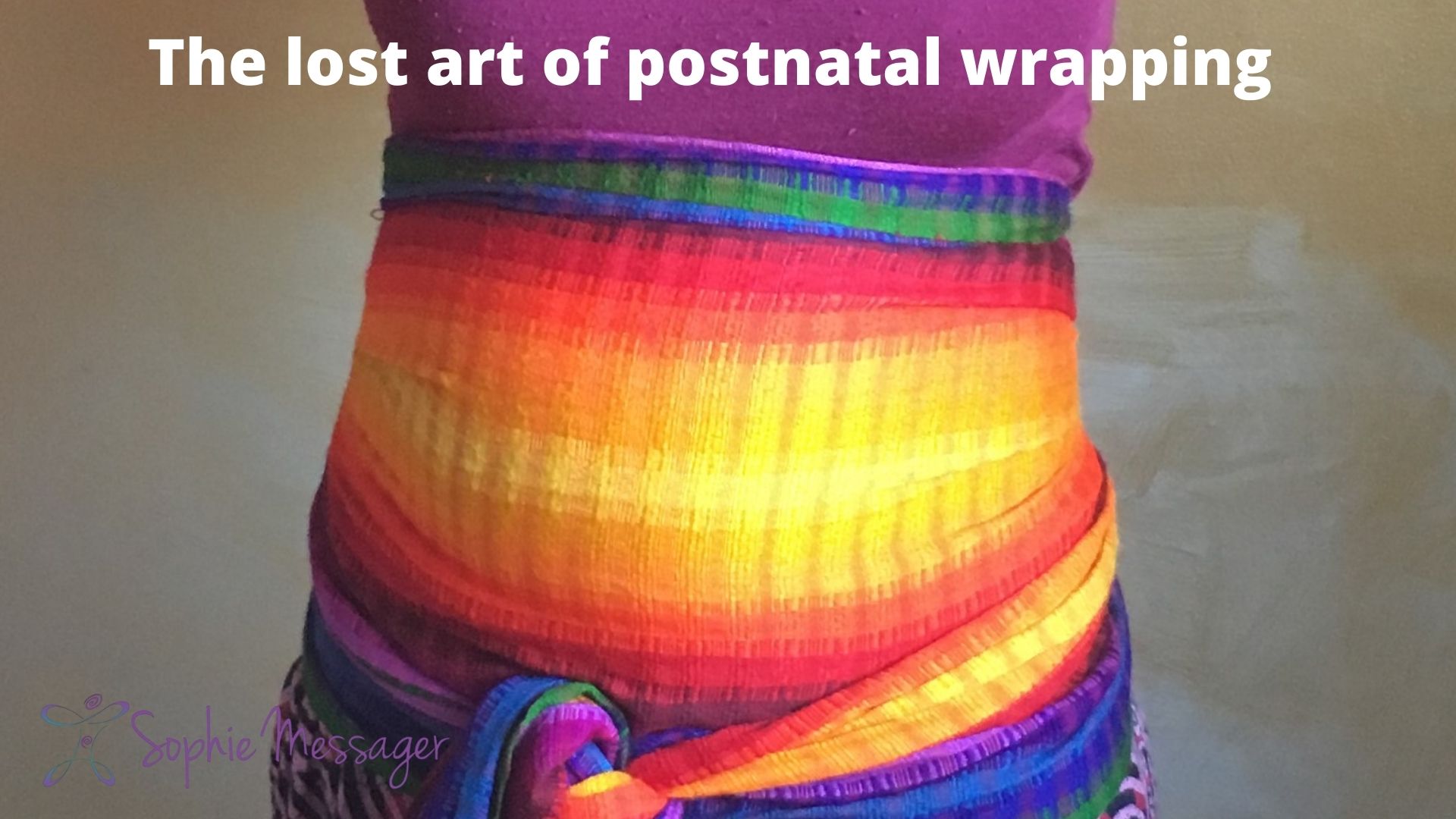
    Rebozos are perfect for this, providing just the right level of grip and strength. You can find some in my online shop . Other shawls and scarves may work well too, try with what you have at home.

    You can use lots of other things too, such as scarves and pashminas that you already have. Fabric belts can work well too. A pregnant friend even used the belt from her dressing gown!

    There is also the option to use velcro wraps for the hips. The sacroiliac pelvic belt from Belly Bands, or the  Serola sacroiliac belt.

    I did an hour long live on Instagram with my wise doula sister Laura Leongomez from Colombia, about the wisdom of hip wrapping. You can watch it on my Instagram IGTV, or on my Youtube channel.

    Have you tried wrapping your belly and hips? Did you find it helpful? I’d love to hear from you, just comment below this blog.

    If this inspires you and you’d like to find out more, you may want to check my online courses, which include a course about postpartum wrapping, and 2 rebozo courses (one for pregnancy and birth, and one about a postnatal rebozo massage and wrapping ritual).


  • The lost art of postnatal wrapping

    The lost art of postnatal wrapping

    All around the world, there is a custom of binding the hips and/or the belly for the first few weeks after birth.

    It makes sense when you think about the changes the body undergoes. During pregnancy, the body adapts to accommodate the growing baby: the pelvis tilts and widens, the spine curvature increases, the abdomen stretches to accommodate the growing uterus, which in turn also pushes all the internal abdominal organs up. During the birth the pelvis opens. Then after the birth all of this has to happen in reverse. In particular, as the uterus shrinks back to its pre-pregnancy size, and the abdominal organs descend back into place.

    New mothers are  also open physically, emotionally and spiritually, and therefore the wrapping is part of the nurturing support to bring them back to their centre. On a simple physical level wrapping provides support to unstable joints and muscles. It also provides comfort and warmth. On an emotional level it brings us back to our bodies and provides a sense of being contained. On a spiritual level it feels containing and helps us come back to ourselves.

    An example which illustrates this beautifully is the story of Rowena Hazell who gave birth to triplets vaginally. She found that she couldn’t breathe properly after the birth: ” As I tried to get back out of the pool, I had a weird sensation of not being able to breathe, as if all my body was suddenly too heavy. That was odd. On the postnatal ward I couldn’t sit up or stand for more than five minutes without finding breathing difficult. I was having to be wheeled across to NICU in a wheelchair because I couldn’t walk far. The midwives didn’t know why, didn’t take it seriously, and looked at me quite oddly when I said I needed to use a wheelchair. One of the other mums I met had brought a corset in, because she said that she had had severe diastasis recti before. This is when the stomach muscles have separated so much that for a while after birth they simply don’t hold your organs properly in the right place. The mum described it to me as your diaphragm not holding everything in, so it falls out of the bottom of your tummy. This was exactly what it felt like was happening to me! The midwives on the ward didn’t seem to have heard of this, but they did send a physio to see me. The physio made a corset out of a double layer of their largest Tubigrip, and immediately I could breathe, sit up, and walk again with ease”. (you can read her birth story here)

    Postnatal binding used to be part of Western culture too. Whilst doing the research for my book, Why postnatal recovery matters, I found a UK midwifery book from the beginning of the 20th century (An introduction to midwifery”, Donald, 1915) which says: “The binder should consist of a piece of stout calico, or other strong material, about 18 inches wide and 4 feet long. When applied, the lower border should reach a hand’s breadth below the widest part of the hips and should be drawn tightly and fastened securely with a safety pin or long straight pin, so that it may not work up above the hips. The middle part of the binder must be made sufficiently tight to give a sense of support, but the upper border should be rather lose as to not interfere with the patient’s respiration. The binder is used merely to give external support to the loose abdominal wall.”

    In the western world we abandoned the practice of binding, it fell out of fashion somehow. Sadly this means that it is now seen as an old wife’s tale. Midwife Siobhan Taylor tells me that when she gave birth in the 1980s, her grandmother told her to wrap her belly, but that everyone else dismissed it as old fashioned and unnecessary. I fell prey to this belief myself, before I discovered the stories and research that showed me how compelling this practice is.

    In the book Le mois d’or, medical doctor and yoga teacher Bernadette de Gasquet explains the importance of closing the pelvis, and quotes the dissertation of a French midwife who chose to study the subject. I obtained a copy the dissertation, and as far as I’m aware this is the only scientific study of postpartum binding that exists. The author, Juliette Danis, used a simple binding around the pelvis, applied the day after the birth for an hour. She used a set of written and visual questionnaires to evaluate its effect on pain in the pelvic area on a group of 160 women (80 receiving the wrapping and 80 controls). 64% of women described an improvement in their pelvic and perineal pain after the treatment. 79 out of 80 of the women who received the binding said they would recommend it. The author concludes that the care given to the women after the birth using massages or wrapping has a positive effect both physically and psychically, and that it symbolically helps to redraw the contours of the body. She concludes her dissertation saying that midwives should suggest the wearing of pelvic belts for 21 days after birth as recommended by traditional societies.

    I have also found evidence of the usage of pelvic belt in ancient Greece, via French ancient Greece historian Odile Tresch.

    I see postpartum wrapping as a source of comfort, support and warmth. Done in accordance with the mother’s comfort and preferences, it can feel very good indeed.

    This matches my experience of giving closing the bones massages to new mothers: the binding provides much needed nurturing and relaxation. The purpose of the binding is one of wellbeing and nurturing rather than to help new mothers look slimmer. The focus is on healing and comfort. It is part of a process which put the new mother at the centre of receiving loving support, and of postpartum attention to be focused on the new mother and her well-being, rather than on the baby. I talk about it at length in my book Why Postnatal Recovery Matters. Postpartum wrapping is a source of comfort, support and warmth. Done right, in accordance with the mother’s preferences, it can feel very good indeed.

    How do you wrap?

    I want to demystify the process and show you that it is simple and something that doesn’t require expert knowledge, and that you can do yourself. I also want to show you why it isn’t a one size fits all process, and that there isn’t a kind of binding that is better than the others. For example, one kind of binding that seems to be especially popular is an Indonesian type of binding called Bengkung belly binding. Bengkung is sometimes perceived as ‘the’ binding to aspire for. However, as I have done in my book, I want to encourage people to move away from the idea that one type of binding is ‘right’, or better than the others. Choosing a method of binding is like choosing a pair of jeans: you cannot be prescriptive about what fits one person, and you may have to try before you buy. It needs to fit with your lifestyle, and it needs to feel good and comfortable for you as a unique person with a unique body and needs.

    I used to believe that soft fabric was best, until I realised that it didn’t suit everybody. I supported a new mother of twins who was already used to carrying her first child in a woven wrap, therefore already experienced in manipulating fabric. She asked me to show her how to wrap her belly post birth using a rebozo. However, regardless how much we tried, she just couldn’t get it tight enough by herself. She loved one of my velcro wraps, however, so she ordered one.

    We need to remember that many traditional binding methods are usually done by someone else for you. Since few of us have the luxury to have someone come wrap us every day at home after birth, it makes sense that we learn techniques we can use on our own.

    What can you use?

    There is a plethora of tools to use-from simple pieces of cloth, scarves, rebozos, pashmina, babywearing wraps (both stretchy and woven ones) and more. There are also many different velcro belts and girdles, and other simple tools to use, like supportive underwear and clothing.

    I am going to list a collection of types of wrapping that I have tried. You cannot go wrong if you start with what appeals to you more and try that first. You can wrap your abdomen or hips by using a scarf (such as a rebozo, a pashmina, of any scarf you happen to have that does the job). You wrap the fabric around you and either twisting and tucking the fabric, or twisting and knotting it, depending on how much tension you prefer, how long your scarf is, and what feels good. I show one way of doing it in the video below.

    Play

    With a long enough cloth, you can wrap your belly, twist at the back, then wrap your hips and tie a knot at the front, wrapping your hips as well as your belly. If you’d like to wrap with a Mexican rebozo, I have some in my online  shop. You can also use a babywearing wrap to wrap your belly and hips after the birth.

    I have had Womb belts specially woven for me by a rebozo supplier, based on the design of the traditional Colombian Chumbe belt that my friend Laura Leongomez introduced me to. It feels incredibly supportive and my postpartum clients love it too. You can see me demoing it in the video below. and Laura and I did a long video about pelvis wrapping where we talk about this belt. which you can watch here.

    Play

    With a very long, narrow cloth (about 15cm wide and 7 m long), you can do the Bengkung style binding, which goes from the hips to the ribs. Here is a video tutorial for it. If you like the idea of the Indonesian belly binding but not the process of wrapping a long cloth around you, there are Dutch postpartum girdles, called sluitlakens, some of which look uncannily like the Indonesian binding. Australian brand Unina has created a Velcro wrap (pictured on the left) which reproduces the effect of the Benkung binding, and which is very easy to use and adjust, and is very pretty.

    If you prefer something a bit more structured, there are many velcro belts and girdles. From what I have experienced, you really get what you pay for: cheap ones are often made of scratchy and/or uncomfortable material. Also a good postpartum belt won’t be too tight at the top, supporting the lower abdomen and pelvis without adding pressure to the pelvic floor. The easiest and comfiest belts also have a double velcro system that allows you to tighten the belt/girdle effortlessly (an important point when one has weak core muscles).

    There are two brands I really like and recommend for pelvic and or pelvic/abdominal support: For pelvic support only : The sacroiliac pelvic belt from Belly Bands, or the Serola sacroiliac belt. For both pelvic and abdominal support : the pregnancy and caesarean 3 in 1 belly band from Belly Band, which can be used for pregnancy support, postpartum support, and post caesarean too. This is a truly amazing product which has been designed especially with mothers in mind. It is extremely comfy and easy to use, and its standard size fits from a size 6 to 16 (they have smaller and bigger sizes too).

    You can see me demonstrate this velcro belt as well as rebozo wrapping in the video below

    Play

    Talking about caesarean, I was surprised about the post caesarean binding myself, as I didn’t know it was a thing. When my friend Kate had her baby by caesarean in Bangkok, they bound her abdomen the next day. She says she healed much better than when she had her next child in Norway, were there was no binding. I found a published paper which shows that binding post caesarean reduces pain. The Belly Band caesarean wrap has a video explaining how you can use it in a hospital setting.

    There are a couple of gentle support options available to you if you’d rather not use a scarf or a wrap: You could use a belly band like a Haramaki. A Haramaki is a Japanese belly warmer. It’s like a boob tube for your waist. Or you could buy a belly band such as the ones that some people use during pregnancy. H&M sells a pack of three.

    You could try high waisted postpartum support underwear, and there are also some brands that offer postpartum support shorts or leggings. Just make sure you don’t use something too tight to avoid putting pressure on your pelvic floor. If you used maternity leggings, they might still work to provide some gentle support after the birth too. H&M has a pair which costs under £10.

    How to choose the right way to wrap/bind for you?
    If you can, try before you buy. With online items, you can try and return items if needed. Only you can tell whether it is comfortable and right for you, so it’s worth trying a couple of options to see which you find easiest to use and most comfy. Some women prefer using a soft piece of cloth, and some women get on better with a velcro belt.

    How long to wear it for?

    Use it like a treatment ie not 24/7, see how it makes you feel, and probably not any longer than for the first 4 to 6 weeks postpartum.

    PS: I have been working with wraps, rebozos, shawls and scarves for several years now and I see them as something that has a lot of use beyond the childbearing years. When it comes to wrapping for example, I now see my period as a mini postpartum time with similar needs, and I find that wrapping my hips or my abdomen or both during this time is extremely comforting. Try it and tell me what you think.

    If you feel drawn to learning more, my book Why postnatal recovery matters has a chapter on postpartum bodywork. I have an online course dedicated to The Art and Science of Postpartum wrapping. I also offer a rebozo online course , a closing the bones rebozo massage online course.


  • How to write a postnatal plan

    How to write a postnatal plan

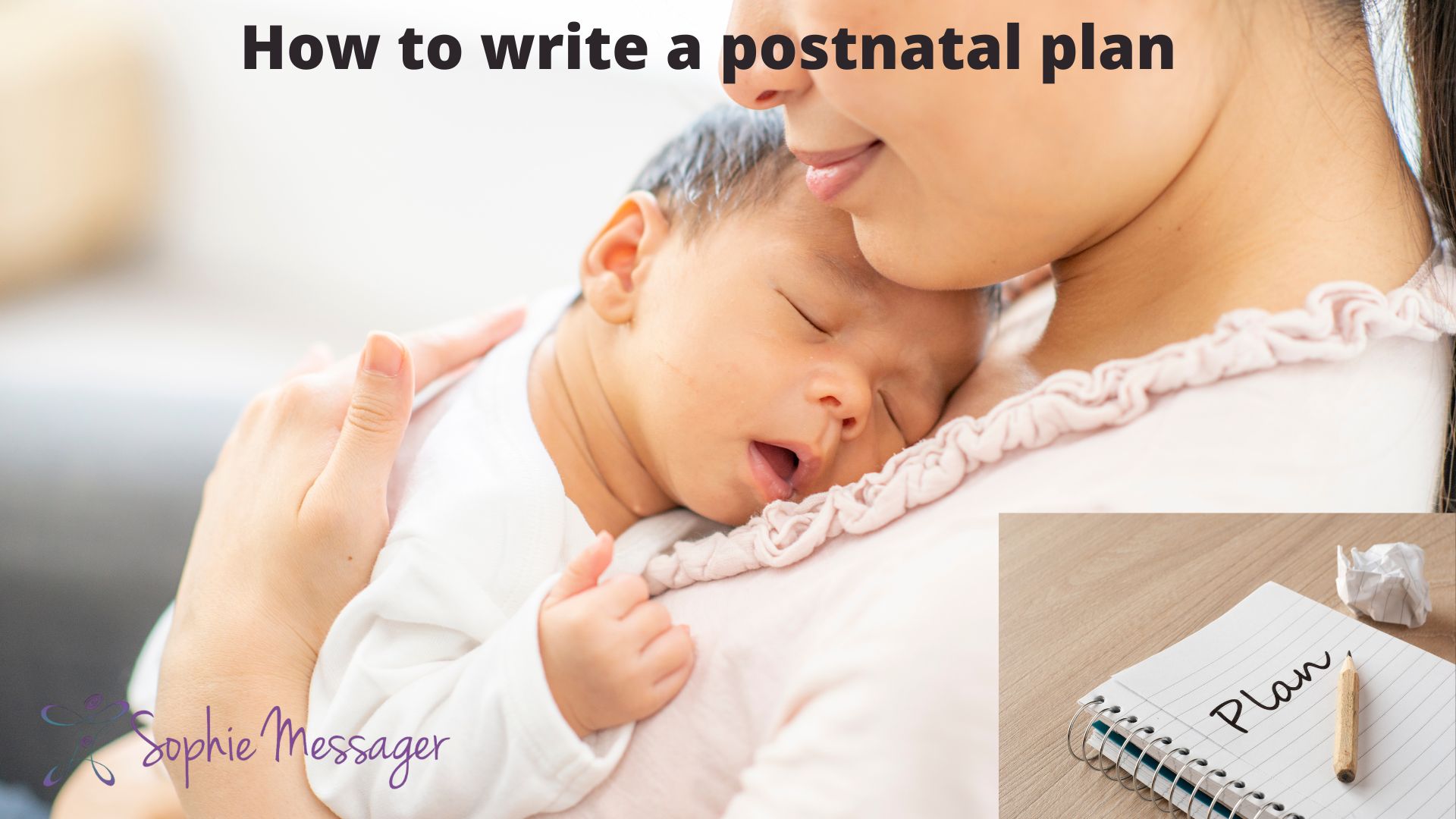
    You may have heard of a birth plan, but have you heard about a postnatal plan?

    In our culture we are often focused on the birth, and most of all, on the baby. It is clear from the focus antenatal classes have, there is preparation for the birth, and also preparation for the postpartum, but the postpartum aspect is usually mostly focusing on babycare rather than on the mother’s needs (and I should know about it because I taught antenatal classes for several years). It is also clear from the presents expectant and new parents receive, which are also usually all for the baby.

    It didn’t used to be this way. In every culture around the world, there used to be (and still is in many cultures even today), a period of at least a month post birth during which the new mother didn’t lift a finger. The community (usually female relatives), rallied round and took care of her household, so all she had to do was rest, eat nutritious food people prepared for her, receive healing bodywork treatments, and get to know her new baby. Compare this to what we get in the Western world: two weeks paternity leave, and then you’ve on your own.

    Because we no longer live in a culture that understands and supports the need for recovery post birth, writing a postnatal plan is a fantastic way to ensure that there is support in place for after the birth, and that you aren’t alone trying to meet your own needs and the intense needs of a newborn baby (as well as running a house, and maybe looking after older children too).

    I love this quote by Jojo Hogan, a postnatal doula who created the Slow postpartum movement.

    If birth is like a wedding day (lots of planning, high expectations, being the centre of attention, lasts for about a day or so, get something special at the end), then the postpartum should be like a honeymoon (Equal amounts of planning and investment. Time, space and privacy to relax, bond and fall in love. Lots of people and services around to care for and look after you and a peaceful and blissful environment where all your needs are met for a few days or weeks).

    As you would plan for your honeymoon, it is well worth putting plans in place for your baby moon, i.e. creating your own postnatal plan. Just like planning for birth, this isn’t about having a rigid plan. The magic isn’t in the finalised plan, or to have a ‘perfect’ plan, it is in the process of exploring options (some of which you may not even know exist) and getting informed so that you can have an experience which is as positive as possible, regardless of what happens.

    I use this analogy: you need to find what’s in a buffet, before you decide what you’d like to eat (I explain this process in my blog called The buffet curator).

    You don’t know how you’ll feel in advance. You don’t know what curveballs life might throw you (for example: your birth might happen sooner or later than you expected, it might unfold differently from what you had hoped, you might need to stay for a while in the hospital, your baby might need to stay for a while in the hospital etc).

    So just like for birth, it’s worth having thought about all the options, so that, regardless of how your birth unfolds, and how your baby comes into the world, and how you end up feeling once you’re home with your baby, you have at least some form of support in place.

    You may encounter people who dismiss your idea. “You can’t plan birth ” is a common phrase used to dismiss birth plans. Because a postnatal plan is an even newer concept than a birth plan, you may encounter some dismissiveness or negativity. People might say “what’s this newfangled thing, we didn’t need that in our time” or “you don’t need that” from people who don’t understand the point, because they did not do it themselves. Some of my clients who have written postnatal plan have encountered reactions from relatives who even said “I didn’t have support, I just got on with it”, implying that they suffered, and you should too. Therefore you might need to choose carefully who will be part of your postnatal support team, who to discuss it with, depending whether they are likely to be supportive or dismissive. In the vulnerable tender state of new motherhood, the last thing you need is being criticised for your choices. After all, you just single handed grew and birthed a whole new human, and you should be revered as the goddess that you are.

    How to you write a postnatal recovery plan? It’s simple really, because a nurturing postpartum boils down to 4 pillars: Social support, Rest, Food and bodywork.

    Here is a list of these topics with prompts, which you can use as basic to start write your postnatal plan.

    Rest

    • Help with household (chores, cooking, cleaning, other children etc make a list of potential helpers)
    • Visitors-list them/how to manage them so they do not interfere with rest/write a “new mother and baby sleeping” note for the door.
    • Naps/sleep when the baby sleeps/early nights/sleep with your baby
    • Relaxation: techniques and apps

    Food

    • Batch cook and freeze
    • Who can make/bring you some/meal trains
    • Deliveries (supermarkets, take away meals, frozen, fresh, meal boxes)
    • Nutritious non perishable snacks
    • Use a sling so you have your hands available to make yourself something to eat.

    Bodywork

    • Postnatal massages/closing the bones massage
    • Specialist manual therapists such as osteopaths, chiropractors, and physiotherapists
    • Wrapping your pelvis/abdomen
    • Keeping warm

    Social support

    • Friends, family, neighbours
    • Hired help (doulas, nannies, cleaners…)
    • Online support (social media, WhatsApp groups…)

    Planning for the unplanned:

    You might want to include a part on navigating possible curveballs. For instance if you end up giving birth by caesarean when this wasn’t part of your plan and what your recovery might look like if that’s the case.  If you end up having a longer than expected hospital stay after the birth, or if your baby needs to stay in hospital for a while.

    There are many ways to create a postnatal plan. You could write one, and you could also make a mindmap or a vision board, of draw something or whatever other modality appeals to you.

    You can download a free postnatal recovery plan template as a PDF on my website front page.

    If you’d like to learn more about this topic, feel free to browse my blog for more posts on this topic. My book, Why postnatal recovery matters has a whole chapter on writing a postnatal recovery plan, and my online course How to prepare for a nurturing postpartum, has a whole module on it.

    This coming Tuesday 28th of June I am also running a free Webinar called How to prepare for a nurturing postpartum.

  • Baby shower? Have a mother blessing instead.

    Baby shower? Have a mother blessing instead.

    What is a mother blessing?

    You probably have heard of a baby shower, but have you heard of mother blessing? It is a celebration and honouring of a woman’s transition into motherhood. A mother blessing is a celebration that takes place during pregnancy and which is designed to celebrate and support the mother and her upcoming birth and postpartum period. Contrary to a baby shower, where all the focus and presents are on the baby, a mother blessing places the mother at the centre of the attention and support. It is a gathering, usually of women, coming together to celebrate the expectant mother, to honour her and give her loving attention, good wishes and support for the birth and the postpartum period.

    I wrote about this in the past  but I want to expand and explain the process a bit more, as I have gained a lot more experience in running these rituals.

    What happens during a mother blessing?

    Altar centerpiece

    There is no prescriptive recipe. It is about having a gathering to celebrate the mother in a way that feels good for her. The most important aspect is that she feels loved and nurtured, and that the event is tailored to her needs. I used to think that mother blessings where always a hippy affair, but I have come to realize that, whilst they are powerful and spiritual in nature, it is not the way they look like that makes them special but rather it is the intention behind it and how people come together to hold it.

    Offering mother blessings through the years has taught me a lot. For example I organized one for a mother who is Christian, and she was worried that the event would involve spiritual aspects that would be incompatible with her religion. I reassured her that this wouldn’t be the case and that we would make sure that what happened was in line with her beliefs.

    A mother blessing is a gathering a friends and family of the mother. Here are some simple logistical aspects to think about:

    • Discuss the gathering with the mother
    • Plan the structure of the gathering, with a beginning, middle and end
    • Choose a venue and date
    • Invite the guests
    • Ask people to bring things to share such as reading a poem, or a singing a song, and meaningful gifts for the mother, and something to eat at the end
    • Run the event

    Here are some of the things I like to do to make a mother blessing special:

    Setting up the space

    I like to make the space special with colourful fabrics, flowers, candles, and lovely smells and sounds, like a sanctuary. Be guided by what the mother likes and tailor the level of woo accordingly.

    Starting the ceremony

    I like to have a simple ritual to mark the beginning of the ceremony, such as smudging or ringing a bell. Start the process with a short sharing circle, for example, having everyone introducing themselves saying their name, the name of their mother and maternal grandmother (in my case: I am Sophie, daughter of Michelle and granddaughter of Jacqueline).

    If it feels right, singing a short circle song can be lovely too. For example, I like the song The river is flowing.

    The ceremony itself

    Here are some simple ritual activities to build into the ceremony can involve:

    • Ask everyone to bring a bead to give to the mother. As each person presents her bead, they explain why they chose it, and what it represents. The beads get threaded on a string to make a necklace that the mother can wear or use like prayer beads during labour or the postpartum to remind herself of the circle of support around her.
    • Pass some wool or string around the circle and have everyone wrap it a couple of times around one of their wrists. Once everyone is bound by the thread, pass scissors around to cut it and have everyone knot the thread around their wrist or ankle and keep it until the baby has been born.
    • Gift a small candle (like a tealight) to everyone, and a bigger one to the mother. When the mother goes into labour, people will be notified (for example in a WhatsApp group) to light their candle and send love and good wishes for the birth.
    • Have guests read texts, poems or sing songs (some lovely examples here)
    • Do something nurturing for the mother, for example massaging her hands or feet.
    • Have people bring or pledge some gifts for the mother for the postpartum. For example vouchers for postnatal massage or closing the bones ceremony, postnatal doula vouchers, food delivery, feel good products like postnatal herbal baths or massage oils, promise to come and clean her house/hold her baby whilst she sleeps etc.
    • Have a final sharing circle at the end.

    Finally, have some informal time afterwards to share food, some tea and cake (a groaning cake would be lovely) or a potluck meal. It is always lovely to have some informal chatting and eating time after the ceremony.

    What are the advantages of having a mother blessing?

    The main point of the mother blessing, besides making the mother feel loved and cherished, is to redirect the focus of the support towards the mother rather than the baby. Encouraging the mother to write a postnatal recovery plan, and/or using said plan to ask friends to provide pledges for the postartum is a good way to think ahead about what the mother might need after the birth (you can use my free postnatal recovery plan download as a template for this).

    Beyond the mother herself I have found such ceremonies deeply moving for the facilitator and for all the people involved in the gathering. Western societies lack rituals to celebrate life transitions, and bringing this back into our culture is very powerful and meaningful. People often say that they had never taken part in something like this and how much they loved it, and wish they had one themselves.

    I especially love to bring the whole process full circle, by bringing back the same group of people to honour the new mother a few weeks after the birth in a closing the bones ceremony.

    In 2020 I have also participated in mother blessings over zoom. The process was the same e xcept that we sent cards and beads by post ahead of time. It was still very special and meaningful.

    I am offering an online course on how to run mother blessings.

    Here is a short video showing snippet of mother blessings and workshop I have run in the past

    Play

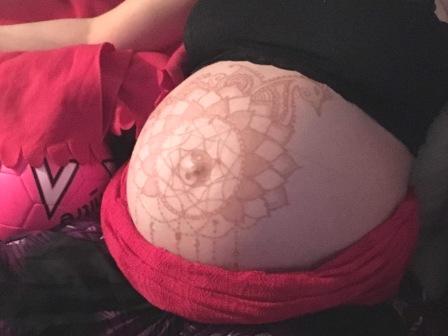
    (The Henna tattoo belly painting on the main picture, was designed by Jo Rogers as part of a mother blessing)

  • Three rebozo techniques for pregnancy and birth

    Three rebozo techniques for pregnancy and birth

    I’ve had so many positive experiences using rebozo techniques as a doula to support pregnancy, birth, the postpartum and beyond, I’m on a mission to pass on this skill to ask many people as possible.

    Every technique is extremely simple to do, anybody can do it. Yet this humble tool provides an unparalleled a level of comfort and relaxation.

    There are hundred of different things you can do with a rebozo (and it works with other shawls and scarves too). The techniques usually fall within a rocking or a wrapping technique.

    Here I share 3 simple techniques you can use during pregnancy, birth, and the postpartum period

    Pregnancy technique: Hip wrapping

    During pregnancy the rebozo can be wrapped tightly around the hips to provide support to the pelvic girdle. The rebozo can be twisted and tucked at the front or at the back of the pelvis. Whether you are tying at the front or the back will have slightly different effects on the sacro-iliac joints. Try both version and be guided by the feedback fon what feels best.
    Remember whilst this will provide support and comfort, this technique won’t ‘fix’ the underlying cause of the pain/discomfort and therefore won’t replace being treated by a skilled bodyworker (like an osteopath). In situations where pain is present, such as pelvic girdle pain (the Pelvic Partnership is an awesome resource), however it can provide support and comfort whilst awaiting treatment. It should be used mindfully, as a treatment, and not 24/7. You can also use the rebozo to hold an ice pack or a hot pack in place.

    Play

    Teddy the osteopath‘s view of the technique

    Wrapping the hips-supports and stretches the pelvic ligaments (the broad and the round ligament) and helps support weight from the bump on the abdominal muscles and fascia. Many women experience lower pelvic tension and discomfort and band like pain around the front of the pelvis during pregnancy. This technique may also help the ache or soreness in the genitals that can happen during to pregnancy. Wrapping from the back instead of the front provides a similar effect but might be better later on in pregnancy as it provides a broader contact, less pressure at the front and more opening at the back. Both techniques have an impact on the sacro-iliac joints by opening them in slightly different ways. The front tying opens the joints more posteriorally versus anteriorally for the back tying technique.

    Rocking technique (for pregnancy and labour)

    Jiggling the hips or abdomen (or any other part of the body) can relax tight ligaments and may help a baby rotate in pregnancy or labour more easily, as well as provide relaxation and comfort. Being rocked elicits a very primal feeling  (reminding us of being in the womb) and it is very calming and soothing for anyone. It can help a pregnant or a birthing woman relax when she is tense or anxious. Generally, these techniques relax the body so that the baby is more likely to take a better position.

    Here I show you how to rock the pelvis whilst standing up. This can also be done with the woman resting her back against a wall for support.

    Play

    Teddy the osteopath‘s view of the technique

    This provides movement between the lower thoracic spine and the lumbar spine, and helps with the compression forces caused by postural changes during pregnancy. It provides a passive articulation, completely removes the pressure, especially in the thoraco-lumbar joint. This can have a positive impact on breathing too as it also releases the diaphragm. Using a faster movement makes it more of a fluid technique/viscera (which can direct movement into the uterus and its ligaments) towards the front rather than the back. On the bump, faster movement again move the uterus rather than slower articulations.

    Fluid health is about transition of fluids. Movement in the body causes pressure changes resulting in fluid pumping in and out of tissues and right down to the cellular level, increased fluid movement leads to more healthy body tissues. Fascial tightness or looseness (connective tissue) can govern the ability of fluid to move in and out.

    Bump rocking on hand and knees

    The woman is on her hands and knees, kneeling over a sofa or birth ball or chair, and the rebozo is wrapped around the bump and lifted gently prior to sifting. When lifting, ask for feedback from the woman so you can lift enough to take all of the weight of her bump from her spine. As well as providing relaxation and comfort, this technique can  help restore balance to the uterus and with the positioning of the baby during pregnancy or labour.

    Play

    Teddy the osteopath‘s view of the technique

    This loosens all the fascial tension from the front to the back: abdominal fascia and muscles, viscera (organ) ligaments, lumbar muscles and fascia. The vibration provides more movement into the uterus and uterine ligaments and helps to take the tension off it.

    All the techniques in this article are a taster version of my Rebozo for an easier birth course. The course contains over 25 techniques for pregnancy, birth and the postpartum.

    I have also made this set of techniques available to download as a handy PDF, you can get it by scrolling to the bottom of the Rebozo for an easier birth course page.

    Watch the video below, where I show examples of more techniques included in the course.

    Play


  • How baby books ‘experts’ harm new parents

    How baby books ‘experts’ harm new parents

    I hate so-called ‘baby experts’ who promise that your baby will be happy and super easy to look after if you follow their rigid ‘schedule’. Gina Ford is the most famous one in the UK, but there are plenty of similar ones all over the world. Many of these so-called ‘experts’ are just self professed experts cashing in on new parents worries.

    The reason I dislike them so much is because I’ve seen so many new parents lose confidence in their parenting skills because they couldn’t get their baby do what the book said. For many new parents, these books are actually harmful.

    Having a baby is like having a new guest in your house. You need to get to know them, their likes and dislikes, so you can make their stay as comfortable as possible.

    Imagine for a second that you had never had an adult guest in your house. Because you didn’t know what to do, you bought a book on the topic. Imagine that the book suggested a really rigid schedule such as the one below :

    • Wake your guest up at 7am exactly every morning  (what if they aren’t a morning person?)
    • Serve them a full English breakfast with bacon, eggs and beans at 7h15 exactly (what if they are vegetarian, or if they need a bit more time after waking up before they feel hungry. Or would prefer a slice of toast. Or prefer to get washed and dressed before breakfast, etc)
    • After breakfast take them immediately to the bathroom for a shower
    • Then play a game of monopoly with them for 23 minutes exactly
    • Take them out for a 20 min walk
    • Give them a snack of a banana and biscuit at 10h30 exactly
    • Take them to a darkened bedroom and insist they lay down for  a nap
    • Wake them up at 12h exactly even if they are deeply asleep

    Do you think your guest would feel good? Do you think you would feel good? What are the odds that you would both enjoy the experience? How would you get to know each other? It sounds pretty ridiculous doesn’t it? And yet this is similar to what is advocated in many baby books.

    Professor Amy Brown published a great piece of research that shows that reading books that recommend strict routines for babies is associated with poor mental health.

    “New research from academics in the Department of Public Health, Policy and Social Sciences has explored the link between parenting books that encourage parents to try and put their babies into strict sleeping and feeding routines and maternal wellbeing.  The study found that the more mothers read these books, the more likely they were to have symptoms of depression, low self-efficacy and not feel confident as a parent.”

    I am glad this research is now here to prove what I have witnessed for years. I tell new parents to read as many books as they like, but to check in whether they feel right, and only follows the suggestions if they fit with their instincts and their family routine. I also tell parents to check the credentials on the author. Often the authors come from a nanny background. Nannies are hired to look after babies by parents who do not look after their babies themselves. Nannies do not have the bond and emotional connection that a parent has with their baby, and it is a very different story for someone who looks after their baby themselves. The authors of these books may have experience in nannying, but seldom have a scientific background, or solid evidence to backup their claims, which are often just personal opinions which fly in the face of evidence. And finally, and maybe more importantly, they do not know you or your baby.

    And I have seen many times exactly what the study says: new parents who buy those books promising that if you follow their rigid, strict routines, you’ll be rewarded with an easy going, predictable baby, but only end up feeling more inadequate when they cannot make their babies fit into what the books prescribe.

    Dr Brown’s research states that:

    “Many of these books suggest goals that go against the normal developmental needs of babies. They suggest stretched out feeding routines, not picking up your baby as soon as they cry and that babies can sleep extended periods at night. But babies need to feed lots because their tummy is tiny and they want to be held close as human babies are vulnerable – far more so compared to lots of mammals that can walk and feed themselves shortly after birth. Waking up at night is normal too – after all, many adults wake up at night but babies need a bit more help getting back to sleep.”

    This is also what I’ve seen. Whilst routine, as in the normal daily rhythms most of us tend to adopt, can be quite healthy, strict schedules do not fit with normal life. These books often set up abnormal expectations about infant sleeping and feeding patterns. Exhausted new parents try and fail to make their baby fit into the schedule and end up feeling like failures.

    How on earth are we supposed, as new parents, to navigate the maze of conflicting advice, and listen to our own voice in the middle of it? This is one of the many reasons why hiring a postnatal doula is invaluable. A doula will often be the only person whose sole interest is to help you listen to yourself and support you in developing your own, unique style of parenting.

    As I wrote in this blog before : who else is going to truly listen without an agenda? This is the heart of counselling, or coaching-helping someone listen to the voice within. From childhood onwards we are led to believe that the answers lie outside ourselves-with the ‘experts’ . The parenting world is awash with self proclaimed gurus cashing in on new parents insecurities-people who promise the holy grail of a baby who sleeps through the night, and have rigid quick fixes answers to every problem.

    To grow and learn to trust your own instincts and ability to parent, having someone who helps you see your strength, as opposed to insisting that you do things their way, is truly invaluable.


  • Postpartum support and butterflies: what do they have in common?

    Postpartum support and butterflies: what do they have in common?

    In my book, Why postnatal recovery matters, I explain that postnatal recovery boils down to 4 pillars: social support, rest, food and bodywork.

    Social support is the foundation on which everything else is built. If you are going to rest, have some great nourishing, food and some bodywork after birth, it’s kind of impossible to do this alone. You need other adults around to be supporting you in order to do this.

    But postpartum support goes beyond the simple practical aspect of having other pairs of hands to hold the baby, cook you food or give you a massage.

    Yes, having another adult in the house means that there is someone to help with house stuff, but most importantly, it means that we aren’t alone. It means that there is someone else to keep us company, listens, and reassure us when we doubt ourselves.

    It means, most importantly, that there is someone to hold the space for us.

    Holding the space looks like someone is doing nothing, but it might be the most important aspect of all. Heather Plett explains this concept beautifully in her article.

    In the episode of the Midwives’s Cauldron podcast I did about postnatal recovery, I tell a story that illustrates this beautifully (you can listen to it here). When my daughter was a baby, she suffered from painful gas at night which left her inconsolable. I became aware that she reacted to certain foods I ate and had to eliminate these from my diet. On a holiday to France when she was 3 months old, I unknowingly ate some food she reacted really badly to, and she woke up in the middle of the night and cried for over an hour. As I got out of her bed to rock and soothe her, my mother heard her cry, and she came to keep me company. She didn’t do much; she just sat with me whilst I rocked my baby. But having another adult there, just being present for me, meant that I felt much stronger and able to support my daughter.

    Recently a new mother I supported as a doula told me something similar: she said you have help during the day, but at night, you’re alone and it’s so hard. I helped her find a night doula, and it made a world of difference to her wellbeing.

    As humans we are a social species, and we kind of intuitively know that we need community support through life transitions. This is why every culture used to have (and many still have) a set of rituals around big life transitions life becoming a parent.

    The polyvagal nervous system theory tells her that we need each other to regulate our stress levels, especially at times when we are vulnerable.

    Postpartum rituals around the world all have in common a period of about a month during which the new mother is nurtured and looked after, almost like a child, because there is an innate understanding that she needs to be surrounded and supported by experienced adults as she navigates her new role and identity.

    Western societies are so focused on productivity that we tend to only plan for practical things. I see a parallel with what people ask me about my doula role. They ask what does a doula do, yet most of my role isn’t easily quantified, because it is more about being than doing.

    An analogy often used for the transition to motherhood is that the change from a caterpillar to a butterfly.

    If you have ever seen a butterfly emerge from its cocoon, you’ll know that as the butterfly first comes out, its wings are crumpled and soft. The butterfly needs to hang upside down from its cocoon or a nearby branch, whilst it waits for the wings to unfold, dry and strengthen. Only then can it take its first flight. If you’ve ever witnessed this you may also know that if the butterfly falls before the wings are dried, the wings are usually damaged.

    Postpartum support is the same. It is about providing stable ground. One cannot help or speed up the wings unfolding and drying process, but they can be the strong cocoon on which the butterfly hangs whilst they unfurl.

    We need to introduce this concept in the postpartum too: that what new mothers need, most of all, are people to hold the space for them, and who trust that they can find their own path, and unfold and spread their wings by themselves, in their own time, once there have become strong enough.

    (PS: if you’re a birth geek like me you’ll be fascinated like I was to learn that there is a substance called meconium, which sounds quite similar to the human version, which the butterfly pushes through its wings to unfurl them.)