Category: rebozo

  • Three rebozo techniques for pregnancy and birth

    Three rebozo techniques for pregnancy and birth

    I’ve had so many positive experiences using rebozo techniques as a doula to support pregnancy, birth, the postpartum and beyond, I’m on a mission to pass on this skill to ask many people as possible.

    Every technique is extremely simple to do, anybody can do it. Yet this humble tool provides an unparalleled a level of comfort and relaxation.

    There are hundred of different things you can do with a rebozo (and it works with other shawls and scarves too). The techniques usually fall within a rocking or a wrapping technique.

    Here I share 3 simple techniques you can use during pregnancy, birth, and the postpartum period

    Pregnancy technique: Hip wrapping

    During pregnancy the rebozo can be wrapped tightly around the hips to provide support to the pelvic girdle. The rebozo can be twisted and tucked at the front or at the back of the pelvis. Whether you are tying at the front or the back will have slightly different effects on the sacro-iliac joints. Try both version and be guided by the feedback fon what feels best.
    Remember whilst this will provide support and comfort, this technique won’t ‘fix’ the underlying cause of the pain/discomfort and therefore won’t replace being treated by a skilled bodyworker (like an osteopath). In situations where pain is present, such as pelvic girdle pain (the Pelvic Partnership is an awesome resource), however it can provide support and comfort whilst awaiting treatment. It should be used mindfully, as a treatment, and not 24/7. You can also use the rebozo to hold an ice pack or a hot pack in place.

    Play

    Teddy the osteopath‘s view of the technique

    Wrapping the hips-supports and stretches the pelvic ligaments (the broad and the round ligament) and helps support weight from the bump on the abdominal muscles and fascia. Many women experience lower pelvic tension and discomfort and band like pain around the front of the pelvis during pregnancy. This technique may also help the ache or soreness in the genitals that can happen during to pregnancy. Wrapping from the back instead of the front provides a similar effect but might be better later on in pregnancy as it provides a broader contact, less pressure at the front and more opening at the back. Both techniques have an impact on the sacro-iliac joints by opening them in slightly different ways. The front tying opens the joints more posteriorally versus anteriorally for the back tying technique.

    Rocking technique (for pregnancy and labour)

    Jiggling the hips or abdomen (or any other part of the body) can relax tight ligaments and may help a baby rotate in pregnancy or labour more easily, as well as provide relaxation and comfort. Being rocked elicits a very primal feeling  (reminding us of being in the womb) and it is very calming and soothing for anyone. It can help a pregnant or a birthing woman relax when she is tense or anxious. Generally, these techniques relax the body so that the baby is more likely to take a better position.

    Here I show you how to rock the pelvis whilst standing up. This can also be done with the woman resting her back against a wall for support.

    Play

    Teddy the osteopath‘s view of the technique

    This provides movement between the lower thoracic spine and the lumbar spine, and helps with the compression forces caused by postural changes during pregnancy. It provides a passive articulation, completely removes the pressure, especially in the thoraco-lumbar joint. This can have a positive impact on breathing too as it also releases the diaphragm. Using a faster movement makes it more of a fluid technique/viscera (which can direct movement into the uterus and its ligaments) towards the front rather than the back. On the bump, faster movement again move the uterus rather than slower articulations.

    Fluid health is about transition of fluids. Movement in the body causes pressure changes resulting in fluid pumping in and out of tissues and right down to the cellular level, increased fluid movement leads to more healthy body tissues. Fascial tightness or looseness (connective tissue) can govern the ability of fluid to move in and out.

    Bump rocking on hand and knees

    The woman is on her hands and knees, kneeling over a sofa or birth ball or chair, and the rebozo is wrapped around the bump and lifted gently prior to sifting. When lifting, ask for feedback from the woman so you can lift enough to take all of the weight of her bump from her spine. As well as providing relaxation and comfort, this technique can  help restore balance to the uterus and with the positioning of the baby during pregnancy or labour.

    Play

    Teddy the osteopath‘s view of the technique

    This loosens all the fascial tension from the front to the back: abdominal fascia and muscles, viscera (organ) ligaments, lumbar muscles and fascia. The vibration provides more movement into the uterus and uterine ligaments and helps to take the tension off it.

    All the techniques in this article are a taster version of my Rebozo for an easier birth course. The course contains over 25 techniques for pregnancy, birth and the postpartum.

    I have also made this set of techniques available to download as a handy PDF, you can get it by scrolling to the bottom of the Rebozo for an easier birth course page.

    Watch the video below, where I show examples of more techniques included in the course.

    Play


  • Ceremonial birth food

    Ceremonial birth food

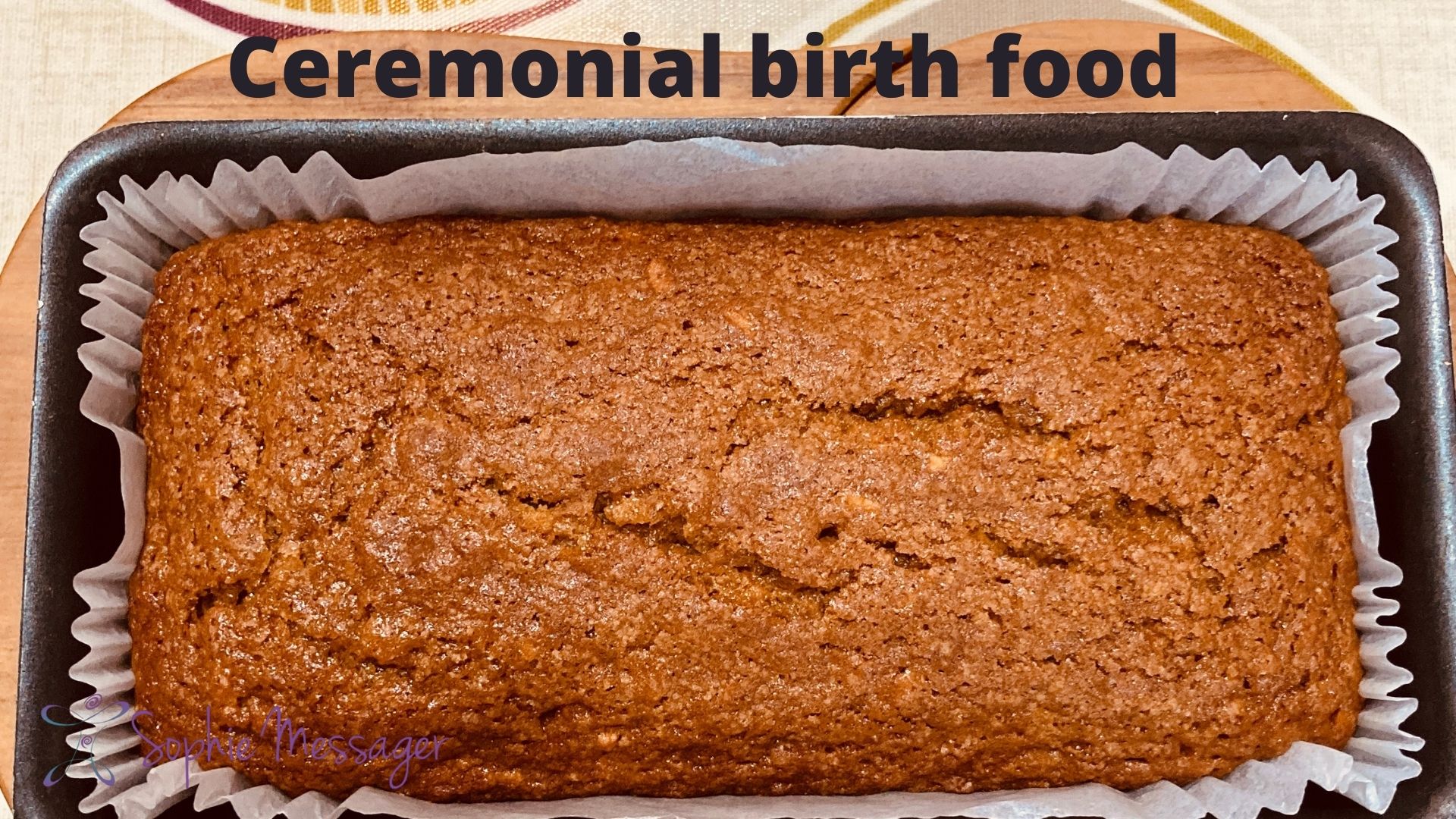
    I have baked groaning cakes for my clients for nearly ten years, since I came across it in the book The Birth House. Before I go on-call for a birth, I bake the cake, and then I freeze it, ready to take with me to the birth when I get the call. Most of the time, with the exception of a couple of super speedy births, the cake is thawed by the time the baby arrives, and I offer the cake to the mother as her first food after the birth (I offer some to the midwives too). I also bake this cake for my postnatal clients.

    It had never occurred to me that this counted as ceremonial food.

    Many of us are blind to our gifts, and take for granted the things we find easy. Baking is such a thing for me. I have loved baking for as long as I can remember. I was baking on my own by the time I was 8 years old. When I moved to university, I had to teach myself to cook savoury food because the only things I had cooked until then were cakes and sweets. Throughout the years I have loved making cakes for people. When I am asked to contribute to a shared meal, bringing something sweet is usually my first choice.

    When something comes easily to us it is easy to forget the love and care we put into it.

    Last week I was chatting with my friend Amanda. I complimented her on the love and care she puts in the stews she cooks. I told her about my groaning cake tradition, and she pointed out that this is ceremonial food. Her words had a big impact on me, because I had never stopped to consider that this was the case. 

    I realised that, for me, ceremonial food was something that happened in a ‘special context’, like at a retreat. For instance I have taken part in cacao ceremonies run by others, and this counted as ceremonial food for me. Recently I attended a Cacao ceremony and I was excited because I thought that this was the first time that I would be taking place in a ‘proper’ cacao ceremony. Only when it happened I realised that I had already attended several similar ones, and that what I had labelled as ceremony in my head was a very narrow, restricted label.

    I find it fascinating how we pigeonhole things in our heads, despite ourselves, and define whether they fit or not, whether they are worthy. What is ceremony? What is sacred? If not simply the intention put behind the action and the care taken to do it mindfully?

    Until now, had never considered everyday food as ceremonial.

    Reflecting on this was very powerful for me. Many years ago I used to believe that spiritual magic only happened in retreat spaces, outside of the drudgery of everyday life. After attending retreats, I always found re-entering my normal life, especially with small children, hard, full of drudgery and somewhat boring. I longed for the feelings of specialness and connection that came with the retreats. A friend told me that I needed to bring this magic in my everyday life. I didn’t understand how this was even possible and dismissed it as ridiculous. I just didn’t know how.

    A few years ago I started paying attention to the small moments of grace and magic in my life and I finally understood what she meant. It had been right in front of me the whole time, the grace, the beauty and the magic, but I just couldn’t see it, because my mind had put a narrow label on it. Starting a daily gratitude practise really helped.

    In her book, Dare to Lead, Brene Brown use the analogy of a marble jar to symbolise building trust. When someone does something that makes us feel good, it adds a marble in our jar. She is surprised when she asks her daughter, what adds marbles to her jar, because she expected her daughter to talk about grand gestures, but it’s just tiny everyday little things, like someone remembering your name, or something important happening to you, on which trust is built. Brene tells of her research in the topic:

    “As a researcher, I start looking into the data. And it is crystal clear. Trust is built in very small moments. And when we started looking at examples of when people talked about trust in the research, they said things like, “Yeah, I really trust my boss. She even asked me how my mom’s chemotherapy was going.” “I trust my neighbor because if something’s going on with my kid, it doesn’t matter what she’s doing, she’ll come over and help me figure it out.” You know, one of the number one things emerged around trust and small things? People who attend funerals. “This is someone who showed up at my sister’s funeral.”

    You can read the full story here. 

    With food it is the same. What makes it a ceremonial, jar building process, is that it someone has made it for you for a special reason.

    Have you ever eaten food that has been cooked especially for you, and found it to be really special? Have you ever had this feeling that it was more than just food, that it was imbued with love? That it nourished the soul as well as the body?

    I remember eating such foods several times in my life. When I gave birth to my daughter, my midwife, Siobhan, brought a fruit cake she had baked for me. This was the first thing I ate after the birth, and it tasted like the most delicious thing I had ever eaten.

    Once, unexpectedly, a Chinese mum at my children school gifted me a Pandan cake she had baked especially for me. She said that I deserved it for all that I did for new mothers. I was very surprised, and very touched. This cake has also become a family favourite, and, when my new Chinese neighbours moved in a few weeks ago, I baked them the very same cake to welcome them. Kindness has a way to pay it forward.

    I also remember times in my life when I cooked food with love for others, in situations where nourishing was needed. 

    When I was pregnant with my son, a new friend from my antenatal class gave birth unexpectedly at 32 weeks pregnancy. I visited her in the NICU, and I brought her a box of homemade beef bourguignon, because I knew that hospital food wasn’t the tastiest food, and I wanted to do something caring for her. 16 years late, Suzanne and I are still friends, and she recently told me that she still remembers that, out of all the people who visited, I was the only one who brought a casserole. Until she spoked these words, I hadn’t realised how much of an impact it had on her.

    More recently, my friend Amber was sick with Covid. I made her a traditional postpartum dish of a Chinese chicken and red dates soup for her, and I left the soup on her doorstep. Two years later, she tells me she still remembers how nourishing it had felt for her.

    It is easy to dismiss and to forget, but ceremonial food isn’t just something that happens in spiritual spaces and retreats. More than the special space in which it is shared, it is the intention behind creating the food that makes it sacred.

    Now that I know this, I look forward to putting even more intention when making nourishing food for others. I want to try and bring more of this in my everyday life too, when I cook for my family.

    I invite you to do the same. As you bake or cook for your clients, your friends or your family, tune into the intention and the love that you are imbuing into it. You too can make ceremonial food and bake sacred cakes. All you need is intention.

  • Embracing your unique, quirky self

    Embracing your unique, quirky self

    This morning, a memory just popped on my Facebook feed about a blog I wrote in 2016 called Confessions of a hippy scientist. It helped me reflect on how far I’ve come in embracing my unique, quirky self. Back then, I felt that I had to hide my energy work practise because it didn’t fit with my science self.

    Prospective clients kept telling me they had picked me because of my PhD in biology. They felt safe because of my scientific background. They could relate with what I appeared to offer on the surface. They said things like ‘you’ve not the kind of person who is going to suggest using crystals’, or “everyone else is a hippy”. 

    Yet, it was attending births, and feeling the incredible shift of energy in the room when the baby emerged, that led me down the energy work knowledge further. I felt a hunger for it. I took Reiki training from Reiki 2 to Master in less than a year because of this. I loved my Reiki training and practise, but for a while I agonised over the fact that it would put off my prospective clients. I even considered creating a separate website for my healing work. I felt ashamed about my energy practise.

    In 2016 I wrote the blog above and I ‘came out’ about my Reiki work. Publishing the blog felt vulnerable and I worried about potential backlash. Instead what I received was an incredible response. Many people replied to my post on social media, or messaged me privately, to thank me. They said they felt the same as me. It was clear from people’s replies that my coming out helped them feel more comfortable with themselves too. I hadn’t anticipated this at all. This was the first time I experienced the power of sharing one’s journey to empower others to feel good about who they are.

    Our culture likes to put us in boxes. We ask people what they do work wise and we think that we know everything about them. I have done this so many times myself. For example I spent years thinking the accountant of a charity I was a trustee of was just a man in a suit. Then I discovered he could see ghosts and did work around this. Later on, his wife, also an accountant, started coming to my shamanic drum circles.  Thankfully being a doula exposed me to a wide enough variety of people to help broaden my mind. I quickly learnt that people don’t behave according to what they look like on paper, and that nobody fits into a neat little box.

    Today, it feels silly that I once worried about embracing the my whole self for fear of putting off potential clients. I now understand that putting people off is part of the process, because these are not the people I want to work with. I feel very comfortable in my own skin now and I am more my whole self than when I was a scientist. I no longer feel the need to justify my offerings either, nor take personally the judgement of others when it comes to practises that don’t fit their view of the world.

    I am grateful that my embracing this helps others to do the same. I feel this hunger for embracing themselves, spirituality and energy in many people. I understand this longing because I used to have it. I always felt that there was more to life than what we can see and what science tells us is true. I love to help nourish this hunger in others. To help them experience energy work and ceremonial spaces. I love to help people explore this and trust themselves in their journey in feeling and working with subtle energies.

    I feel that the foremost disease of our world is disconnection. Disconnection to the self, to the world, and to each other. We live in a world where we are encouraged to seek answers outside of ourselves all the time, from ‘experts’. We learn to distrust our instincts, and tune out rather than in. I believe that this not only harms us and decreases our vitality and joy. Mass education formats us into narrow versions of ourselves instead of embracing our unique gifts. It can cut us up from our own gifts and from growing into who we are meant to be.

    At this particular moment in time, helping others explore their spiritual nature, listen to their hearts and trust themselves feels like the more important task there is. It feels like a revolutionary act.

    If you feel uncomfortable about embracing a side of yourself that doesn’t fit with what mainstream society believes to be good or valuable, validated or worthy but you feel this burning desire to explore, trust yourself in the journey.  We aren’t meant to be stagnant, but always evolve and grow. Embrace your whole evolving self. If faced between the choice of disappointing yourself or others, always choose others.

    I love the Blacksheep Gospel from Toko-Pa Turner’s book Belonging:

    1. Give up your vows of silence which only serve to protect the old and the stale.
    2. Unwind your vigilance, soften your belly, open your jaw and speak the truth you long to hear.
    3. Be the champion of your right to be here.
    4. Know that it is you who must first accept your rejected qualities, adopting them with the totality of your love and commitment. Aspire to let them never feel outside of love again.
    5. Venerate your too-muchness with an ever-renewing vow to become increasingly weird and eccentric.
    6. Send out your signals of originality with frequency and constancy, honouring whatever small trickle of response you may get until it becomes a momentum.
    7. Notice your helpers and not your unbelievers.
    8. Remember that your offering needs no explanation. It is its own explanation.
    9. Go it alone until you are alone with others. Support each other without hesitation.
    10. Become a crack in the network that undermines the great towers of Establishment.
    11. Make your life a wayfinding, proof that we can live outside the usual grooves.
    12. Brag about your escape.
    13. Send your missives into the network to be reproduced. Let your symbols be adopted and adapted and transmitted broadly into the new culture we’re building together.
  • What getting a puppy has taught me about doulaing, pregnancy, birth and the postpartum

    What getting a puppy has taught me about doulaing, pregnancy, birth and the postpartum

    I’m the new mum of a 10 weeks old golden retriever who came to live with my family about a week ago. I feel a lot of similarity with someone who just had a baby. I’m tired. I’m in love. I’m overwhelmed. I’m not sure I’m doing things right and I’m second guessing myself. 

    I’m also fascinated by how much I’ve grown and learnt in my ability to trust myself, and I’ve marvelled at how much more relaxed I am about it all than when I became a mother for the first time 16 years ago.

    In this post I am dividing the topics in the cycle of pregnancy.

    Conception

    Just as when one starts considering the idea of having a baby, I have had a slow process into deciding to bring a dog into my family. I even got to try it for size, which isn’t something that most parents get to do! My daughter has been begging for a dog for years, and with my doula work and my husband working full time outside the home, it didn’t feel possible. However, with lockdown, my husband working from home, my daughter suffering from severe anxiety, it seemed like something we’d like to try. Last summer a friend had to go abroad for several weeks so I offered to look after her dog. Incredibly my husband agreed (he was really against the idea of getting a dog). We looked after this dog for 5 weeks, and within 48h my husband admitted that he was convinced that having a dog was lovely. It helped the whole family enjoy nature and time together more. 

    I set the intention of getting a dog after that. For a while it looked like we might get a puppy from the dog we looked after, but it didn’t happen. I hired a dog behaviourist to come to visit us and make suggestions of breeds based on our family’s needs. This reminded me of times when I had been hired as a doula prior to conception, by people who felt anxious about pregnancy. I too felt excited but anxious about certain aspects of having a dog, in particular the fact that I knew the brunt of the work would be mine and that my family would help but not take charge of the whole thing. 

    The dog behaviourist suggested we get an adult rescue dog. I had misgivings but he reassured me. So I put the wheels in motion in contacting a local shelter and started looking at the dogs they had.

    I’m a knowledge freak and I like to acquire a lot of information whenever I’m embarking on something new. I started asking everyone I knew about their experiences of older rescue dogs versus puppies. This convinced me that, despite the extra work involved, having a puppy was the right thing to do.

    The universe heard my intention loud and clear. In September as I was going swimming at my usual river spot, I met a gorgeous female golden retriever, who felt extra special. As I petted her and chatted to the person walking her, and expressed that this was my favourite kind of dog and I would love to have one, the person walking her told me that she the owner was planning to breed her. I gave her my card. Two months later I got a text from the owner telling me her dog was pregnant.

    Pregnancy

    Once we committed to getting this puppy, I felt a similar sense of excitement and anxiety as I had during pregnancy. There was so much to know, I wish I had a dog doula. As I started to read books and articles on the topic, ask questions to many dog owner friends, and to people on social media, one thing soon became clear: just like for all things birth and parenting, there is a plethora of conflicting advice from everything from food to sleeping arrangements.  I discovered the breadth of the topic, which was entirely unknown to me until then, I felt quite overwhelmed by all the options available and how to choose.

     As I explored options, I was fascinated by the parallels between them and perinatality. As my Facebook feed filled with ads for dog products, I noticed how products were marketed similarly to baby products, by subtly implying that you weren’t a good parent if you didn’t buy said product. 

    Searching for weaning advice for puppies returned links for dog food companies at the top of the google page, as opposed to balanced overview pages (just like searching for weaning for babies returns the links of baby food companies).

    I felt quite overwhelmed, and this gave me a whole new respect for what I do for pregnant women as a doula. I realised that, by offering my experience and curating information tailored to the person, I saved them a whole lot of research and helped bring calm instead of overwhelm. As I thought to myself, I need a dog doula, I also realised how much work I do to help empower people to make their own choices, as opposed to being led by others.

    I reflected on my own growth and ability to follow my instincts. It’s like I had my own doula in my head reminding me that I would muddle through, find my way, and that there wasn’t such a thing as the perfect right choice.

    Getting ready (aka waiting for the birth)

    About 6 weeks before we got our puppy, we started the long overdue process of clearing our entire house, and puppy proofing it. This was a welcome impetus and our house hasn’t been this tidy in years!

    I also bought a fairly large amount of kit, and it reminded me of the first trip we took to a baby superstore when I was pregnant with my son. Now the puppy is there I realise I got convinced to buy some stuff that isn’t actually working for us or our dog. 

    I’m hearing myself ask similar questions to what new mums ask: what’s the best product for xyz? I am hoping for a magic wand solution to everything. Only there is no such thing
I have to constantly remind myself of my own doula wisdom.

    Birth

    Obviously I didn’t give birth to my pup, and I wasn’t on call for the mama dog either, so this wasn’t the same as what I normally do as a doula. However, I received pictures and videos of the litter, and it had a similar flavour to new baby pictures and videos I receive from parents.

    We were lucky that the family who bred our puppy’s mother lived locally, so, from 2 weeks post birth onwards, we visited weekly or more and were able to start developing a bond with our pup. This was extra lovely and the visits were the highlight of my week.

    I had interesting conversations on the idea of carrying my puppy in a sling, in that, just like for babies, people had different opinions on whether this was right or not, and which was the best carrier to use. Researching dog carriers online brought back terribly unergonomic carriers, just like for human babies. Marketing over quality was a theme that ran through my research on doggy stuff, like it does for baby stuff.

    Another similar aspect to birth was the unpredictability. We were supposed to get our pup when he would be ten weeks old, just before half term. However the person looking after the litter had a bereavement and we had to take the pup home a week earlier than planned. This at first made me feel quite stressed as it added pressure on finishing to get the house ready in time and on my work. I had planned to slow down a week later, and I was busy preparing for the launch of a new online course when the puppy arrived.

    My anxiety rose as the deadline of the puppy’s arrival loomed, very much like when I was pregnant. I worried about the change of lifestyle, about house training, about how we’d cope with broken nights etc. I worried about a lot of “what ifs”. I mentioned it to my husband who didn’t share these anxieties. He asked me if any of the ones I had whilst pregnant had come true, and I said “no but others that were just as bad happened!”, and I realised I was worrying myself for no good reason. Isn’t it funny how we try to manage future emotions ahead of time, despite not having any idea what they’ll be when the times come?

    I like to make plans, but like I tell expectant parents, I reminded myself that I didn’t know how things would actually go and what kind of personality my puppy would have. So flexible plans were needed.

    Postpartum 

    The dog came to live with us about 10 days ago. It’s been a hectic ride, and so many aspects are similar to having a new baby: the puppy needs constant supervision and confinement to an easily cleanable surface, so I’ve been mostly living in the kitchen. 

    Like new parents I discovered that some equipment that seemed a good idea in theory just didn’t work for us.  Many families I support often discover with dismay that their new baby refuses to sleep in the cute cosleeping cot they bought (an idea that works in theory, but in my experience the majority of these cots end up being used as a bedside or changing table), I had this idea that I would put my puppy in a portable playpen and carry on with my work in my office when he was asleep (after all the books I read said that new puppies sleep as much as 20h a day). Except the puppy hates the playpen, barks, jumps and topple it up!

    I should have heeded my own wisdom and plan to take immediate pupternity leave! Making some kind of postpartum plan to slow down and look after myself more wouldn’t have gone amiss either.

    My morning routine has been turned upside down. I’m used to getting up at 6 and swimming/swinging some kettlebells/drumming in the woods. These things have had to take a step back for the time being. Instead I wake up around 6 with the sounds of the puppy waking, and take him to do his business in the garden immediately. As he needs regular trips there in order to teach him not to do said business in the house, everything I do is done in short, interrupted chunks, which reminds me of babyhood. Even getting washed or going to the toilet is a challenge, unless someone else is available to look after the puppy.

    My sleeping habits have changed too. In order to ease the transition from leaving his mum and littermates, I am sleeping on the sofa bed downstairs with the dog in his crate nearby, to ease the separation from his mother and littermates, until he is used to living with us and feels safe enough to sleep alone.

    There has been some nice surprises as well as challenges. Every book I read told me to expect to need to get up in the middle of the night for pee trips in the garden, but my pup has slept in his crate from 10h30 to between 5h30 and 6h30 am since he arrived. I’ve had to take a nap of two in the afternoon to make up for the reduced sleep, like when I was a new mum. All in all, though, it’s been much less tiring than waking up at night to care for a baby.

    I have carried my puppy in a sling on short walking trips in the neighbourhood to expose him to as many sights and sounds as possible (there is a window during which this needs to happen, lest the puppy becomes fearful later of things he hasn’t been exposed to). He’s about over 5kg so I’ve found myself avoiding to carry him more than once a day as my body isn’t used to carrying a child anymore. It has brought back a lot of memories of carrying my kids in a sling as babies and toddlers.

    Overall, whilst the intensity was a shock for the first 2 or 3 days (and because of mismatched expectations), I’ve also been pondering how I’ve been able to accept the change in routine without feeling too upset about it. This wasn’t the case when I became a mother for the first time, and I battled against it at the time. 

    This time, something in me is surrendering to the flow of my new rhythm, dictated by the intense needs of this new tiny being. There are frustrating moments but I am mostly trusting that things will work out, and learning to adapt my work, as I type this blog post from a laptop in my kitchen, with the pup asleep by my feet.

    As with new babies, having this little pup in our lives has also brought me and my family a lot of joy. He truly is a bundle of unadulterated love and joy, and I really appreciate how caring for his needs is utterly grounding and a useful lesson in presence living in the now. It is, as I hoped, increasing connection within my family, and we spend more time outdoors and sharing the fun moments together. My daughter’s anxiety is being helped by his presence.

    I also look forward to quieter days and to the joy of seeing him grow into a calmer adult dog (which, mercifully, is a lot quicker than with babies).


  • Why I created a postnatal closing ritual online course

    Why I created a postnatal closing ritual online course

    Everywhere around the world, there used to be a period of about a month after birth during which the new mother was taken care of completely. Members of the family or the community used to take charge of the household (chores, older kids etc), make sure the mother rested, provided specific nourishing foods, and well as give or organise some postpartum specific bodywork. It was a ubiquitous practice in every continent (and still is in many parts of the world today). This used to be part of Western culture too.

    I published my book, Why postnatal recovery matters, in order to start and support a movement towards returning to a nurturing postpartum. In my book I explain that a nurturing postpartum boils down to 4 pillars: social support, rest, food and bodywork.

    I have become acutely aware that bodywork seems to be the most neglected part of the 4 elements of postpartum nurture. I have started working towards creating courses to rectify this. The first of these course is the rebozo massage and closing ritual online course.

    Learning postpartum rituals such as the closing the bones massage was instrumental in my journey towards writing the book. I have given this massage to hundred of women since I first learnt it in 2013. I have also taught this massage in live workshops since 2014 and trained several hundred people in giving this ritual. I also co-created a new version of this massage, called the postnatal recovery massage, with an osteopath.

    Prior to 2020 I was asked many times to teach this remotely, but I felt I couldn’t teach this ritual without being physically present because of the need to adjust position and pressure whilst doing the hands on part of the massage. With the 2020 lockdown and many teachings moving online, and the publication of my book, the number of requests intensified, but I still felt I couldn’t do it justice without being present.

    Several events contributed to changing my mind. Firstly, as a doula, during 2020 I found myself having to teach rebozo techniques to couples via a mix of sharing video links and live zoom sessions. This taught me that it could be done quite well remotely. On several occasions, because partners restrictions meant that I couldn’t be in hospital with the couple I was supporting, the partner called me when there was a stall in labour. By suggesting positions and techniques, I found that several babies being born without obstetric interventions. These experiences showed me that remote learning could be very effective. Secondly, because of the isolation brought by lockdown, I saw new mothers suffer emotionally and physically more than ever before, with almost no access to support or physical therapists. Giving closing the bones to them showed me that this ritual was needed more than ever. Thirdly, I took part in trainings offering by other practitioners online which were only available face to face before, and in particular online rebozo training with Mexican Midwife Naoli Vinaver. I saw power in this, because, suddenly, I could learn from people anywhere in the world, and the learning was still powerful despite the remote aspect.

    However, I still felt that I couldn’t teach the “hands on skin” massage part of the ritual remotely because it required precise observation and correction, so I had to create something new.

    Over the last couple of years I have supported new mothers who struggled with pain post caesarean, and whose bellies  were too tender to massage so soon post surgery. I adapted the massage and used rocking and wrapping techniques with the rebozo only rather than my hands to provide comfort and relaxation. I found that this was still a powerful and effective ritual.

    The online course I have created, over a period of a year, is extremely extensive in content. I pre launched the course to a group of early adopters in 2021, and receiving feedback from them means that I have extensively refined the process (for example I reshot several videos based on what people told me that wanted to understand better, or when something wasn’t clear).

    The course also contains much deeper content in terms of preparation, equipment, and creating ceremony than any live courses I have taught, because I wasn’t limited by timing. The course includes an entire module on creating ceremony, ritual and sacred space. This is one of the most beautiful and important aspects of the rebozo massage and closing ritual. What you get is based on my years of experience as well as years of listening to questions about it from live workshop trainees. This is he first time that I am teaching this aspect in such depth. You will learn how to be attuned to your intuition to hold space and allow whatever needs to be expressed. This is a creative and sacred process that adds much to the experience for both you and the mother.

    I want to make sure that there is enough interest in this course before putting more energy into it starting it, and I also want to be able to run ideas via a group of early adopters as I develop the course, so I’m offering the future course as a pre-sale to early adopters for a discounted price.

    You can find out more about this here.

    Here is a video showing what the massage and ritual process looks like.

    Play

  • Why postnatal bodywork matters

    Why postnatal bodywork matters

    Everywhere in the world, new mothers used to have a period of rest and healing after the birth. During about a month, the new mother would be cared for by the community. Her house would be taken care of, and all she would do, would rest, be fed nutritious food, and be nurtured postpartum specific bodywork.

    Out of the four pillars of the postpartum (community support, rest, food and bodywork), the bodywork aspect seems to be the most forgotten one. Even if new mothers are often left without support, I think many of us still understand that new mothers need community support, rest and food. The bodywork, on the other hand, is not only completely absent, but it isn’t even within our consciousness.

    In the UK, new mothers are invited to have a check up with their doctor about 6 weeks after birth. The check is question is usually a 10 min appointment chat, without any physical examination whatsoever. And yet this appointment is considered a clean bill of health, with many people believing that all is well once this has happened, and many activities (such as massage) being prohibited until the appointment has happened.

    This makes absolutely no sense. And sadly the statistics are very telling, because 1 in 3 new mothers experience urinary incontinence at 3 months postpartum and nearly one in 2 still has diastasis recti at 6 months postpartum. Research shows that it takes on average 8-10 years post birth for women to seek help for such issues.

    Traditional wisdom understands that during the first 4-6 weeks postpartum, when the body is still plastic and resetting itself post birth, there is a unique opportunity for healing. Traditional postpartum bodywork usually include specific massages which are often akin to empirical osteopathy, binding/wrapping the belly and pelvis, and keeping the new mother warm.

    Postpartum specific massages, such as closing the bones, understand this need and the window of opportunity, and are designed speed up healing on a  physical, emotional and energetic level.

    Since we seem to have forgotten this wisdom, what can we do to replace it?

    Postnatal specific therapies:

    How soon to have treatment/bodywork?

    Contrary to popular belief, there is no scientific evidence behind waiting until 6 weeks have elapsed. As I explain in this blog, the 6 weeks wait isn’t based on any evidence, but rather dictated by insurance companies. We cannot be prescriptive about when to have it because it will depend on your birth, and when you feel ready, but having a treatment (or better still, a course of treatments) as soon as possible during the first 6-8 weeks is when you will benefit the most. Having massaged many new mothers, some as soon as 24h post birth, I can attest that this is when the bodywork is the most effective to speed up healing. Even if you had a caesarean, some of the bodywork can be adapted to avoid the lower abdomen and still be hugely beneficial to help with both wellbeing and healing.

    What can I do for myself?

    • Read my book, Why postnatal recovery matters
    • Write a postnatal recovery plan, which is like a birth plan but for the postpartum. You can use the 4 pillars of postnatal recovery (Social support, rest, food and bodywork) to write such a plan (you can download a free template here), and make sure to include bodywork. Rather than lots of presents for the baby, you could ask for gifts vouchers towards postnatal bodywork.
    • Plan to wrap your belly and hips. It is easier than you think, I wrote a blog about it which includes many different options and tutorial tutorials. You can wrap post cesarean as well as post vaginal birth. Again, the sooner the better.
    • Plan ways to keep warm: As well as wearing warm, cosy clothes ( the belly wrapping will help with this too), think about consuming warm and warming (as in warming spices and ingredients) foods and drinks.

    What can I do to support new mothers?

    • Read Why postnatal recovery matters, or gift it to an expectant family
    • Help expectant families to prepare for the postpartum. Offer physical support in the early days so they can rest and heal.
    • Give them a voucher towards postpartum bodywork and offer to look after the baby whilst they have their treatment


    I am in the process of completing an online closing the bones course, which will be launched in February. I will be offering a free Webinar on postpartum bodywork in February too. Feel free to signup for my newsletter below if you’d like know when these will happen.

  • Marketing does not have to feel yucky

    Marketing does not have to feel yucky

    I used to think that marketing was yucky. Manipulative, sleazy, salesy, you name it. I thought I had to use manipulative techniques, I thought I had to force sales. It felt at odd with my heart-centred, authentic business values.

    I hired people to help me become better at marketing. Only it didn’t work, and I blamed myself. I thought it was me who was shit at marketing myself. After all, these people built high income, successful businesses using these techniques, so why couldn’t it? It also caused me a lot of stress as I worried about all the things that these people told me I should do, but that I wasn’t doing. I did a good job recruiting early adopters for my courses, but I felt really uncomfortable trying to sell my completed online courses. I couldn’t find a way forward.

    It didn’t occur to me to think that it was the approach that was wrong. That it was wrong for me and my business. That the reason it didn’t feel good was because it was out of alignment with my values.

    In January 2021, I discovered authentic marketing mentor George Kao and took on his Authentic Content Flow Course. George was the first marketing specialist who introduced me to the idea that this kind of marketing is not effective in the long term, and can even be harmful. It’s difficult to capture the depth of learning and change I have gone through over the last year, but it has completely transformed how I share my work. You can read some of my journey in my review of 2021.

    If like me, you think that old school marketing is yucky, I hope you will find this post helpful. I’ve come to the conclusion that the manipulative marketing techniques that are still rife are actually a thing of the past. That they are old school techniques, and have no room in the world of heart-centred solopreneurs.

    If like me you want to build your business on trust, integrity and authenticity, and attract people who resonate with your own unique way of looking at things, by engaging in these old forms of marketing you may be harming that trust, and therefore your business. And because it doesn’t feel good the energy of that will permeate what you share too.

    I’m sure you have probably come across a lot of the techniques I’m talking about. The free webinars which do not contain any valuable information and are only designed to sell you products. The free 5 days challenges, at the end of which a too good to be true time limited offer for a course or workshop is given? The courses and workshops valued at an astronomical price, but available to you (before a deadline) at an incredibly discounted price? And the idea that if a course is very expensive it contains more valuable content?

    I have attended many such webinars, challenges and courses. Something didn’t feel quite right. Since I started learning about the logic being these techniques (which is appealing to your FOMO (fear of missing out), I understand why it always felt uncomfortable. George Kao explains this very well in this blog post called stop marketing to the lizard brain.

    Here is a story that illustrates the problem. A few years ago  I took part in one of those free 5 day challenges. A friend recommended it and it sounded interesting. At the end of the 5 days challenge, which required us to share daily videos of ourselves on social media on topics about bravery, the person who ran the challenge announced what her business was really about, and gave this special offer on an expensive set of essential oils from an MLM company. The lack of relevance to the topic of the challenge felt extremely odd to me, but I didn’t say anything because I was already aware that free challenges are just disguise to sell product. There was a woman in the small group I was in, however, who wasn’t aware of this before joining the challenge. She felt angry about it (because the person running the challenge hadn’t been transparent about her motives at the start), and expressed it very strongly in the Facebook group. The business owner replied in a triggered and unkind way, before banning this woman from the group. I was very unimpressed by the business owner’s behaviour and the whole experience left a bitter taste in my mouth.

    Now that I can see the tactics for what they are, it still grates massively. What also saddens me of most is seeing how many people are unaware of these tactics, fall prey to them, and end up spending large amounts of money on courses that are misaligned to their needs, just because the sales pitch was good.

    I have got a recent example of my own: I am in the process of getting a puppy. Over the last few weeks I started researching and building knowledge around dog ownership. I have read books, spoken to several friends who own dogs, and even hired a local puppy trainer who I call a dog doula. Naturally my Facebook feed is now full of adverts for dog training. Last week I signed up for a free dog training webinar which on paper sounded very interesting. It only took me only about 10 min into the webinar to see that it was one of those that contains zero useful information, and was peppered with invites to buy an online course at regular intervals. I was annoyed at the business owner and at myself for falling for it. This was just wasting my time.  I immediately unsubscribed from the trainer’s newsletters.

    I am also wary of very expensive courses or programmes. I used to think that more expensive meant more value. And the people selling them are very good at promoting their own success and make you believe you can become rich and successful very quickly. After all they did it, so why not you? Whilst they look promising, you may not learn as much as you expect, for two reasons. First, such courses many not necessarily contain as much useful information as you think because high ticket is simply a marketing decision. A course that costs £1000 may not actually contain more useful stuff than one that costs £100. Second, the value isn’t just in attending the course, but in how much time you put into applying what you learn in it.

    This blog called beware of expensive training explains the issue very well.  As George explains: The journey of creating your own authentic business is not a formulaic one, as sold by those high-priced programs. The real and sustainable journey is highly individualized, and no big program can give you that kind of customized guidance and specific support.

    In 2021 I started offering impostor syndrome mentoring sessions. I was saddened to hear from several birthworkers starting their career, who had spent several thousand pounds on credit card loans to buy online courses. They told me that the course lacked in both depth of knowledge and support. One woman told me that she had paid for a ÂŁ7k group programme where she had no direct access to the trainer (the group calls where so large she never got to actually ask a question). She then bought a course for ÂŁ150 which contained a lot more knowledge and support from the trainer and was really helpful for her business.

    Expensive courses sometimes work like a pyramid scheme where only the person at the top gets rich. Interestingly, the two marketing mentors I work with have very large income figures, yet their online courses cost under £100. One of them used to sell expensive courses in the past, and felt bad about taking people’s money and seeing them not achieve results, and decided to change his model. See his blog post about it.

    What to do instead?

    The good news is: you don’t have to use manipulative techniques to share your work and grow your business. You can simply share for sharing’s sake, your unique message. Consistency and tiny steps are you. You also do not have to aim for a large following of people for your business to be successful ,but rather a small organically growing group of people who are genuinely interested in what you have to say.

    If you decided to run a marathon, despite having never done any running before, you wouldn’t aim for a full marathon at first, and you certainly wouldn’t expect to be able to run one without a programme of gentle training that would take you many weeks. You wouldn’t signup to run several marathons at once. You wouldn’t simply watch how other runs marathons and think that it counts as training. You wouldn’t feel defeated because you have done a week of running, are out of breath, and the goal of running for 26 miles feel out of reach. It’s the same for any other new habits in your life, including for your business.

    Above all, it feels incredibly refreshing to grow a business from a place of sharing rather than from a place of hustling, it removes all the pressure and it feels so much more authentic!

    Think of marketing as a simply act of service. You offer something that helps people. Think of it as offering a drink to someone who is thirsty. You would offer them a simple choice of drinks. You wouldn’t say “this is the best drink in the world,”, but you might explain what are the advantage of each so they can choose (I’ve blogged about why people are experts at what’s right for them). https://sophiemessager.com/expert-in-what-is-right/

    Share for sharing’s sake instead of sharing to sell. Build an audience who really wants to hear your unique voice. Grow slowly in a way that feels sustainable. When doing free webinar, make sure they contain actual useful information, and be upfront when advertising said Webinar that you will publicise your online course or programme in it.

    Build networks with other professionals, from a place of care and support rather than from trying to sell your products. It pays off, and it also feels really lovely to have genuine connections with people that share your values and lift each other up.

    Rather than feeling that you have to charge what other people are telling you, charge enough for you and your unique circumstances. Enough that you do not feel hard done by, and that you do not feel that you are taking advantage of your clients. I find a helpful technique when unsure what to charge to think of a price that would make me feel like I’m being taken advantage of, versus one that feels like I’m would be taking advantage of my clients, and find something in the middle.

    Enrol the support of mentors and peers who share your values, and help grow your business from a place of authenticity.


  • Induction of labour: does it really save lives?

    Induction of labour: does it really save lives?

    The rate of induction of labour is increasing at an alarming rate. We are facing an induction of labour epidemic.

    More and more women are being coerced into having their labour induced early based on very debatable evidence, and threatened with dire consequences for their baby if they do not consent. They are being told that they are “overdue”, that their placenta is failing, and a whole host of other reasons such as being too old, too big, being from an ethnic minority etc.

    Over the last 2 years, rates of induction have shot up even further (in my local area, from around 25% to 35%). Surely the medical needs of the population cannot have changed that much in such a short time to justify such a large increase? I suspect this is more likely to be a knee-jerk response to the current pandemic and maternity staffing crisis. And if it is such a life saving intervention, shouldn’t we observe a drop in stillbirth rates in parallel?

    Before I go any further I want to make something clear: I am not anti induction when the balance of risk clearly shows that continuing the pregnancy would be endangering the mother or baby, for example in the case of pre-eclampsia. As a doula I have supported many such births and I also feel as fiercely supportive people who want a medicalised births, as I do of low intervention ones. This is because the underpinning principle of my work is supporting body autonomy and informed choice. I am concerned by the rising rates of induction and the lack of clear evidence behind it.

    But we are running into crazy territory with induction of labour. Earlier this year, the National Institute for Clinical Excellence produced a new draft induction guideline, which suggested induction at 39 weeks pregnancy for everyone who was over 35, had conceived through IVF, had a BMI over 30, or was from an ethnic minority group. I blogged about this here. The draft guideline received a lot of backlash and the final guideline which was published in November has slightly less extreme suggestions, but it still has moved the postdate induction forward, from between 41 and 42 weeks, to closer to 41 weeks. This means that yet more women are going to be pushed to be induced for the sole reason that they have reached a certain date.

    I have blogged before about induction of labour for postdates, and also about the myth of the aging placenta, which is something that it usually quoted like a mantra (“Your placenta is failing right now”) to instil fear and coerce expectant parents.

    I am also concerned about the fact that the reality of labour induction and risks associated with it aren’t usually discussed with parents, and I have talked about it in this blog before.  What I’ve witnessed time and time again is parents only being told about the risks of not inducing, and the reality of induction not mentioned at all, and downplayed by parroting research that claims that induction do not increase the rate of cesarean.

    Since March 2020, there has also been added trauma, because covid rules means that some hospitals restricted partner’s access until labour had progressed enough to warrant transfer to the labour ward. I supported such births remotely, were women were alone, having contractions, for several days in antenatal wards, without access to pain relief or any direct support from myself or their partner.

    Recent published research has come to light which refutes the fact that induction does not increase the rate of cesarean. In their 2021 paper title Reducing the cesarean delivery rate, Levine et al  demonstrate a clear increase (on average doubling) of cesarean rate following induction (which is something I have personally observed in hospital data since 2012). They also found no differences in neonatal morbidity. Dr Sara Wickham wrote an in depth analysis of this paper.

    The authors conclused that:

    Awaiting the natural onset of labor, if there are no maternal or fetal reasons to intervene, may yield no worse a perinatal outcome than an earlier induction of labor. The consequences of a cesarean delivery are known to be associated with immediate and longer-term maternal morbidity, and this may be potentially avoided, if elective inductions of labor can be minimized.

    More concerning is also the fact that, in this long term study by Hannah Dahlen , induction of labour was shown to increase the rate of intervention:

    Women with uncomplicated pregnancies who had their labour induced had higher rates of epidural/spinal analgesia, CS (except for multiparous women induced at between 37 and 40 weeks gestation), instrumental birth, episiotomy and PPH than women with a similar risk profile who went into labour spontaneously.

    And this study also shows for the first time that induction has long term impact on the health of children, namely that:

    Between birth and 16 years of age, and controlled for year of birth, their children had higher odds of birth asphyxia, birth trauma, respiratory disorders, major resuscitation at birth and hospitalisation for infection.

    The authors concluded that

    IOL for non-medical reasons was associated with higher birth interventions, particularly in primiparous women, and more adverse maternal, neonatal and child outcomes for most variables assessed.

    In the paper by Dahlen, inductions rates in Australia were found to have tripled, with no concomitant reduction in stillbirth rates.

    UK maternity statistics show that 21% of women had their labour induced in 2009, versus 34% in 2020-21. Data also shows that stillbirth rates were 3.5 per 1000 in 2009, and 3.9 per 1000 in 2020. So during this period of time that the rate of induction has gone up by 62%, without a reduction in stillbirth rate. In the Levine paper above, the authors also found that there were no differences in neonatal morbidity between the induced and non induced groups.

    If induction of labour does reduces stillbirth, it puzzles me that the rate of induction steadily going up, yet the stillbirth rate is staying pretty much the same. Something just doesn’t add up. It doesn’t feel right that medical professionals mention stillbirth to coerce women in consenting to induction.

    Where are we headed with this? Towards induction rates of 50% or more as it already is the case in some UK hospitals? Towards caesarean becoming the norm as opposed to the life saving operation is normally is? Towards 100% of babies being born by caesarean like it already is the case in some Brazilian hospitals?

    Levine et al share this concern:

    The rate at which cesarean deliveries are performed has continued to rise in these past couple of decades, for which many have expressed concern. The reason for this concern lies in the associated maternal morbidity that has been seen with cesarean delivery.

    Why is it that even in the face of solid data proving otherwise, we seem to always move towards more intervention, rather than reflecting on the fact that the intervention itself is not solving the problem, and causing harm? We leave in a technocentric culture, one that always sees interventions as more desirable as waiting. One that is motivated by the fear of litigation. And one, which, as Dr Rachel Reed says so eloquently in her book ,Reclaiming birth as a rite of passage, treats the mother as potentially dangerous to her unborn baby.

    In her latest book, book In Your Own Time: how western medicine controls the start of labour and why this needs to stop, Dr Sara Wickham explains that:

    The female body is really capable of growing, birthing and feeding a baby and, when we support ourselves and each other to do that, intervention is only occasionally needed.

    I believe that change cannot come from within the system which has created the problem, but from grassroots movements, from birthworkers who understand that birth is a healthy physiological process that mostly goes well rather than a catastrophe waiting to happen, and from women who take back ownership of their birth and demand balanced, respectful care.


  • The birth cycle as a blueprint for a joyful life and business

    The birth cycle as a blueprint for a joyful life and business

    As the end of year draws near and we are encouraged to make plans for the next year, I feel a familiar pang of resistance and guilt around this. This isn’t new and I have reflected on it several times before.

    I think I feel this discomfort for two reasons: one, it doesn’t feel quite right energetically. Two, I do not feel that planning for the whole year is something that works for me.

    Winter, energetically, is not the right time to make plans and goals for the New Year. Winter time feels, to me, like a time to retreat inwards, instead of springing forward.

    Planning, as in writing goals and set targets feels too much like a masculine way of thinking. I prefer a more feminine energetic approach, by first sinking into what I’d like to feel and dream about and tuning into my vision for myself and the coming year, before I can start to pen it down.

    I’d like to introduce you to the idea of using the cycle of birth to run your life and business.

    Whether it’s something you want more of in your life, or a new business project of goal you want to apply, the principle is the same.

    The Birth cycle contains 4 distinct phases: Conception, Pregnancy, Birth, and the postpartum.

    Conception is the dreaming phase. It is the time during which you call upon the spirit about what you’d like to do, achieve or change in your life. It is the seed. In energetic terms, it is like winter, the energy where we are right now. It is going inwards, tuning in, and resting. It is visioning and imagining what might be.

    Pregnancy is growing the dream and giving it form. It also happens in stages, like the 3 trimesters of pregnancy. The form is tiny at first, and the shape in undefined, then it fleshes out and grows. In energetic terms it is similar to spring, with new growth and energies rising up. You can use the model of the 3 trimesters are 3×3 monthly stages of the growth of your project in different stages.

    Labour and birth are the final stages of the growing process, when the idea/project is completed and gets released into the world. Energetically is it like summer, when the energies are high, and when nature’s bounty is plentiful and we are reaping the rewards of our planting.

    Postpartum is the rest after the pregnancy, labour and birth, when one replenishes one’s energy after all this growth, energy spending and effort. Energetically it is like Autumn, when the leaves fall from the tree and energy starts going inwards once more, before a new dreaming state and before the cycle can start again. It is also a time to reflect on the process and learn from it.

    If you’d like to start with your dreaming now, my friend Dina shares some ideas in this blog post.

    I will share more over the next few weeks, as I reflect on the 2021 and staff to dream about 2022, including some of the techniques I use to dream and vision what might be.


  • Why I write a Ta-da list

    Why I write a Ta-da list

    At the end of each week I write a “Ta-da” list.

    It’s a quick review list of all the things I have done that week. It usually only takes me 5 min to write. I start in the same order that I start my to-do list, which is write the self care activities first (I call it Connection tasks), and then the work tasks, and I also include important family related tasks.

    As I wrote the one for last week, I was fascinated to notice that, yet again, I had forgotten all the many things I had done work and family wise that week.

    I think I do this because it’s easy to just focus on what I’m not doing. After all, there are always more tasks to do, and the list is never completed.

    I think this is also because from childhood we are conditioned to associate productivity with worth.

    I’ve been writing such lists for nearly a year now.

    Yet, every week I’m still surprised that I had not realized how much I’d done and achieved that week until I wrote it down.

    As I reflected on last week I wrote: no wonder I felt tired and a bit overwhelmed!

    I recommend trying it, as it really shifts your focus from beating yourself up about all the stuff you’re done doing, to patting yourself on the back for having done many things.

    Here’s what I did last week

    • My connection activities for the week: Drumming in the woods x2, pool swim and river swim, 5rhythms dancing session, family pizza night.
    • Monday: Taught a postnatal massage course in London (a 15h day)
    • Tuesday: Took a day of mostly rest on Tuesday (still did a bit of work that really needed to be done)
    • Wednesday: Had an admin day, planned things that needed to happen later that week (a mother blessing and a closing the bones photoshoot), answered emails, had a couple of zoom meetings, got my car clutch repaired, and attended a 90 min online course session.
    • Thursday : A long antenatal appointment with a client, some admin work, prepped equipment for photoshoot.
    • Friday : Photoshoot (took half a day), and downloading pictures and videos, and packing all the equipment for mother blessing.
    • Saturday: Ran a mother blessing.
    • Sunday: Rested and hung out with my family.