Tag: informed decision

  • Evidence-Based Rebozo: The Science Behind Traditional Birth Techniques

    Evidence-Based Rebozo: The Science Behind Traditional Birth Techniques

    Introduction

    For centuries, birthing women around the world have been supported through labour using traditional techniques that modern obstetrics is only beginning to rediscover. Among these, the rebozo—a traditional Mexican shawl—is one of the most versatile and effective tools for supporting physiological birth. As rates of medical interventions continue to rise globally, these ancient practices are more needed than ever because of their effectiveness in addressing common challenges during labour.

    In this article, I explore the history, techniques, and growing research evidence behind the use of rebozo techniques during birth. As both a scientist and birth worker with over 15 years of experience, I have witnessed firsthand the remarkable effects these simple techniques can have, often transforming challenging labours and helping women avoid unnecessary interventions. 

    The rebozo’s effectiveness isn’t mystical; it’s based on sound biomechanical principles that facilitate optimal fetal positioning and maternal comfort. This article is both a personal journey and an evidence-based exploration of how a humble woven cloth can revolutionise birth support in modern settings


    History & background

    I feel it is important to start with a bit of history and background (and feel free to skip this and go straight to the analysis of the published rebozo research in the second part of this article if you prefer)

    What is a rebozo

    A rebozo is a handwoven shawl from Mexico, traditionally used as an item of clothing, for massage and support during pregnancy, labour, birth and the postpartum, as well as to carry babies.

    What are rebozo techniques

    Rebozo techniques are a mix of rocking, jiggling, and wrapping techniques, where the rebozo scarf is placed on specific areas around the body. 

    The techniques have 3 main aims: 

    1. To provide relaxation and comfort. 
    2. To support the baby to be in an optimal position for birth
    3. To support moving out of a situation where labour is not progressing (caused by something in the woman’s body or the baby).

    How are they used?

    Rebozos have been used to support childbirth for hundreds of years, likely dating back to pre-Columbian Mesoamerica. The exact historical origins are unclear, but it became a versatile tool in the hands of midwives (parteras) in traditional Mexican cultures. Midwives used it for various purposes, such as aiding in fetal positioning, relieving labor discomfort, and offering emotional and physical support during birth.

    There are tens of different rebozo techniques in existence. I personally know over 40 techniques, including several original techniques that were created by Mexican Midwife Naoli Vinaver. 

    Rebozo techniques have become known in the birth professional community because Mexican midwives started sharing them with an international audience.

    While the rebozo is rooted in Mexican traditions, I have found similar practices with different shawls in other countries too (read my article Rebozos, shawls and scarves-the lost art of supporting women through the childbearing years for more information).

    Rebozo techniques have gained international recognition in recent decades as part of a broader revival of traditional and non-invasive childbirth techniques, because they have been shared with international audiences by Mexican midwives such as Naoli Vinaver and Angelina Martinez. 

    Midwives and doulas worldwide now incorporate rebozo techniques within their birth support, because they provide gentle yet incredibly effective alternatives to obstetric interventions, something that is more needed than ever before in the face of ever rising rates of induction of labour, and cesareans.


    My story

    I came to rebozo training out of frustration. During my first year as a doula, back in 2013, I witnessed many first time mothers have long labours lasting 30+ hours. At some point the woman would start to push, after a couple of hours of no baby, a midwife would do a vaginal exam and find the woman to be 6cm dilated with a “back to back” baby. Most of the time another exam later would reveal no further dilation. The midwife would then insist that the mother stops pushing, for fear of causing trauma to the cervix. The mother couldn’t stop pushing, by this time she was usually very tired and vulnerable, and the “lack of progress” aspect was very difficult to cope with. So an epidural was “offered”. She ended up in bed on her back. The baby could not rotate, and this was always followed by a trip to the theatre, with the baby being born by either forceps or a cesarean.

    I became increasingly frustrated by this for two reasons; I felt frustrated on behalf of the mothers, because I knew that the intervention offered would only make things worse (how on earth is a baby taking a while to rotate in an optimal position for birth is supposed to be helped by making a woman lie on her back in bed?). And I also felt frustrated for myself, because this meant that I supported long, challenging births, that did not end up the way the mother wanted it, and also without me being able to support them when they needed me the most (my local hospital applied a strict one partner only rule in theatre-this is something I tried but failed to change, which never had anything to do with safety but with control-but this would be another blog post entirely).

    I knew that there had to be another way, one that supported physiology and allowed women to remain in their power. That’s how I discovered rebozo techniques.

    I started training in 2013, and trained with the following people:

    • Doula Stacia Smales Hill (rebozo workshop 2013).
    • Doula Bridget Baker (doula UK AGM, 2014)
    • Doula Selina Wallis (Unlocking Birth workshop 2014).
    • Osteopath Teddy Brookes (he taught me what the techniques do to various joints and organs)
    • Francoise Freedman (One to one Rebozo techniques workshop & Birthlight workshop)
    • Jennifer Walker and Gail Tully (Spinning babies workshops, 2016 & 2017)
    • Doula Gena Kirby (Rebozo online course, 2017)
    • Midwife Molly O’Brien (Biomechanics for birth workshop 2019)
    • Midwife Naoli Vinaver (Rebozo techniques online from 2020 and 3 days in-person workshop 2022).
    • The women I’ve supported through pregnancy birth and the postpartum with rebozo techniques.
    • The professionals who have attended my rebozo workshops and rebozo for an easier birth online course (I started teaching these techniques in person in 2016 and online in 2018).

    I also read the following books on rebozo techniques:

    • Le Rebozo: Bien l’utiliser au quotidien et dans sa vie professionnelle by Virginie Mandin
    • The rebozo technique unfolded by Mirjam de Keijzer , Thea Van Tuyl and Naoli Vinaver
    • The Easy Guide to Rebozo for Pregnancy and Birth: 3 simple techniques to increase your comfort by Nicola Nelson
    • Rebozo me mummy and Rebozo Basic book, by Gena Kirby.
    “​The rebozo is an extension of our hands, driven by our warmth, focus & intention” Naoli Vinaver


    Witnessing Miracles 

    As soon as I started using rebozo techniques, I saw miracles happen. During pregnancy, the techniques often helped rotate a baby from OA to OP in a few minutes. But it was during birth that the effect was the most amazing. Where before the typical OP scenario I described above would unfold, this time, using the shaking the apples technique, combined with belly rocking during a few contractions would change things completely. I have more examples than I can count, but the three births below are the ones that stick to mind.

    First time mother

    After 24h of labour, the dreaded “stuck at 6cm” situation happened. The mother refused to transfer from the birth centre to the delivery unit for an epidural, but the midwife pushed hard for diamorphine to prevent the involuntary pushing (note: the issue here is with the belief within mainstream maternity care  that this early pushing is harmful-this isn’t true, nor based on evidence Learn more about this in the book Birthing your baby-the second stage of labour, by Nadine Edwards). The mother was exhausted and agreed to the diamorphine. I explained that after receiving the drug she would probably fall asleep, and asked if she would be happy to try some rebozo (shaking the apples and belly sifting) whilst we waited for the midwife to prepare the drug. She agreed. Within 2 or 3 contractions I knew something had shifted because her contractions felt completely different, more powerful and productive. The midwife came back and explained that she needed to examine her again before administering the drug. She had gone from 6cm to fully dilated in less than 30 minutes. She never got the diamorphine and started to push and birthed her baby shortly after. To say that I was elated was an understatement.

    Birth Centre VBAC

    This mother had had the typical back to back labour scenario during her first labour, ending in a cesarean. SHe expressed that she was very worried about this happening again. When I joined them in labour at the birth centre, she was on her hands and knees, having the typical OP pattern of one long-contraction followed by one short contraction, and back pain during and between contractions. Knowing that letting her know that her baby might be OP would not feel good, I asked if I could try some rebozo techniques to ease her back pain. Within 3 contractions each of shaking the apples and belly sifting, her contractions were even and she no longer had back pain. She birthed her baby in the pool a few hours later.

    Home birth VBAC (you can read the longer story here)

    In this home birth VBAC, after 4 long days of labour, the mother found herself with the “stuck at 6cm” scenario again (with no progress over a period of several hours), this time with an asynclitic baby as well. Having experienced this very scenario before and asked specifically what to do to Gail Tully at a Spinning Babies workshop, I knew exactly what to do. I helped the mother get into an inversion position, and shook the apples during 3 contractions. The mother said she felt the baby turn during the process, and when she came back up, her back was no longer hurting. She started to push soon afterwards, and had her baby in the pool in her lounge a couple of hours later. When the baby was born I was so exhausted and elated I cried and laughed at the same time.

    The evidence behind rebozo techniques

    Even though it is a traditional practice, there is nothing “woo” about the way rebozo techniques work. They simply work on the principles of biomechanics. When something is stuck, gently jiggling it will help it come unstuck. Jiggling helps move things when they are stuck as well as provide relaxation because it is impossible to stay tense when being jiggled.


    Why there was so little research

    Before I share this I feel it is important to address the elephant in the room: in our modern world, unless something is published about in a peer reviewed journal, people often believe that it is not  “evidence based”. From this misguided viewpoint, people often assume that it is  a proof that the untested techniques are ineffective. However, lack of evidence isn’t equal to lack of effectiveness, it just means that it hasn’t been studied!

    There are three main reasons why rebozo techniques haven’t been extensively studied (until recently-read more below) : 

    1) We have an unconscious, biased, colonialist mindset which is very prevalent in modern science and medicine. This mindset assumes that what hasn’t come from modern science is both uneducated and ineffective. If the rebozo techniques were applied with a fancy piece of technology instead of with handwoven scarves, people’s reactions to it would be very different.

    2) There is no financial gain in using rebozo techniques. Nobody is going to make big bucks from them and they cannot be patented.

    3) There are tens of different techniques and each one would need to be studied individually. Dr Sara Wickham explains this well in her article, The evidence for rebozos.


    “The rebozo evolved as a tool rather than being invented to solve a specific, measurable problem. But the difficulty in evaluating rebozo effectiveness isn’t a reflection of the inappropriateness of tools such as rebozos. It reflects the uneasy relationship that exists between the very rigid thinking and evaluation means of western medicine and the more fluid knowledge that exists within and around other healing modalities, such as traditional midwifery.”

    Dr Sara Wickham


    Rebozo techniques used in the research

    In the research papers listed below, the 3 techniques most common techniques used are rocking the hips (lying down), shaking the apples, and bump rocking.

    Read my article about 3 rebozo techniques, or read the description (and click on the link to watch the videos to understand what each technique entails)

    Hip Rocking (this can be done standing up or lying down)

    This consists in gently rocking the hips of a pregnant woman with a rebozo. This can be used for comfort, to help labour start or to adjust fetal malposition by adding a tug in the direction desired.

    Play

    Teddy’s the osteopath biomechanical explanations of the technique:

    This provides movement between the lower thoracic spine and the lumbar spine, and helps with the compression forces caused by postural changes during pregnancy. It provides a passive articulation, completely removes the pressure, especially in the thoraco-lumbar joint. This can have a positive impact on breathing too as it also releases the diaphragm. Using a faster movement makes it more of a fluid technique/viscera (which can direct movement into the uterus and its ligaments). Movement in the body causes pressure changes resulting in fluid pumping in and out of tissues and at cellular level, increased fluid movement leads to more healthy body tissues. Fascial tightness or looseness can govern the ability of fluid to move in and out.

    Bump rocking 

    The mother is on her hands and knees, kneeling over a sofa or birth ball or chair, and the rebozo is wrapped around the bump and lifted gently, then rocked. As well as providing relaxation and comfort, this technique can help restore balance to the uterus and therefore the positioning of the baby during pregnancy or labour.

    Play

    Teddy’s the osteopath biomechanical explanations of the technique:

    This loosens all the fascial tension: abdominal fascia and muscles, viscera (organ) ligaments, lumbar muscles and fascia. The vibration provides more movement into the uterus and uterine ligaments and helps to take the tension off it.

    Shaking the apples

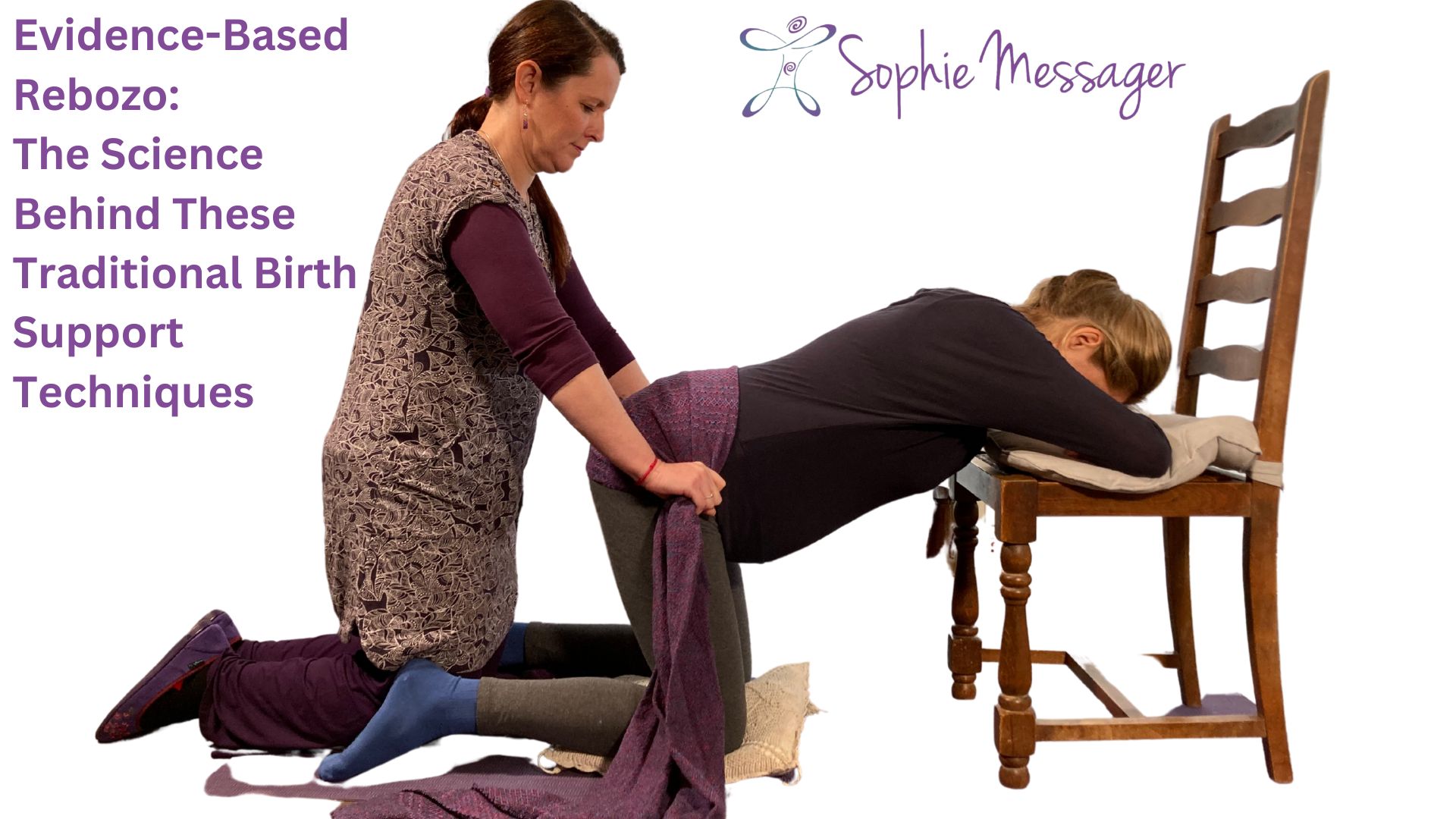
    The woman is on her hands and knees (or standing up), kneeling over a sofa or birth ball or chair, and the rebozo is wrapped around her buttocks, applied tightly to the hip bones, and a jiggle is applied. This technique helps relax the pelvis ligaments and muscles (including the pelvic floor) and provide pain relief during contractions.

    Play

    Teddy’s the osteopath biomechanical explanations of the technique:

    This provides a fluid vibration technique and helps with pelvic ligaments and to vibrate the viscera. The jostling can help resettle things and can encourage the baby to move.

    Review of the research

    Until recently there was almost no published evidence behind the effectiveness of rebozo techniques to support labour and birth.

    The last time I wrote about this, there were literally 3 papers: one story of a midwife’s experience in using rebozo within the NHS, one that looked at how rebozo techniques could help turned OP babies (but this was a descriptive paper rather than an experimental one) , and one about the satisfaction of women receiving a rebozo intervention during labour.

    However this has changed, with 11 new papers being published since 2022, and it is time for this evidence to be reviewed, so it can be shared, so we can help break the misguided belief that rebozo techniques are just not effective. 

    Below you will find a summary of all the published scientific papers (I have only included the papers in English) I have found about rebozo techniques, in chronological order, with a link to each of the papers, should you be a geek like me and want to read them.

    Type of study: Discussion paper

    Location: UK

    Techniques : sifting, shaking the apples, and head massage. 

    Summary: The article explains what a rebozo is, how the author was introduced to rebozo techniques, and how she has incorporated them into her midwifery practice in the UK. The author shares her journey from being hesitant to use these techniques in hospital settings to eventually teaching them in active birth workshops. There is an emphasis on the fact that these techniques should be used appropriately and that any intervention is still an intervention. 


    Study type: Clinical review and practice paper

    Location: USA

    Techniques: hip rocking lying down, shaking the apples, and belly sifting.

    Summary and outcomes :The paper explains the background for the techniques and how to carry them out. The article outlines practical considerations for implementing rebozo techniques in a hospital setting. The paper includes a case study of a woman in labour with an OP baby for whom using the belly sifting techniques lead to a more comfortable and effective labour.


    Study type: Qualitative study

    Location: Danemark

    Number of women: 17

    Techniques: Sifting and jiggling (both hips and belly, either standing up/ lying down or on hands and knees)

    Summary and outcomes: Techniques were mostly used with suspected malposition. In more than half of the cases, the midwife answered that a change in the labour was observed after rebozo use. Most women reported positive bodily sensations, pain relief, and described the techniques as user-friendly and non-invasive. The techniques were well-received as a supportive measure during labour. 


    Study type: Multicenter randomised controlled trial 

    Location: Danemark

    Number of women: 372 (women with a singleton breech presentation at 35-36 weeks pregnancy)

    Techniques: Sifting and jiggling (both hips and belly, either standing up/ lying down or on hands and knees), combined with Spinning babies type positioning (open-knee

    chest, breech tilt, and crawling on all fours).

    Summary and outcomes: Techniques were mostly used with suspected malposition. Most women reported positive bodily sensations, pain relief, and described the techniques as user-friendly and non-invasive. The techniques were well-received as a supportive measure during labour. 

    This is the only published randomized controlled trial to date examining the effect of rebozo techniques as an adjunct to ECV. Contrary to expectations, the addition of rebozo techniques before ECV did not improve, but rather reduced, the likelihood of achieving a cephalic presentation at birth (51% vs 62%). The intervention was found to be safe, with no adverse events reported.

    Note : the paper states that despite initial consent to refrain from performing rebozo, 32 women from the control group reported to have performed rebozo exercises at home or had consultations with a private provider outside the hospitals.


    Study type: Quasi-experimental 

    Location: Indonesia

    Number of women: 15

    Techniques: Unspecified, but assumed to be the trio above, combined with light touch massage

    Summary and outcomes: Before intervention, most women reported moderate (53.3%) or severe (20%) pain. Afterward, the majority experienced only mild pain (60%) or no pain (26.7%), with just 13.3% reporting moderate pain and none reporting severe pain. Every participant experienced pain reduction. 


    Study type: Quasi-experimental 

    Location: Egypt

    Number of women: 124

    Techniques: Belly sifting, shaking the apples and double hip squeeze with rebozo

    Summary and outcomes: Statistically significant reduction of  both pain (a 20% reduction on average) and anxiety (average of 17%) in the rebozo group. The majority of the rebozo group reported a positive experience with labour, compared to the control group.


    Study type: Pre-Experimental 

    Location: Indonesia

    Number of women: 32

    Techniques: Belly sifting and shaking the apples.

    Summary and outcomes: The rebozo group had, on average, a shorter first stage of labour than the control group (measured by the number of women having a labour under 6h versus over 6h).


    Study type: Quasi experimental 

    Location: Indonesia

    Number of women: 20

    Techniques: not specified but assumed to be sifting and jiggling based on references, using either combined rebozo and hypnobirthing, or just hypnobirthing as a control group.

    Summary and outcomes: The rebozo and hypnobirthing was associated with a shorter second stage of labour, and no difference in Agpar score.


    Study type: Quasi experimental 

    Location: Indonesia

    Number of women: 26

    Techniques: Shaking the apples or Zilgrei method (a breathing technique)

    Summary and outcomes: Both the rebozo and Zilgrei interventions reduced the length of the first stage of labour, and the rebozo group had on average a shorter first stage of labour than in the Zilgrei group. 


    Study type: Pre-experimental 

    Location: Indonesia

    Number of women: 30

    Techniques: Rebozo techniques (not specified but assumed to be sifting and jiggling based on references).

    Summary and outcomes: The rebozo group experienced significantly less pain, approximately 25% less pain than the non rebozo group.


    Study type: Quasi-experimental 

    Location: Indonesia

    Number of women: 30

    Techniques: Hip rocking lying down and shaking the apples with rebozo compared with oxytocin massage (light touch spine massage)

    Summary and outcomes: Significant difference between the massage and rebozo group, with the rebozo group having a shorter average second stage of labour (58 min) than the massage group (67 min) .


    Study type: Non-randomised control trial

    Location: Egypt

    Number of women: 80

    Techniques: Belly rocking, double hip squeeze, sifting, shaking the apples

    Summary and outcomes: The rebozo group experienced both reduced pain and anxiety.


    Study type: Randomised control trial

    Location: Turkey

    Number of women: 113

    Techniques: Rebozo techniques (not specified in the paper, but assumed to be the same as in the other papers) versus relaxing massage.

    Summary and outcomes: Women in the rebozo group had lower pain levels during birth and greater birth satisfaction, as well as a shorter duration of labour.


    Study type: Quasi-experimental

    Location: Italy

    Number of women: 1500 in prospective cohort (before the techniques were used) and 779 in retrospective cohort (after the techniques were used regularly)- 2279 in total

    Techniques: Rebozo combined with Spinning babies techniques

    Summary and outcomes: Reduction of persistence of OP position during labour. About 35% of babies in both groups started labour with an OP position. In the control group about 36% of those babies remained OP until birth. In the study group, only about 28% remained OP, a statistically significant reduction of 8%.


    Summary of the research

    • Studies have been conducted in the USA, Egypt, Turkey, Indonesia, Italy, and Denmark.
    • Sample sizes are small (range from 14 to 2,279 women)
    • Techniques: Most studies used rebozo sifting (rocking/jiggling the pelvis or belly), sometimes combined with maternal postures or combined or compared to other pain-relief methods.
    • Outcomes:
      • Consistent findings of reduced perceived labour pain and improved birth satisfaction.
      • Some evidence of shorter labour and improved fetal positioning.
      • High acceptability and positive feedback from women using the technique.
      • No significant adverse outcomes reported.


    Strength of the research:

    • Growing international interest with studies from diverse healthcare settings
    • Consistent positive findings for pain reduction and maternal satisfaction across multiple studies
    • Some larger sample sizes in more recent studies (notably the Italian study with 2,279 women)
    • Evolution from purely observational to experimental and randomized controlled designs


    Limitations of the research:

    • Small sample size in most studies
    • Inconsistent methodology: Techniques vary significantly between studies, making direct comparison difficult
    • Many studies combine rebozo with other techniques (Massage, positions
) making isolating effects difficult
    • Limited blinding: Due to the nature of the intervention, proper blinding is challenging, increasing risk of bias


    The current body of research evidence indicates that rebozo techniques are an effective, safe, and well-accepted non-pharmacological intervention for reducing labour pain, improving the birth experience, and potentially facilitating labour progress. The integration of rebozo techniques into modern maternity care is supported by both quantitative and qualitative evidence. Bigger and more rigorous studies would help to strengthen the evidence base and guide standardised practice.


    Conclusion

    As you can see, through both my personal account and emerging research, rebozo techniques offer a transformative approach to supporting physiological birth in an era of increasing medicalisation. The growing body of evidence, spanning multiple countries and methodologies, consistently shows benefits for pain reduction, maternal satisfaction, labour duration, and potentially fetal positioning.

    What makes rebozo techniques particularly valuable is their simplicity, accessibility, and safety. Unlike many medical interventions, they work with the body’s natural physiological processes rather than overriding them. They empower both birthing women, their partners and supporters with practical tools that can be applied in virtually any birth setting, from hospitals to home births.

    Ideally, there would need to be larger, more standardised studies. But we must also be careful not to fall into the trap of dismissing traditional wisdom simply because rebozo techniques haven’t been subjected to large double blind clinical trials. The absence of these does not indicate a lack of effectiveness : it reflects historical biases about which knowledge systems are deemed worthy of scientific attention. (And I also want to point out that a published review of UK maternity care guidelines showed that only 9 to 12% of them are based on this kind of evidence
.)

    As birth professionals and maternity care systems continue to seek balance between technology and physiological support, rebozo techniques are a powerful symbol of integration, honouring traditional wisdom while meeting contemporary standards for evidence-based care. Through this integration, my hope is that we may move closer to a model of birth that places the needs and experiences of birthing women at the centre.


    If you want to learn more

    I offer an online course called Rebozo for an easier birth, which contains written explanations of 25 rebozo techniques, with video tutorials and an explanation of what each techniques does to the body by an osteopath.

    I offer one to one mentoring sessions. These sessions are ideal if you are a birth professional and want to extend your confidence and knowledge about how/when to use the techniques. I also offer a 3 months mentoring package for perinatal and holistic professionals. I create a space where your inner wisdom can emerge and be recognised. Through deep listening, embodied practices, and ritual, we’ll walk together on this path of discovery.

    If you’d like me to come and teach these techniques to you, I am happy to offer training up to 2h from Cambridge, UK. I am especially keen to train more NHS midwives (I have already delivered several workshops within the NHS). Sharing these tools with healthcare providers creates powerful ripple effects, enhancing care for birthing families throughout the system. This allows us to re-integrate traditional wisdom into standard practice, benefiting both providers and the families they serve. Contact me to explore training opportunities for your team or unit.

  • Shrinking Mountains: Practical Tools to Transform Overwhelm

    Shrinking Mountains: Practical Tools to Transform Overwhelm

    Every time I take a break from my routine, whether it’s a holiday or just some time off, I always struggle a bit to switch back into work mode. After a period of relaxation, it can feel challenging to return to the many tasks that come with running a small business and managing family life. It’s like the weight of both roles—the solopreneur and the “CEO” of my family—hits all at once.

    In the past, this shift often left me feeling grumpy and overwhelmed, but this time I approached it differently and was able to overcome the stress more quickly. Here’s how.

    Many years ago, I embarked on a journey to reduce overwhelm  (read about that here). The biggest two learning points in my de-overwhelming journey and process are as follow:

    • Put the self care in the diary first
    • Decrease the size of the mountain

    1) Put the self care in the diary first.

    I know this is going to sound counterproductive, but it really work. If you try to work harder out of overwhelm, if you wait until you’ve done all the stuff in your to-do list before you allow yourself to relax, to take the time to do the things that make you feel good (in my case, swimming, drumming, and dancing) then you never find the time to do these things. You are not only likely to remain stuck in the overwhelm cycle, but also to make things worse. You cannot create spaciousness from a place of scarcity. If you feel you never have enough time, the way to create more time is to give your mind and body the chance to experience what it feels like to be spacious and relaxed.

    I’ve found that practices such as  reflecting in a journal every time I feel stressed or overwhelmed, putting a timer on for 5 min, simply starting with “what does my soul wants to tell me today”. Or doodling myself as a stick figure and writing speech or thought bubbles works well to, putting a timer on for 5 min and drumming. All of these things help my overwhelm settle down. What comes up, with either of these practises, is usually that when I feel there is too much on my plate, I actually need to slow down instead of trying to flog myself to work harder. Overwhelms is often a sign that you need to slow down.

    When you feel stuck or stressed or overwhelmed, rather than trying to push through the stuckness, which usually doesn’t work, you can choose to do something that involves a bit of movement, and that makes you feel good instead. For me this means a walk in the woods, a swim in the river (I usually tell myself “fuck it I’m going for a swim!”) or a short 5rhythms dancing session (as in, just one short track I love).  This ALWAYS results in the stuck energy moving through and my being able to start seeing the forest for the trees, and starting to be able to get stuff done from a refreshed place.

    Building up your sense of achievement rather than focusing on what you aren’t doing is also important. Another practice that I’ve found transformative is to use a “ta-da” list. At the end of each week I write everything I’ve done that week, self care, family and  work wise. I’m always surprised by how much I have accomplished, even when I’ve felt that this wasn’t a very productive week.

    2) Decrease the size of the mountain.

    Since I started working with authentic business mentor George Kao I’ve learnt the importance of capturing the process whenever I start anything new. This is for three reasons:

    • It helps understand the large numbers of steps and time involved in creating something (see Ta-da list above)
    • It saves time for the future, as you already have all the steps and tasks captured if you want to do it again (for example, creating an online course)
    • But most importantly, it decreases the size of the mountain. It helps to break down the impossible ascent into tiny, do-able steps. It creates a path where there was none before.

    Imagine that you are facing climbing an enormous mountain. Or that you have to carve a track in a deep jungle with a machete. All the tasks, the thoughts about the tasks, they all get jumbled in your head and all you can feel is this enormous, impossible task. You feel exhausted just thinking about it, and you don’t know where to start or even want to start. It feels heavy, overwhelming and scary. Running away feels easier,  or pretending it’s not there. Yet you feel the weight of the “unclimbed mountain” on your shoulders all the time. Sounds familiar?

    This is because you cannot see your way through. You just see the top, or the impossibly far destination. And this keeps you stuck in fight and flight, or freeze mode, because our brains have evolved to be very good at protecting us. A perceived danger is experienced by our nervous systems in the same way as a real one.

    If you decrease the size of the mountain, as in capture all the tasks in small dividable steps, and then decide to maybe only do one, tiny step, as soon as you start to move, it creates a path, and the overwhelm gets resolved almost instantly. The energy starts to move, and you realize that the anxiety about doing the tasks was much bigger than the task itself. In fact, very often as soon as you start taking steps towards doing the task, the anxiety dissolves and you realized that you made a much bigger deal about it than it was.

    I’ve found that when I procrastinate, if I start writing a list of what needs to be done rather than doing the actual task, it feels more doable to write that list than to do the task. And then when I’m ready to tackle the task, the list I’ve written creates a simple path I just need to follow, so I no longer procrastinate about it.

    Here is one of George Kao’s blogs about it, and also a video about it.

    I have had such an incredible journey doing this that I plan to create a course to help others do the same. I am offering one to one mentoring sessions to start with so I can get feedback and experience. Do get in touch if this is something you would be interested in.

    Does this resonate with you? If so I’d love to hear about it.

  • How to write a postnatal plan

    How to write a postnatal plan

    You may have heard of a birth plan, but have you heard about a postnatal plan?

    In our culture we are often focused on the birth, and most of all, on the baby. It is clear from the focus antenatal classes have, there is preparation for the birth, and also preparation for the postpartum, but the postpartum aspect is usually mostly focusing on babycare rather than on the mother’s needs (and I should know about it because I taught antenatal classes for several years). It is also clear from the presents expectant and new parents receive, which are also usually all for the baby.

    It didn’t used to be this way. In every culture around the world, there used to be (and still is in many cultures even today), a period of at least a month post birth during which the new mother didn’t lift a finger. The community (usually female relatives), rallied round and took care of her household, so all she had to do was rest, eat nutritious food people prepared for her, receive healing bodywork treatments, and get to know her new baby. Compare this to what we get in the Western world: two weeks paternity leave, and then you’ve on your own.

    Because we no longer live in a culture that understands and supports the need for recovery post birth, writing a postnatal plan is a fantastic way to ensure that there is support in place for after the birth, and that you aren’t alone trying to meet your own needs and the intense needs of a newborn baby (as well as running a house, and maybe looking after older children too).

    I love this quote by Jojo Hogan, a postnatal doula who created the Slow postpartum movement.

    If birth is like a wedding day (lots of planning, high expectations, being the centre of attention, lasts for about a day or so, get something special at the end), then the postpartum should be like a honeymoon (Equal amounts of planning and investment. Time, space and privacy to relax, bond and fall in love. Lots of people and services around to care for and look after you and a peaceful and blissful environment where all your needs are met for a few days or weeks).

    As you would plan for your honeymoon, it is well worth putting plans in place for your baby moon, i.e. creating your own postnatal plan. Just like planning for birth, this isn’t about having a rigid plan. The magic isn’t in the finalised plan, or to have a ‘perfect’ plan, it is in the process of exploring options (some of which you may not even know exist) and getting informed so that you can have an experience which is as positive as possible, regardless of what happens.

    I use this analogy: you need to find what’s in a buffet, before you decide what you’d like to eat (I explain this process in my blog called The buffet curator).

    You don’t know how you’ll feel in advance. You don’t know what curveballs life might throw you (for example: your birth might happen sooner or later than you expected, it might unfold differently from what you had hoped, you might need to stay for a while in the hospital, your baby might need to stay for a while in the hospital etc).

    So just like for birth, it’s worth having thought about all the options, so that, regardless of how your birth unfolds, and how your baby comes into the world, and how you end up feeling once you’re home with your baby, you have at least some form of support in place.

    You may encounter people who dismiss your idea. “You can’t plan birth ” is a common phrase used to dismiss birth plans. Because a postnatal plan is an even newer concept than a birth plan, you may encounter some dismissiveness or negativity. People might say “what’s this newfangled thing, we didn’t need that in our time” or “you don’t need that” from people who don’t understand the point, because they did not do it themselves. Some of my clients who have written postnatal plan have encountered reactions from relatives who even said “I didn’t have support, I just got on with it”, implying that they suffered, and you should too. Therefore you might need to choose carefully who will be part of your postnatal support team, who to discuss it with, depending whether they are likely to be supportive or dismissive. In the vulnerable tender state of new motherhood, the last thing you need is being criticised for your choices. After all, you just single handed grew and birthed a whole new human, and you should be revered as the goddess that you are.

    How to you write a postnatal recovery plan? It’s simple really, because a nurturing postpartum boils down to 4 pillars: Social support, Rest, Food and bodywork.

    Here is a list of these topics with prompts, which you can use as basic to start write your postnatal plan.

    Rest

    • Help with household (chores, cooking, cleaning, other children etc make a list of potential helpers)
    • Visitors-list them/how to manage them so they do not interfere with rest/write a “new mother and baby sleeping” note for the door.
    • Naps/sleep when the baby sleeps/early nights/sleep with your baby
    • Relaxation: techniques and apps

    Food

    • Batch cook and freeze
    • Who can make/bring you some/meal trains
    • Deliveries (supermarkets, take away meals, frozen, fresh, meal boxes)
    • Nutritious non perishable snacks
    • Use a sling so you have your hands available to make yourself something to eat.

    Bodywork

    • Postnatal massages/closing the bones massage
    • Specialist manual therapists such as osteopaths, chiropractors, and physiotherapists
    • Wrapping your pelvis/abdomen
    • Keeping warm

    Social support

    • Friends, family, neighbours
    • Hired help (doulas, nannies, cleaners…)
    • Online support (social media, WhatsApp groups…)

    Planning for the unplanned:

    You might want to include a part on navigating possible curveballs. For instance if you end up giving birth by caesarean when this wasn’t part of your plan and what your recovery might look like if that’s the case.  If you end up having a longer than expected hospital stay after the birth, or if your baby needs to stay in hospital for a while.

    There are many ways to create a postnatal plan. You could write one, and you could also make a mindmap or a vision board, of draw something or whatever other modality appeals to you.

    You can download a free postnatal recovery plan template as a PDF on my website front page.

    If you’d like to learn more about this topic, feel free to browse my blog for more posts on this topic. My book, Why postnatal recovery matters has a whole chapter on writing a postnatal recovery plan, and my online course How to prepare for a nurturing postpartum, has a whole module on it.

    This coming Tuesday 28th of June I am also running a free Webinar called How to prepare for a nurturing postpartum.

  • Do you confuse productivity with effort?

    Do you confuse productivity with effort?

    Do only feel that you are “working” when it feels like hard work?

    At the end of each week I do a “ta-da” list. Often as I reflect on my week, I notice that I often forget to include one to one session with clients as part of my “work” .

    I believe that the reason I forget to count these sessions is because sessions with clients (in this case, several pregnant or new families I supported), do not feel like an effort. These sessions do not feel like an effort because I love supporting families. These sessions feel like a magical time out of time, where I’m at my best, holding space for someone whilst their own journey unfolds. During these sessions, I’m in a state of flow. It feels effortless and joyful.

    I had an epiphany as I realized this : we live in a culture that equates success with hard work, with effort. The underlying idea is that there has to be some level of strenuousness to the effort for it to be counted as “work”. That we have to flog ourselves to push through unpleasantness for it to count. It is part of the system of education we have grown up in, and of the system that our children are in. A system that equals demanding effort= praiseworthy, and also behind it that whatever is easy has less value.

    When I did my antenatal education diploma, I was amazed to discover that I had unconsciously internalized the idea that learning had to be “serious”. As I discovered the science of learning, I realized that mainstream education had it all wrong, and that we learnt much better when having fun. The internalized aspect is so strong that I felt the need to start every single one of my antenatal courses with a disclaimer explaining why I’d make the group do all the work in an interactive, fun way, instead of lecturing them.

    The same is true of undoing the misconception that hard work is the only valuable way to achieve something. There is much to say about working within a state of joy, flow and ease. Since I started applying this principle, I have found that not only is my work more joyful, but opportunities seem to flow towards me more easily as well.

    I have come to think of it this way: we exist in two extreme states, much like the fight or flight versus rest and relaxation state. We are either closed, rigid and hard, or open, playful and soft.

    Magic happens from the second state. There is no room for anything in the closed, hard, rigid state.

    Next time you catch yourself in this state, sink into your body and ask yourself how your body feels when you are in that state. Try to soften and open your heart and see what your work feels like from there.


  • What is postpartum bodywork and why we need it back.

    What is postpartum bodywork and why we need it back.

    All around the world there are (or used to be) traditional practices to help a new mother’s body heal after birth.

    Regardless of the continent, these traditions usually include some massage and wrapping rituals, as well as binding the belly and pelvis, and keeping the mother warm.

    When you think about the tremendous changes a mother’s body undergoes, it makes so much sense! During pregnancy, the uterus grows from the size of a pear to that of a watermelon, the pelvis tilts forward and becomes wider, the ribs open, the spine curves increase, the abdominal organs get pushed up etc. To give birth, the mother’s body opens up on a physical and energetic level. After birth, these changes need to happen in reverse, whilst the body also undergoes the beginning of lactation.

    It seems crazy that we no longer have processes in place to support these changes, or at the very least, some kind of physical examination to make sure everything has returned to a healthy place. At the 6 weeks doctor “check” in the UK, there is no overall physical examination of the mother.

    With no checkup, and no sense of what is normal, we have a perfect storm of issues not being treated. The statistics are very telling: 1 in 3 new mothers experience urinary incontinence at 3 months postpartum and nearly one in 2 still has diastasis recti at 6 months postpartum. Research shows that it takes on average 8-10 years post birth for women to seek help for such issues.

    Yet, during the first 4-6 weeks postpartum, when the body is still plastic and resetting itself post birth, there is a unique opportunity for healing.

    Traditional massages and rituals, such as closing the bones, understand this need and the window of opportunity, and are designed to “close” a new mother physically, emotionally and energetically, after the widening and opening of pregnancy and birth. Because the needs of new mothers are the same regardless of where they are from, it makes sense all cultures have similar processes to support postpartum healing. This article from Innate traditions provides a beautiful overview of the topic.

    As no such treatment is available as standard within the health system, it makes sense to seek bodywork and healing from people who can provide it.

    What kind of postnatal bodywork can you have?

    When can you have postnatal bodywork?

    As soon as possible during the first 6-8 weeks postpartum or as soon as you are ready. In traditional wisdom, there is a window of healing opportunity and plasticity during this time when the body is designed to heal faster. The strange “don’t do anything before you’ve had your 6 weeks check” isn’t based on any evidence. Moreover, it makes no sense because the 6 weeks check doesn’t include a physical examination. Having massaged many new mothers, some as soon as 24h post birth, I can attest that this is when the bodywork is the most effective to speed up healing.

    What can you do for yourself?

    • Use the 4 pillars of postnatal recovery (Social support, rest, food and bodywork) to write a postnatal recovery plan (you can download a free template here) to include bodywork. You can ask for gifts vouchers towards postnatal bodywork.
    • Wrap your belly and hips. I wrote a blog about it which includes tutorials.
    • Keep warm (like a convalescent person would: wrap up, and consume warming foods and drinks)

    What can you do for new mothers?

    • If you know someone who is pregnant or recently had a baby, it would be a wonderful gift to give them a voucher towards such a treatment.
  • New NICE induction of labour guidelines. Have we taken leave of our senses?

    New NICE induction of labour guidelines. Have we taken leave of our senses?

    The National institute for clinical excellence (NICE) has published new draft guidelines for induction of labour. They are open for consultation until the 6th of July 2021.

    The part that is most concerning is this:

    Consider induction of labour from 39+0 weeks in women with otherwise uncomplicated singleton pregnancies who are at a higher risk of complications associated with continued pregnancy (for example, BMI 30 kg/m2 23 or above, age 35 years or above, with a black, Asian or minority ethnic family background, or after assisted conception).

    You read that right. The new guidelines propose that everyone whose body mass index is over 30, above 35 years old, who is black, brown or any non white background, who have conceived through IVF, should all be induced at 39 weeks of pregnancy. I couldn’t help but wonder: how many people does this leave, who do not fall in these categories?

    I had a look at the office of national statistics, to check what percentage of the population these groups represent together. I haven’t been able to find detailed enough data to remove overlaps between the groups. However, I have found the following:

    • About 50% of pregnant women are classified as overweight or obese in the UK
    • Black, brown and ethnic minorities represent about 10% of the UK population
    • About 25% of babies born in the UK were conceived by IVF
    • About 25% of babies born in the UK are from mothers over 35

    I know that some of these categories overlap, but I’m guessing that not many people will still fall within the “low-risk” people being “allowed” to go into labour naturally if this guideline passes at it is. Especially as, in my experience, few people question the “guidelines” and apply them as if they were the law.

    Worryingly the rate of induction has already just gone through a major rise. Since March 2020 many trusts have seen steep rise in induction (and cesarean) rates. (this is easy to find in the infographics shared from various trust pages on social media). In my local trust, the induction rate has gone from being between 25 and 30% prior to March 2020 to 39% in May 2021. Doesn’t it feel extremely odd to you that nearly 40% of the population already needs to have their labour artificially started? Isn’t it possible that this rise wasn’t justified by evidence, but rather by a knee jerk reaction to the covid crisis?

    If the above guideline goes ahead as it is, what rates of induction are we going to see? Are we headed towards in a situation where everyone has their labour induced? How is this logical? How is this balanced? Have we taken leave of our senses?

    The draft guidelines  are open for consultation until the 6th of July 2021. If you wish to comment, you are welcome to copy and paste some of my comments to issue your own reply to the NICE consultation. Just email InducingLabourUpdate@nice.org.uk

    Dr Sara Wickham has published an extensive blog about it too.

    Dear Nice labour induction team

    My name is Dr Sophie Messager. I am an ex biology research scientist turned doula and perinatal educator.

    Over the last ten years in this role I have seen the rate of induction of labour in my local trust rise from 24% to 39% without an improvement in maternal or fetal outcomes.

    What I have witnessed however, is that induction of labour often causes trauma for mothers and their partners. I have also witnessed time and time again that true informed decision rarely takes place because the majority of parents rarely get told what induction of labour entails (in primips often a 3 to 5 days process which ends up in a caesarean). They rarely get told that it is a choice (most get told “we’ll book you in for an induction”), and they also rarely get told of the risks that are involved in inducing labour (increased risk of caesarean birth and fetal distress amongst other things). I also see a lot of coercion in making sure people consent to having their labour induced, and in particular implying that the baby might die if they do not agree. I wrote in more details about it in this blog post.

    Since March 2020, most hospitals trusts banned the access of partners to antenatal wards, only allowing them during established labour, I have witnessed women being induced for 5 days, alone in antenatal wards with no support from myself or their partners. This is dehumanising and traumatising for women and their partners.

    Since March 2020, I have also seen rates of induction and caesarean rise by about 10% in many hospital trusts, with no evidence behind the change. In my local trust, the induction rates was 40% in May 2021, when it was between 25% and 30% prior to March 2020. Carrying out a survey of the rise of induction rates since 2020 across UK hospital trusts since March 2020, and the reasons behind them, and whether this rise improved outcomes or not would probably prove very informative. Surely the percentage of women who go into labour spontaneously has not decreased by 10% in less than a year?

    I am worried that the people who are making the recommendation in the guidelines have no experience of supporting women and their partners in labour, and in particular, induced labour, or that if they do, they have no experience of what happens in the aftermath. Most health professionals only get to see people for a few days after birth, until they leave the hospital. Doulas and other private perinatal practitioners often support new families for weeks after birth, and they may be the only ones who truly understand how traumatising induction of labour can be, especially when the process hasn’t been communicated adequately ahead of time.

    The draft guidelines state the following:

    Consider induction of labour from 39+0 weeks in women with otherwise uncomplicated singleton pregnancies who are at a higher risk of complications associated with continued pregnancy (for example, BMI 30 kg/m2 23 or above, age 35 years or above, with a black, Asian or minority ethnic family background, or after assisted conception).

    Yet the guidelines also state that “As there was no evidence to identify the optimal timing of induction in these groups, the committee made a research recommendation”.

    I had a look at the office of national statistics, to check what percentage of the population these groups represent together. I haven’t been able to find detailed enough data to remove overlaps between the groups. However, I have found the following:

    • About 50% of pregnant women are classified as overweight or obese in the UK
    • Black, brown and ethnic minorities represent about 10% of the UK population
    • About 25% of babies born in the UK were conceived by IVF
    • About a quarter of all babies born in the UK are from mothers over 35

    Which percentage of the population does this leaves that still falls within a low risk group? Has this been assessed as part of the drafting of the guideline?

    If the draft guideline gets published as it is we are very likely to see a further rise in an already alarmingly high induction rate, and a concomitant rise in caesarean rate, as despite some flawed research claiming that induction of labour doesn’t increase caesarean rates, in practise (and according to some recent research), induction of labour usually leads to doubling of the rate of caesarean. See https://www.sciencedirect.com/science/article/abs/pii/S0301211521002463.

    I am worried that we are headed for the same rates of caesarean as countries like Brazil or China (which are around 50%), without improvement in birth outcomes.

    Experience and history (for example in the case of the Hannah breech birth trial) shows that when new guidelines like this one get published, they tend to get adopted widely without question within maternity care, and that, even when new evidence disproves the original results, it is very hard to get the system to change, because the belief about what is “normal” has become entrenched within maternity care.

    The long term impact of a rise induction of labour on the health of the general population is this happens is greatly concerning. As concluded by the author of this study explains:

    “IOL for non-medical reasons was associated with higher birth interventions, particularly in primiparous women, and more adverse maternal, neonatal and child outcomes for most variables assessed.“

    More worryingly, there appears to have been no consultation of the interested party, i.e people having to undergo the actual induction of labour (women and their partners) in the drafting of this guideline.

    I urge you to reconsider these guidelines, and in particular, ensure that a consultation of the experience of induction of labour for mothers and their partners takes place prior to any new recommendations being made. I would also like to see the long term physical and mental health implications for families and babies taken into account to balance the recommendation.

    Regards

    Dr Sophie Messager


  • You already know what is right for you (how to access your own wisdom)

    You already know what is right for you (how to access your own wisdom)

    What if I told you that you always know what is right for you?

    What if I told you that you do not need to outsource your wisdom, defer to other people, seek answers from outside sources, and that the answers, the real, true, optimal ones for you as a unique being, are already inside of you?

    In my previous blog, I explained that you are the expert is what is right for you and I want to expand on the topic and go further, as well as present ways you can access your inner wisdom.

    I believe that we are all born with inner wisdom and knowing and that we can originally access it easily. Babies and small children know what feels good and what doesn’t. They trust their inner compass. They express their bliss and displeasure loudly. It is very plain for all to see: when they are happy, their whole body is happy. When they are sad you can see it too.

    But then, because we live in a society that expects us to obey and do as we are told, and because this is present at every level, whether it is parenting, education, or the corporate world, we slowly learn to ignore our inner knowing and trusts that authority figures know best what’s right for us. To be seen as lovable, acceptable, we slowly learn to fit within the constraints of what is seen as acceptable in our society. We learn to ignore what feels right, in favour of what is seen as right.

    It can be hard to unlayer the learning of distrust of one’s instinct and to start accessing the inner voice inside. This is especially true when we enter an experience that is outside of our field of knowledge. And this is particularly true of the experience of pregnancy, birth and parenting. I see it a lot in my work as a doula. I see highly educated, intelligent individuals, who find it really hard to trust their instincts in the face of pressure from coercive maternity care policies.

    The same is true when we become parents, and it can be tempting to choose to believe the opinion of so-called “experts” in parenting, rather than following one’s inner guidance. I wrote about this in my blog Why baby books and “experts” can really harm you after you have a baby . It is true for most new experiences in life, most choices, and most life transitions.

    I see this being highlighted more than ever since the 2020 pandemic. There are so many conflicting pieces of information. Experts disagreeing with each other. Public health policies that treat people as a single entity and fail to take into account unique individual circumstances. Forever changing goalposts. Not knowing who and what to believe.

    I am not saying that it isn’t worth consulting people who know more than you do about an area. But as I explained in my previous blog, they cannot make the decision for you, because they aren’t the ones who are going to live with the consequences of your decisions.

    In navigating the perinatal period, and life changes, and for most of us in the current climate, learning to listen to our inner knowing can be a game changer, and bring out a sense of confidence and peace.

    But how do you start to unlayer the belief that the answers always lie outside of yourself? How do you start listening to your inner voice if you have always let the opinion of others guide you?

    There are many different ways to start accessing your inner wisdom. None of them is necessarily “right” or more powerful than the other. They are simply tools. The most important aspect is that you use one that works for you.

    I have been on a massive journey myself to debunk what I thought I had to do. For example I use to believe I was shit at meditation because I thought you had to sit on a cushion in the lotus position, stare at a candle, and think of nothing. This cool little animated video went a long way in helping to undo this.  It is surprising simple. All you need to do is have the intention to do so, and then start applying ways of accessing your own wisdom that work for you.

    Here are some ideas to try to get you started. Remember, that, as with any new skills, the more you practice the better you become. After all, if you were going to run a marathon you wouldn’t expect to do it without training. Start small. Start with the method you feel most excited about.

    Set an intention

    • The simplest way to access your inner wisdom is simply to set an intention to receive the guidance and see what happens.

    Meditation

    • If trying meditation appeals to you, there are many apps, such as headspace (and plenty of others, some of which are free) around to guide you through the process in tiny, incremental steps. It doesn’t have to be a commitment to have 20 min a day, it could be as little as 5 min and still make a difference.
    • Checkout the one moment meditation video. https://www.youtube.com/watch?v=F6eFFCi12v8

    Mouvement

    • Meditation does not even have to be a still process. One can meditate whilst walking, dancing, or other movement activities too. I am a fan of 5rhythms dancing (https://www.5rhythms.com/) and other conscious movement practices,These practises work much better for me than sitting still. I include my wild river swimming in my meditative practices.
    • When you feel stuck, try moving gently, or going for a walk. Bonus if you can get in nature, as it is extra grounding.

    Grounding

    • Walking barefoot on the grass/ground is a super fast way to discharge stress and ground yourself. From a place of grounding it’s easier to access one’s inner voice.
    • Being in nature is generally grounding. I swim in the local river all year round and it is one of my favourite ways to de-stress and meditate.

    Breathing

    1. As with meditation, simply paying attention to your breath can help your mind quieten enough to hear the inner voice inside. Again there are many techniques available, but you already know how to breathe (after all you’ve been doing it all your life), and simply paying attention to your outbreath, and slowing it down slightly is all you need. Some meditation apps include breathing relaxation.

    Heart centering

    • This is a quick and simple way to gain a more heart centered state. Breathe gently for a couple of minutes, then imagine that you are breathing in and out through the centre of your chest.
    • You can also try the HeartMath institute heart coherence technique .

    Journaling

    • Some people find their inner voice communicate best with them via writing. Again it doesn’t have to be complicated. All you need is a notebook and a pen, and a commitment to start with free writing 5 min a day. One thing that can help is simply to state in your mind before you write “what does my inner voice/soul (or whatever other word resonates most with you) want to tell me today”.

    Learning to recognise your body’s response

    • Did you know that you can use your body as a pendulum to get an answer to a question? Start by asking a very easy question, for example, do I like (favourite food or drink). Close your eyes and really feel inside your body. Feel your unique body’s response to the yes inside. Mine is a feeling of energy circulating in a circle around my heart, but yours might be completely different. Then ask yourself the same question for a food or drink you really dislike. Feel the response inside your body. Once you have familiarized yourself with your own response, you can start practicing with every day questions. The more you practice the easier it becomes.

    Drumming

    • I cannot resist mentioning drumming because I love it. It is one of my preferred forms of meditation. You do not need to be musically trained. Research shows that drumming to a simple, repetitive, heartbeat like rhythms, causes the brain waves to slow down, which helps to get the mind chatter out of the way. I wrote a blog called Drum healing, bullshit? about my self-taught drumming journey. Over the last year I have drummed twice weekly in the local nature reserve first thing in the morning. It is the most nourishing spiritual practice for me.


  • You are the expert in what is right for you

    You are the expert in what is right for you

    You are the expert when it comes to making decisions in your life.

    This is one of the most important points I share with my clients. I think it applies to many things outside of pregnancy and birth too!

    It can be tempting to defer decisions to experts such as doctors and scientists, or anyone you perceive as an expert in the field, especially if you are trying to make a decision in a area of knowledge that is new to you.

    But the role of the experts is advisory.

    They cannot make the decision for you.

    This doesn’t mean that the role of the experts isn’t valuable, because they can curate options that suit you when trying to oversee the whole picture might feel overwhelming.

    I liken it to choosing dishes in a buffet. The role of the experts is to curate the buffet to your needs (for instance making sure there is no animal products if you are a vegetarian), but they cannot choose the dishes for you. You do.

    Not the scientists, not the doctors, not the experts. You are unique with your own unique needs and you get to live with the decisions you make, not the experts. The role of the experts is to lay options in front of you. It doesn’t mean that the a coach isn’t valuable, because they can curate through a lot of options for you, but their job is to lay options in front of you and your job is to choose what’s right for you.

    Because they aren’t the ones who are going to live with the consequences of the decision.

    You are.

    Play


  • Getting out of overwhelm

    Getting out of overwhelm

    A few years ago I started my journey out of overwhelm. I was overworked and stressed and I didn’t know how to get out of the cycle. I was trying to work harder out of it. It was so bad that I remember stopping to pick some berries on a week day on my way home and feeling guilty because I felt I ought to be working.

    I was stuck into a mindset where my productivity and my worth were mixed up, and I wasn’t even aware of it.

    Luckily I embarked on a coaching programme with Bonny Williams. As part of the programme, Bonny challenged me to spend one hour a week doing something called soft play. The idea of soft play was to spend an hour doing something nourishing and fun, alone.

    At first I struggled to find what to do. Bonny suggested I think about what I enjoyed as a child. I remembered I loved being in nature, build dens, that kind of stuff. I can vividly remember my first soft play: I went for a walk to the local nature reserve, alone, on a week day, when I “should” have been working. I had a lot of stuff to do that and I very nearly didn’t go. But I did, and it felt great and oddly rebellious. And, oddly enough, that day I managed to do everything on my to do list and I felt great.

    Fast forward 3 years, this has become part of my new routine, and had spread new fantastic new habits like year round river swimming, and drumming in the woods and 5 rhythms dancing. I’ve realised this is so important that  days I put the time in nature as the first task on my weekly to do list. And you know what? Magic has happened! I feel a more relaxed, creative and productive than ever. I also have a lot more fun. In fact I’m so elated with the results I’m planning to create a course sharing my experience.

    The bottom line is this: You can cannot get out of the overwhelm created by working hard by working harder. Let me say this again: you cannot get out of overwhelm by working harder.

    Instead, to create spaciousness in your life and more balance with play, you need to let yourself experience that play and spaciousness inside. Once you start experiencing this, all sorts of magic will unfold by itself and you will not look back.

  • The buffet curator: an analogy for doula work

    The buffet curator: an analogy for doula work

    Imagine you were going to a buffet restaurant in a foreign country, and that you had no idea what the foods on offer tasted like, or what the dishes contained.

    Imagine that you didn’t speak or read the language

    Imagine that you had your own dietary restrictions, such as being vegetarian, or being gluten free, or allergic to nuts.

    Imagine that the buffet restaurant was this enormous place, with more than a hundred dishes on offer.

    Imagine that, as you started queuing in front of the dishes, that people kept moving in front of the dishes, and that you knew people behind you would become impatient if you didn’t move.

    Wouldn’t you feel stressed? Wouldn’t you worry that you are going to pick the wrong dishes, some that you will not like, or that could cause you a major allergic reaction?

    Now imagine if you had a guide, someone who knew the restaurant and all the dishes in it.

    Imagine if, because you even entered the restaurant, your guide had taken the time to find out about your needs, made sure they understood what you wanted (and didn’t want), and then explained to you which dishes you would be able to choose from. Imagine that they had even gone and asked the chef which dishes were safe for you to eat. What if the guide could even ask the chef to prepare a different dish especially for you? How much safer and enjoyable would the experience be?

    This is what a doula can and will do for you, as you enter the maze of choices that pregnancy, birth and the postpartum bring. The many options, including ones you didn’t even know existed. The conflicting advice you find on every single topic.

    A doula is like your own buffet curator. As your doula gets to know you, your unique needs and preferences, she can sift through the many options available to you and present you with a curated list of options which you can pick from.

    You doula cannot pick the dishes for you, only you can do that, but having the list tailored to your needs might save you a lot of time and stress.

    A doula then walks the path with you, supporting you along the way and always being available to any questions as you choose, and get to decide what’s right for you. You even can change your mind at any point! Imagine how empowering this feels?

    If this resonates with you and you would like to work with me, you can find out more about the education and support I provide for families and birthworkers in the form of one to one support, and online courses.