Category: ceremony & ritual

  • A drum journey to meet the spirit of Beltane

    A drum journey to meet the spirit of Beltane

    Today is Beltane.

    In Celtic traditions, we used to celebrate 8 festivals during the year: the 2 equinoxes, the 2 solstices and the 4 times in between.

    1. Samhain (Oct 31st) – This marks the Celtic New Year and is considered the most important festival. It’s a time to honour the dead and the start of the dark half of the year.
    2. Winter Solstice (Around Dec 21st) – Celebrates the rebirth of the Sun as the days begin growing longer again after the longest night.
    3. Imbolc (Feb 1st) – An early spring festival associated with the first signs of spring and lactating ewes. Celebrates the returning fertility of the earth.
    4. Spring Equinox (Around Mar 21st) – Marking the beginning of the fertile spring season when day and night are equal lengths.
    5. Beltane (May 1st) – A celebration of the full bloom of spring and the fertility of the earth. Traditions include bonfires and May pole dances.
    6. Summer Solstice (Around June 21st) – Celebrating the longest day of the year and the power of the life-giving sun.
    7. Lughnasadh (Aug 1st) – The first of the three autumn harvest festivals, marking the beginning of the harvest season.
    8. Autumn Equinox (Around Sept 21st) – The second harvest festival, signalling the start of autumn when day and night are again equal.

    These eight festivals formed the basis of the ancient Celtic calendar system and marked the key points in the agricultural year.

    Beltane marks the middle of Spring, and the beginning of summer energy. It stands opposite to Samhain. Celebrated around May 1st (when the Hawthorn blossoms), it honours the return of life and fertility to the world as the Earth awakens with warmth and light after the winter months. Beltane festivities traditionally involve lighting bonfires, dancing around a Maypole, Music (and drumming), choosing a May Queen and May King for the year, and feasting in joyous celebration of spring’s renewal.Ā  It signifies the transition into the season of new growth, recognizing the cyclical rhythms of the natural world.Ā  Beltane carries a spirit of merriment, passion, and connection to the bountiful Earth.

    Beltane fires burning bright

    Spring returns with warmth and light

    Hawthorn flowers in full bloom

    Dancers spin to drummers’ tune.

    Over the last year I have carried the energy of Beltane and embodied the divine feminine as I was crowned May Queen at Beltane in 2023. Over the last year I have co-crafted each and everyone of the wheel of the year for my community and held the ceremonies. This has given me a deep attunement to the changing energies of the seasons, a moment to pause and appreciate this, and to serve my community. This means that, for the first time in my 53 years on this earth, I have not dreaded winter, but welcomed its going-within wisdom.

    Last weekend we celebrated Beltane again and I laid down my crown, in a very powerful and profound ritual death and rebirth ceremony, where I received guidance from the earth about how to bring more peace to my heart.

    On this day of Beltane, I feel called to offer a guided drum journey to meet the spirit of Beltane, one where we can ask questions and gain wisdom about the energies of this time of the year.

    Through the pulse of the drum, we reconnect with ancestral wisdom celebrating Beltane – the transformation of spring’s rebirth. This festival reminds us of the eternal cycle – life emerging from winter’s sleep, embodying nature’s regenerative power, and cycles of death and rebirth.

    Join this drum journey honouring Beltane. Let the rhythms awaken our inner wildness, clearing stagnation as spring energy rises. Harness Beltane’s fertile energy to manifest visions, and birth the blossoming goddess within.Ā 

    Just set aside 15 min where you can relax sitting or lying down, and enjoy.

    If you take this journey I would love to hear what you think. Just comment below.

    Play

  • From Tradition to Modernity: Rebozo Techniques and how they support an easier Birth

    From Tradition to Modernity: Rebozo Techniques and how they support an easier Birth

    When I started working as a doula, the majority of births I attended (those of first time mothers in particular) were long and protracted, and often ended in obstetric interventions such as forceps or caesareans. I grew frustrated because the interventions proposed compounded the problem (how exactly was lying on your back with an epidural going to help a malpositioned baby rotate?). This is what led me to learn about rebozo techniques. I attended my first workshop 10 years ago and, being the knowledge junkie that I am, I’ve trained with over 10 different professionals since, most recently with Mexican midwife Naoli Vinaver.

    Rebozo techniques were developed at a time where obstetric interventions didn’t exist, to support change when labour took too long, or when a baby was in a less than optimal position.Ā 

    Rebozo techniques are used to jiggle and rock the body of the mother during pregnancy or labour. They work on a physical, emotional and spiritual level. Physically they soften muscles, ligaments and fascia. This helps the mother manage labour sensations more comfortably, helps the body to be more balanced and open, as well as support the baby and the mother navigate the birth better together.Ā  Emotionally the rebozo techniques provide a much needed sensation of holding and support, as well as helping the mother release stuck energy/emotions that may impact labour progress. Naoli Vinaver talks about ā€œ turning cold stagnant energy into hot flowing energyā€.

    As soon as I started incorporating a combination of rebozo and position techniques during pregnancy andĀ  births, I saw miracles happen. Babies rotated in a more optimal position during pregnancy, often within just one session. Before I saw labours happen slowly, babies turn OP and maternity professionals being adamant that an epidural was needed to prevent the early urge to push Now, a short jiggle of the rebozo on the buttocks, combined with an inversion or open knee chest position, would often change the nature of the contractions so fast that babies were born before any obstetric intervention could be used. I saw women go from a 6cm stall in labour, to birthing their babies within an hour or two.Ā 

    The most beautiful aspect of using the rebozo is that it was easy, that it helped labour feel more comfortable and helped partners feel more confident and supportive too. I saw so many fathers going from being anxious to becoming confident, relaxed and present once they got busy gently rocking a labouring woman’s hips. On several occasions, using a rebozo has prevented a hospital transfer from home or the birth centre, and led to a beautiful empowering birth.

    I soon felt compelled to pass on these skills, because what I kept witnessing was just too amazing to keep to myself, and also because people kept asking me to teach it. I started teaching workshops in 2016 and an online course in 2018. I have trained several hundred professionals and parents since.

    The one thing that was missing for me was being able to understand why these rebozo techniques helped so much. None of that information was provided by the people I trained with. I have an insatiable need to know.Ā 

    Luckily I met Cambridge osteopath Teddy Brookes, and did all the techniques on him many times as I was gathering material for teaching, so that I could provide my students with an anatomical explanation of what each technique did to the various joints and organs, and I provide this information to my students.

    My thirst for knowledge is insatiable and I’m always keen to learn more. When I attended Naoli Vinaver’s training, I met Shellie Poulter, who is both a doula and trained osteopath. Shellie runs trainings on birth biomechanics. I am deeply grateful to have met her, because I get to enrich my own knowledge, and also share this with you. Shellie and I teamed up to pool our knowledge in a webinar called Biomechanics of rebozo techniques for birth, where Shellie explain how each rebozo technique helps the baby navigate the pelvis more easily.


  • Becoming undone: a normal part of growth

    Becoming undone: a normal part of growth

    Are you struggling with the feeling of becoming undone? Like everything you know no longer feels true, no longer relevant, like you no longer know who you are, like you have just become a blank slate?

    If you do, I’ve been struggling with the same for months. If you follow me you’ll know that I shared about this in this post recently. I remember having the same feelings when I was a teenager, and when I became a mother. In this post,Ā I want to share analogies and tools that help me, and I hope they help you too.

    During my first year as a new doula I suffered quite severe burnout. I reached out to my mentor who told me that the self care practises I had put in place in my job as a scientist were no longer adequate, as I was now suffering from spiritual burnout, as well as physical and emotional. I wrote about how I had to develop a new way to care for myself.

    This has the same energetic flavour. And I need, yet again, to grow new ways of caring for myself. I recognise what it feels like, and I know the power that may come from the other side. I know on some deep level that, like the caterpillar that becomes goo inside the cocoon, I have to dissolve to reform. I tell myself, I am goo now. There is not much to do but be goo. You cannot fight against the dissolution as it only makes things harder.Ā 

    The dissolution makes us vulnerable and soft for a while. Animals that need to cast their shell to grow new ones, like lobsters, hide under a rock to shield themselves from predators whilst they wait for their new shell to harden. For these animals, the sign that they have outgrown their old shell is discomfort. As Dr Abraham Twerski says in this video, if lobsters went to the doctor, they would be prescribed antidepressants for the discomfort, and would never grow.

    If you are struggling, remember that the discomfort is there for a reason. If you were comfortable, you would stay where you are.

    When we come undone, even if we understand on an intellectual level that it is a necessary transformational process, it can be very hard to navigate and stay in a place of trust, vulnerability, and surrender. And it is doubly hard as life doesn’t stop and we still need to care for others as we undergo this process. I cannot help but wonder what it would feel like if we still had the rituals that indigenous cultures have to support such tremendous life transitions, and how lost at sea we areĀ  in a culture that does not witness or support times of metamorphosis.

    Nascence is the term that describes a coming into being. As women we have many obvious nascences in our lives: Adolescence (the beginning of our menstrual cycle), Matrescence (becoming a mother), and Cronescence (I’ve made up this word to represent entering perimenopause and menopause). There are other times of course, with every big life change, but these are the ones who share a process of death and rebirth that is not only happening on a visible physical level, but in the mind and the soul too. These times share is the undoing of who we were to allow who we are to become to be born.

    The film Inside out is an anime movie about the emotions in the brain of Riley, a young girl as she enters adolescence. In her brain, as well as characters representing 5 major emotions who rule her behaviours (joy, sadness, fear, disgust and anger), there are islands that represent different aspects of Riley’s personality. As she goes through the beginning of puberty some of these islands are destroyed, much to the dismay of the characters in her brain who try and do everything they can to stop them from crumbling. Eventually, new islands emerge, which the characters are delighted with.

    The crumbling is scary because it feels like everything we have worked for is being destroyed. And we then find ourselves on barren ground, where there are no landmarks. It can feel very disorientating, and frightening. There is no path ahead. Things no longer make sense.Ā 

    Science tells us that the crumbling literally happens in the brain during periods like adolescence, matrescence and cronescence, as neurons and neuronal connections are pruned, and what is no longer relevant is removed, and the brain is remodelled.Ā Ā 

    So what can we do to support ourselves through the challenge of becoming undone?

    I am on the exploratory path of this myself once more, andĀ  sharing what I find helpful. I hope you may find some aspect work for you too. Remember because it works for me, it may not work for you. We are all unique with unique brains and bodies. If you try things, though, you’ll quickly know what helps and what doesn’t. Start with what you feel excited about trying.

    Body stuff

    • Find ways to be present and ground in your body. It can be a simple of feeling the weight of your body on your feet, or where you are sitting. Or try the trick of noticing 5 things you can see, 4 things you can touch, 3 things you can hear, two things you can smell, and one thing you can taste.
    • Develop a regular movement practice. Start small, even just 5 minutes can make a huge difference. It doesn’t matter whether it’s yoga, or a walk, a run, or putting some music on and having a quick dance. When you feel in a funk it’s quite amazing what 5 min of movement can do to help you shift your state.
    • Have some bodywork, like a massage. Bonus if a somatic massage. It can really help re-teach your body to feel calm.Ā  I’ve also found working with a holistic herbalist, an acupuncturist, and an osteopath helpful. Read what I wrote as for my doula colleagues in the past.
    • Give yourself self care practises like a warm bath (I like to use salt and essential oil), or some gentle self massage (a few minutes massaging your feet feels great, especially with a magnesium balm). You can also try my Rebozo self care massage routine.
    • Try a 5 rhythms dancing class, which is like meditation in movement. It ticks the body, mind and spirit boxes all at once. It’s one of my favourite practises, and so much fun to do, and I also now belong to a large community of fantastic people. There are online as well as face to face classes.

    Mind stuff

    • Meditate/practise mindfulness. It’s easier than you think and you can also start with just a few minutes. Watch this cool animated video which debunks a lot of myths. There are free apps like Insight Timer, which offer guided meditations of various lengths to get you started.
    • Connect to your breath. Three mindful breaths is often all it takes to shift your energy.
    • Listen to drumming tracks, it slows down your brain and allows more spaciousness of thoughts. Or even better, take up drumming, and/or join a drum circle. Search for shamanic drumming on youtube or spotify. Read this short post where I explain more, complete with a link to a drum journey.
    • Singing is also a beautiful way to uplift both mind and spirit. Join a local community choir and enjoy both the vocal and community support experience.

    Spiritual stuff

    I have 3 favourite practises because they tick all 3 boxes at once (mind, body and spirit). I do these weekly or more.

    • Year round swimming in my local river. I took this up in 2018 years ago and I’m now entering my 5th winter of swimming. Read more about that here.
    • 5Rhythms and other forms of mindful movement/dancing meditation. I’ve tried 5rhythms, Freedom dance, Open floor, Ecstatic awakening dance, and Zero one.Ā 

    ā€œConscious dance is a free form of dance that anyone can do, whatever their age, shape, gender, mobility or fitness level. No prior knowledge is needed, there are no steps to learn and nothing to get right. It allows you to connect your body to the music, and, if you like, to connect with others in non-verbal communication of common movement. Let go of your mind, let the music move through your body to awaken your heart, find richness and openness in your lifeā€ . This quote is from the Cambsdance community website. There are similar practises all around the UK and the world.

    Despite these practises, I am currently experiencing major challenges. The practises still serve me, and I am also learning to develop micropractises during the day when I notice I am feeling triggered, or overwhelmed (this happens often). The trick is not to try and chase the feelings away, but to feel them deeply and allow them to pass through you. Remember: the only way out is through, and the only way through is to be with whatever wants to be expressed of felt.

    Finally, be gentle with yourself. Becoming undone is deep, hard work, and it can take a long time. It is especially hard to do in the culture that doesn’t recognise it as “work” and want you to only be “your best self” at all times.

    Don’t waste energy beating yourself up wishing that you were further along the journey. You are exactly where you need to be.Ā 

    I take solace in this quote from Brene Brown’s book, Braving the Wilderness, where she quotes Joseph Campbell : ā€œIf you can see your path laid out in front of you step by step, you know it’s not your path. Your own path you make with every step you take. That’s why it’s your path.ā€Ā 


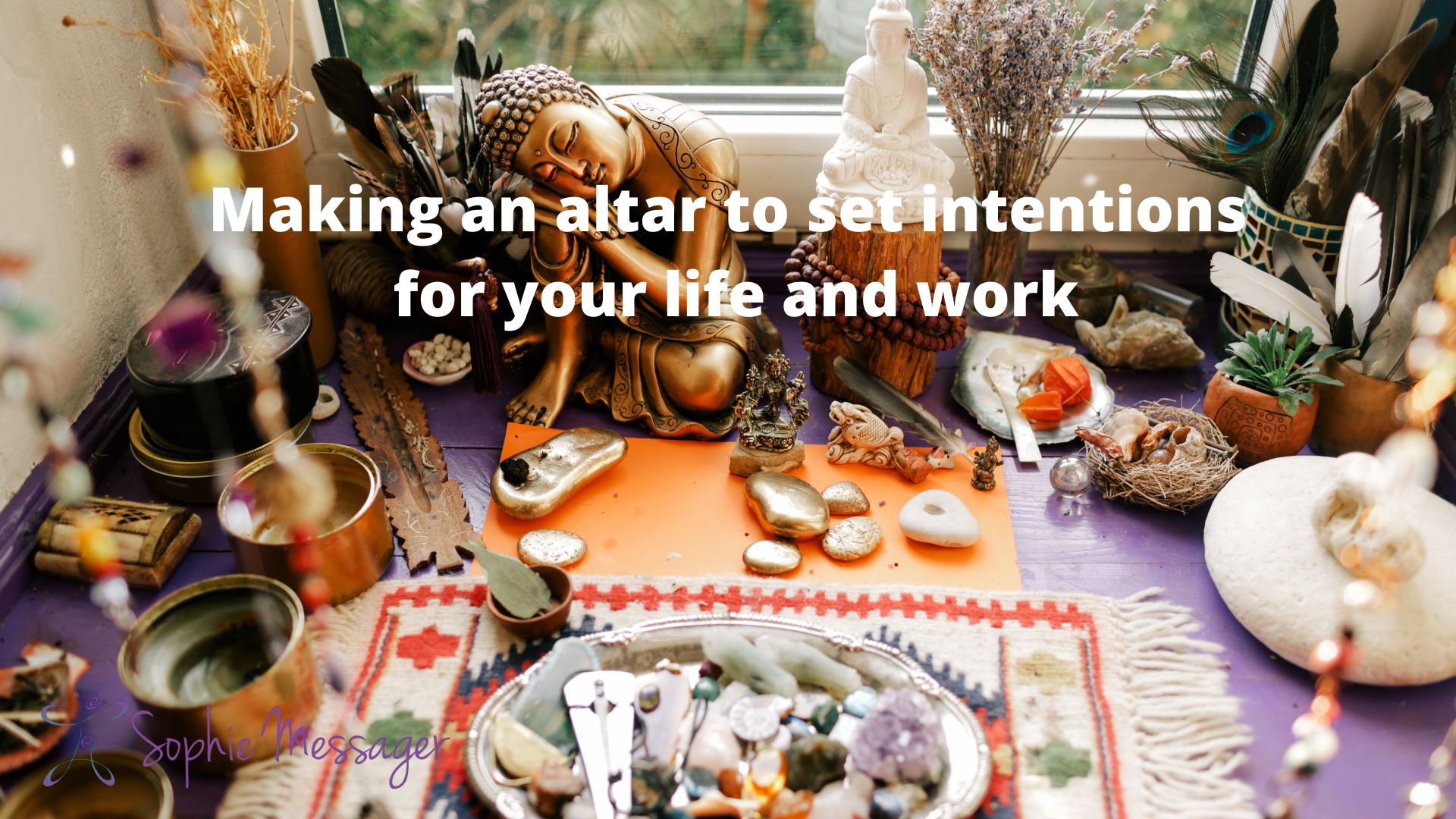
  • Making an altar to set intentions for your life and work

    Making an altar to set intentions for your life and work

    If you want more spirituality in your life, more meaningful ways to connect to yourself and your inner voice, and the world around you, and a more feminine way to set intentions and goals, have you ever tried creating an altar?

    I started by creating a season table to help my children visualise the turning of year many years ago, when they were small. Over the years it slowly morphed into an altar. In fact I have several altars in my house. I use them to help me focus on what I want to bring more into my life, and to remind me of tuning in, and of what is important to me right now.

    Creating an altar is a bit like creating a vision board. It is like a 3D vision board. It is a way to give form to your desires and to help you stay on track with what you want to bring more of in your life. It also helps me to bring more spirituality into everyday life.

    What is an altar?

    • The Merrian Webster dictionary defines an altar as ā€œa table or place which serves as a center of worship or ritualā€.
    • I believe that our lack of rituals leaves us feeling disconnected to ourselves and to each other. We need spirituality in our lives the way we need food and water, lest we feel longing and emptiness.
    • When I visit cultures where spirituality is stillĀ  part of everyday life, such as my husband’s birth place of Hong Kong, I notice that people have little altars everywhere, and that they aren’t restricted to places of worship. You find them at the entrance of people’s homes, as well as inside. People place offerings on these altars, such as flowers or fruits, and often burn incense.
    • For me an altar is a way to give form to your connection to your own desire for spirituality and connection.

    How do you make an altar?

    • An altar can be simple or intricate. It doesn’t really matter. What matters is that it feels true and good to you. Often, less is more.
    • It can, but doesn’t have to, include religious symbols or figures. The most important thing is that it resonates with you.
    • It can be as simple as a picture or a card, and a candle. You could put in on a mantle piece, a windowsill, or a shelf.Ā 
    • It can include objects, such pictures/cards, figures and stones that feel special to you, and/or that represent something that you want more of in your life, or in the life of your loved ones. It can include some form of incense (or an essential oil diffuser).
    • You could also choose to include objects to represent the four elements : air (feather), fire (candle), earth (stone), and water (a cup or small bottle with water).
    • It can be permanent or temporary, and it can be made in nature as well as indoors. When I drum in the woods with my drum sisters, we co-create an altar from a mix of personal objects and things we find in nature (it’s different every time), and animal cards. We remove it after we are done drumming. Many of the outdoor dances and retreats I have taken part in involve the creation of a community altar. A mandala made from objects found in nature could be considered an altar.
    • I usually make an altar when I teach ritual workshops or when running mother blessings.

    What do I use on my altar?

    Here is a list of everything I placed on my latest one. My altars change according to my focus and mood, and throughout the year too (I aim to refresh it every 3 months or so). I love magical objects and I have accumulated a rather large collection over the years, so please do not feel that you have to copy me, I only provide this list for inspirations and ideas:

    • A cloth to cover the table
    • Bear totem,Ā  cards, framed picture, altar cloth, wand, stone and drum beater by Jaine Rose (can you tell I’m a fan of her work?)
    • Healing doll, and custom drumming doll by Fabricsoul
    • Clay dish by Eslpeth Owen
    • Miniature Amma doll (blessed by Amma)
    • Various crystals
    • Phoenix Egg (homemade gift from a friend)
    • Triskel painted stone
    • Items found in nature : seashell, hagstone, staurolite, feathers (Heron, swan, Macaw)
    • Small clay dish made by my daughter
    • Painted stones
  • Do you long for more sacredness in your life?

    Do you long for more sacredness in your life?

    Do you long for a more meaningful life, for a sense of connection to something bigger than yourself? Do you feel this longing in your heart, in your bones? Like something is missing but you don’t know what? Do you have this deep knowing inside that life is meant to feel bigger than it does for you now?

    I used to feel the same. I can still see myself witnessing my first closing the bones ceremony and wishing it was me on the floor receiving the ritual. I can still feel the excitement, as I attended my first doula retreat in 2013, how beautiful and sacred it all felt, and then how much returning to my normal life, especially with 2 young children to care for, felt so bland, so lacking in connection and full of drudgery. I longed to go back to the feeling that this amazing, spiritual retreat gave me.

    Now I know that the issue was that I was looking elsewhere, outside of myself, for the sacred. The issue wasn’t’ with the lack of sacred in my life, but with my narrow view of what constituted sacredness.

    When I attended women’s circles, red tents, retreats and such like, something in me believed that the ā€˜sacred’ only happened in this limited container. What took me a long time was to learn to weave the sacred in my everyday life.

    I had the same issue when I started to learn to meditation because I believed that meditation only happened sitting on a special pose on a special cushion in a special room. I was unconsciously victim of a culture that puts form over substance.

    I was missing and longing for more sacredness partly because it IS missing from most of our culture, but also partly because of my own unconscious and narrow definition of what the sacred was.

    It has taken me a long time to create a sense of sacredness in my daily life, in a way where it feels natural and normal and simple. There is a sayingĀ  I love : ā€œBefore enlightenment, chop the wood, fetch the water, after enlightenment, chop the wood, fetch the waterā€ which illustrates this beautifully.Ā 

    As I explained in my previous blog about mother blessings, I started offering such ceremonies to meet my own, and my community’s needs for more rituals and sacred celebrations.Ā 

    I also pursued my own energy healing training, as a Reiki , then Reiki Drum practitioner, then teacher, first and foremost to fulfil my own longing, and for my own development. What came from it though was a lot more than I had hoped for, as it started to reconnect me to my own sense of the sacred.

    I wanted to be part of a shamanic drum circle. There wasn’t one locally so I started my own early in 2020. I had assumed I would gather a handful of friends who already had a drum, so it was a surprise to see that most people who attended didn’t own a drum nor had taken part in a drum circle before. And it was also a surprise to find a lot more people attending than I had expected. Clearly those people also experienced my longing for spiritual connection in community. The pandemic meant that I ended up running circles in a physical venue, then online, then outdoors in the woods, then in a friend’s garden, all of which were diverse and rich experiences which deepened my practise. Now I’m planning to run them in a new venue in the woods, near Cambridge, in a private woodland.Ā  We will drum around a fire and maybe even in the beautiful geodome built by a dear friend of mine. Feel free to contact me if you’d like to join us.

    In 2020, I started a practice of drumming in the woods at dawn weekly or more with 2 other women. We have drummed in all weather, including in driving rain and in the cold and dark before dawn in winter. I am grateful for owning a synthetic drum which can cope with the changing weather! We are still doing it 2 years on. We make an altar, set intentions, smudge, drum, and then we sit down with a flask of tea to chat about more mundane things. I love it.

    The other 2 practises that have transformed my life in terms of sense of connection are year round wild swimming in the local river (read about how I started that here) and 5rhythms dancing.

    Since the Autumn of 2019, every Friday night, I have danced with the Cambsdance community. We dance 5rhythms, ecstatic dance, freedom dance, open floor and other forms of conscious movement. There are no steps, or ā€˜right’ way to dance. Teachers bring a playlist they have created, which moves from slow and flowy music to fast, strong paced music and back again. They hold the space gently, providing limited guidance, a few words here and there to remind you to pay attention to your breath, or your feet, or another body part, or to each other. All that is required is to dance according to what is moving inside of you. It is a moving meditation, in community with others people who also love to dance. It lasts a couple of hours. It is the antithesis of clubbing. There is a wise range of ages and genders, a range of cultures and styles. Everybody dances in their own unique way, and nobody gives a fuck about what you look like when you dance. It is one of the most liberating practices I have taken part in. It is joyful and beautiful and oh so transformative. You can dance your joy, your grief, everything is welcome. It was a big part of my recovery when I suffered from depression in 2019.

    Some of the dancers have become close friends, with whom I take part in regular community gatherings, celebrating the wheel of the year, and generally connecting as humans in a simple, fun and loving way. I especially love that all the gatherings are drug and alcohol free. We are high on connection, feel good hormones and love. There is often some dancing involved, and singing and drumming too.Ā 

    I have been reflecting on the fact that all cultures around the world used to have 3 practices that belonged both to everyday life and to the sacred. But here, today in the modern world, we think that only special people, gifted people can do them. These practices are singing, drumming and dancing.Ā 

    Having taught workshops that involve a big element of spirituality since 2014, I have witnessed the same longing in others again and again, especially when leading people throw circles and ceremonies.

    This longing I sense in others is why I want to offer more ceremonies, more mother blessings, more drum circles, more intuitive healing, and teach more rituals (such as the postnatal closing ritual). We need to create new rituals for our modern times. A sense of spirituality is as important to wellbeing as eating and drinking.

    As I explore what sacredness means to me in my everyday life, I encourage others to follow their own journey of reintroducing sacredness to their own lives.

    If you feel the same longing in your heart and you want to create a more beautiful life for yourself, listen carefully to what your heart is telling you. We aren’t meant to live such disconnected lives. You deserve a life where you feel more connected to yourself, to your community and to the world around you. Start small. Be gentle. Try things and see what works for you.

    ā€œThe worst thing we ever did
    was put God in the sky
    out of reach
    pulling the divinity
    from the leaf,
    sifting out the holy from our bones,
    insisting God isn’t bursting dazzlementĀ 
    through everything we’ve madeĀ 
    a hard commitment to see as ordinary,Ā 
    stripping the sacred from everywhereĀ 
    to put in a cloud man elsewhere,
    prying closeness from your heart.
    The worst thing we ever did
    was take the dance and the song
    out of prayer
    made it sit up straightĀ 
    and cross its legs
    removed it of rejoicing
    wiped clean its hip sway,Ā 
    its questions,Ā 
    its ecstatic yowl,
    its tears.
    The worst thing we ever did is pretendĀ 
    God isn’t the easiest thingĀ 
    in this UniverseĀ 
    available to every soulĀ 
    in every breath”

    ~ Chelan Harkin, in poetry book ‘Susceptible to Light’

  • Why I offer mother blessing ceremonies

    Why I offer mother blessing ceremonies

    I would like to tell the story about how I came to offer mother blessings ceremonies and the journey that led me to do this in the hope that it may inspire others to do the same.

    I’ve always had an intuitive sense of the lack of ceremony and rituals, and sense of everyday sacredness within our culture. And I’ve had a longing for it all my life.Ā 

    I was raised a Catholic. I left this faith behind as a teenager as it didn’t feel right for me. I noticed that, after leaving the church, I was left with nothing in terms of spiritual life. As a culture, it seems to me that we have squashed our innate wonder and unique sense of spirituality and that it’s only allowed to fit in the neat boxes that belong to organised religion.

    It took me many years to re-create a spiritual life that fitted my unique self, and becoming a doula was a big part of the process.

    In 2013, during my first year as a doula, I attended a doula retreat. There I learnt the closing the bones ritual and attended a shamanic drumming workshop. After the retreat I had a deep longing to create more sacredness in my life. I found the return to normal life, especially with 2 small children to look after, full of drudgery and so lacking in the connection I had experienced during the retreat. A doula at the retreat had mentioned that I could create the sacred in my everyday life, but I didn’t know how to do this. My desire to create community ceremonies came from this longing, and to fulfil this need for myself and for my community.

    When I completed my mentored doula journey in the Autumn of 2013, I didn’t want to celebrate with just a meal, but have a meaningful ceremony instead. I asked a couple of friends to help design such a ceremony for me. The ceremony, a small intimate affair with my doula and my doula mentor, and a doula friend, was perfect. I then used the same process to organise recognition ceremonies for other local doulas.

    Altar centerpieceI started offering mother blessings in 2016 to local doulas because I felt that doulas gave a lot to their clients but rarely received the same attention themselves. I felt very strongly that they should be celebrated and nurtured by their community when expecting a baby themselves. You can read about such a gathering in this blog.

    I was blessed to lead many beautiful blessing ceremonies, and sometimes even organised for the same group of women who came to the mother blessing come back after the birth to do a group closing the bones ceremony.

    I had impostor syndrome, so I spent about 3 years doing mother blessings for free to doulas, friends and clients before I felt ready to offer it as a paying service. Even then, when I did get booked for my first paying mother blessing, I worried that my client would not find it good enough. However, she loved it, and she was very happy to pay for it.Ā 

    I’m not someone who does things by half, and I poured my heart and soul into preparing for the ceremony, spending many hours researching activities, discussing options with my client, and preparing equipment to bring to the ceremony. All in all I think I spent well over 15h for this blessing between the prep and the blessing itself.Ā  I hadn’t realised how time consuming it would be and I put my price up afterwards. Luckily my first client was also self-employed and reminded me to make sure I charged her for the time I spent with her on emails and phone calls as well as the face to face meetings.Ā 

    Soon I found myself doing a lot of mother blessings. I loved that, with each new experience, I would learn new things to add to my repertoire of options. One woman asked to have a collage activity to create a vision board for her birth, and I love it so much I have done it ever since.Ā 

    I also learnt about the importance of offering options and let the person choose rather than imposing my kind of ceremony. There was a Christian doula who wanted to make sure nothing in the ceremony would clash with her religious beliefs. There was a client who wanted the full hippy ceremony complete with red fabric, red clothes, smudging and drumming, and painting her belly with henna. There was a client who loved the idea of the a very hippy affair for herself,Ā  but knew that her family members would be put off by it so we toned it down, replacing the smoke smudging by creating a bespoke auric spray, and having a very simple, low key decoration. There was a woman whose partner was very sensitive to smells, so instead of using smoke or sprays, she made little individual essential oil roll-on bottles for people to apply to their wrists at the beginning of the ceremony.

    Last year I organised a ceremony for a pregnant friend, and her partner went off with the rest of the men had their own father blessing in a different location, then we all came together for a meal afterwards. I found this particularly lovely.Ā 

    I also ran the biggest group I had ever run, with about 25 people in a building within a private woodland, with another doula friend to help me, and it was beautiful and very spiritual.Ā 

    Now, with several years of experience behind me, running these ceremonies feel within my comfort zone, and I have so many options and ideas to offer that I can easily create a beautiful bespoke ceremony.

    In 2021 I ran my first live workshop on how to run mother blessingsĀ  for a group of doulas and midwives. I loved teaching it and I got incredible feedback from my students. Several said that they’d found it the best workshop I had ever taught, and that it was hard to believe that I was teaching it for the first time. Here is some of the things they said:

    • ā€œI loved the beautiful energy you created hereā€
    • ā€œThe experiential learning was fabulousā€
    • ā€œI particularly liked the circle energy, the flow, and the drumming, it was all beautifulā€

    I decided to teach people how to offer mother blessings because I want to encourage more sense of sacredness into the lives of pregnant women, more celebration centred towards them and more community building, as well as help put in place postpartum support in place by gathering pledges of support during the ceremony. I’ve just launched a new online course to spread this even further, and I’m delighted to report that I have students from all over the world booked on the course.https:https://sophiemessager.com/how-to-run-a-mother-blessing.

    Today I charge clients but I also still do free ceremonies for friends. I did many of these in 2021. In one of them I remember driving a long distance and asking myself why I’d agreed to do this. However, the ceremony itself was so touching I was moved to tears (and so were all the other guests in the room including the mother’s mother, who told me afterwards that she had found in extraordinary). It made it so worthwhile and left the gathering with a very full heart.

    What do I love about mother blessings? I love that it creates a sense of community and support around the expectant mother. It gives me joy. It make the mother feel very loved and special, and it makes everyone who attends feel this way too. I love that it helps put community support in place for after the birth too. I love that the feeling of belonging lasts beyond the ceremony. I love wearing the red thread on my wrist as a reminder until the baby has been born, and I love telling everyone to light their candle when we hear that labour has started. Most of all I love that I help bring a sense of wonder and sacredness back into people’s lives.

    I love that it spills over into the rest of my life and how I often use some of the honouring activities (like washing someone’s feet and massaging their hands and feet, or telling someone what we love about them) as part of the birthday celebrations of my friends. I love that, with mother blessings, we can help start a cultural shift from a culture where all the attention is focused on the baby, towards one that is more mother centered.
    Understanding what attending such a ceremony feels like isn’t something you can be told about. You have to be there to get it. Often, guests approach me at the end of the gathering to tell me how they had never taken part in something like this, and how much they loved it.I love giving people a positive experience that will remain with them for the rest of their lives.

    How does this post make you feel? Does it resonate? Have you have a mother blessing, wished you had one, or taken part in one, or led one? Please comment below. I would love to hear what you think.

  • Baby shower? Have a mother blessing instead.

    Baby shower? Have a mother blessing instead.

    What is a mother blessing?

    You probably have heard of a baby shower, but have you heard of mother blessing? It is a celebration and honouring of a woman’s transition into motherhood. A mother blessing is a celebration that takes place during pregnancy and which is designed to celebrate and support the mother and her upcoming birth and postpartum period. Contrary to a baby shower, where all the focus and presents are on the baby, a mother blessing places the mother at the centre of the attention and support. It is a gathering, usually of women, coming together to celebrate the expectant mother, to honour her and give her loving attention, good wishes and support for the birth and the postpartum period.

    I wrote about this in the past  but I want to expand and explain the process a bit more, as I have gained a lot more experience in running these rituals.

    What happens during a mother blessing?

    Altar centerpiece

    There is no prescriptive recipe. It is about having a gathering to celebrate the mother in a way that feels good for her. The most important aspect is that she feels loved and nurtured, and that the event is tailored to her needs. I used to think that mother blessings where always a hippy affair, but I have come to realize that, whilst they are powerful and spiritual in nature, it is not the way they look like that makes them special but rather it is the intention behind it and how people come together to hold it.

    Offering mother blessings through the years has taught me a lot. For example I organized one for a mother who is Christian, and she was worried that the event would involve spiritual aspects that would be incompatible with her religion. I reassured her that this wouldn’t be the case and that we would make sure that what happened was in line with her beliefs.

    A mother blessing is a gathering a friends and family of the mother. Here are some simple logistical aspects to think about:

    • Discuss the gathering with the mother
    • Plan the structure of the gathering, with a beginning, middle and end
    • Choose a venue and date
    • Invite the guests
    • Ask people to bring things to share such as reading a poem, or a singing a song, and meaningful gifts for the mother, and something to eat at the end
    • Run the event

    Here are some of the things I like to do to make a mother blessing special:

    Setting up the space

    I like to make the space special with colourful fabrics, flowers, candles, and lovely smells and sounds, like a sanctuary. Be guided by what the mother likes and tailor the level of woo accordingly.

    Starting the ceremony

    I like to have a simple ritual to mark the beginning of the ceremony, such as smudging or ringing a bell. Start the process with a short sharing circle, for example, having everyone introducing themselves saying their name, the name of their mother and maternal grandmother (in my case: I am Sophie, daughter of Michelle and granddaughter of Jacqueline).

    If it feels right, singing a short circle song can be lovely too. For example, I like the song The river is flowing.

    The ceremony itself

    Here are some simple ritual activities to build into the ceremony can involve:

    • Ask everyone to bring a bead to give to the mother. As each person presents her bead, they explain why they chose it, and what it represents. The beads get threaded on a string to make a necklace that the mother can wear or use like prayer beads during labour or the postpartum to remind herself of the circle of support around her.
    • Pass some wool or string around the circle and have everyone wrap it a couple of times around one of their wrists. Once everyone is bound by the thread, pass scissors around to cut it and have everyone knot the thread around their wrist or ankle and keep it until the baby has been born.
    • Gift a small candle (like a tealight) to everyone, and a bigger one to the mother. When the mother goes into labour, people will be notified (for example in a WhatsApp group) to light their candle and send love and good wishes for the birth.
    • Have guests read texts, poems or sing songs (some lovely examples here)
    • Do something nurturing for the mother, for example massaging her hands or feet.
    • Have people bring or pledge some gifts for the mother for the postpartum. For example vouchers for postnatal massage or closing the bones ceremony, postnatal doula vouchers, food delivery, feel good products like postnatal herbal baths or massage oils, promise to come and clean her house/hold her baby whilst she sleeps etc.
    • Have a final sharing circle at the end.

    Finally, have some informal time afterwards to share food, some tea and cake (a groaning cake would be lovely) or a potluck meal. It is always lovely to have some informal chatting and eating time after the ceremony.

    What are the advantages of having a mother blessing?

    The main point of the mother blessing, besides making the mother feel loved and cherished, is to redirect the focus of the support towards the mother rather than the baby. Encouraging the mother to write a postnatal recovery plan, and/or using said plan to ask friends to provide pledges for the postartum is a good way to think ahead about what the mother might need after the birth (you can use my free postnatal recovery plan download as a template for this).

    Beyond the mother herself I have found such ceremonies deeply moving for the facilitator and for all the people involved in the gathering. Western societies lack rituals to celebrate life transitions, and bringing this back into our culture is very powerful and meaningful. People often say that they had never taken part in something like this and how much they loved it, and wish they had one themselves.

    I especially love to bring the whole process full circle, by bringing back the same group of people to honour the new mother a few weeks after the birth in a closing the bones ceremony.

    In 2020 I have also participated in mother blessings over zoom. The process was the same e xcept that we sent cards and beads by post ahead of time. It was still very special and meaningful.

    I am offering an online course on how to run mother blessings.

    Here is a short video showing snippet of mother blessings and workshop I have run in the past

    Play

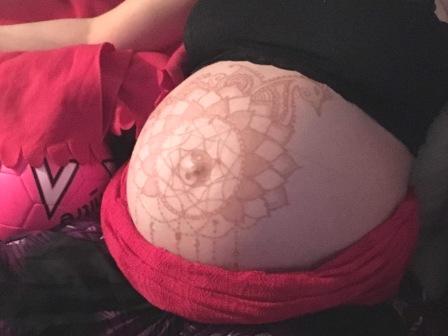
    (The Henna tattoo belly painting on the main picture, was designed by Jo Rogers as part of a mother blessing)

  • Ceremonial birth food

    Ceremonial birth food

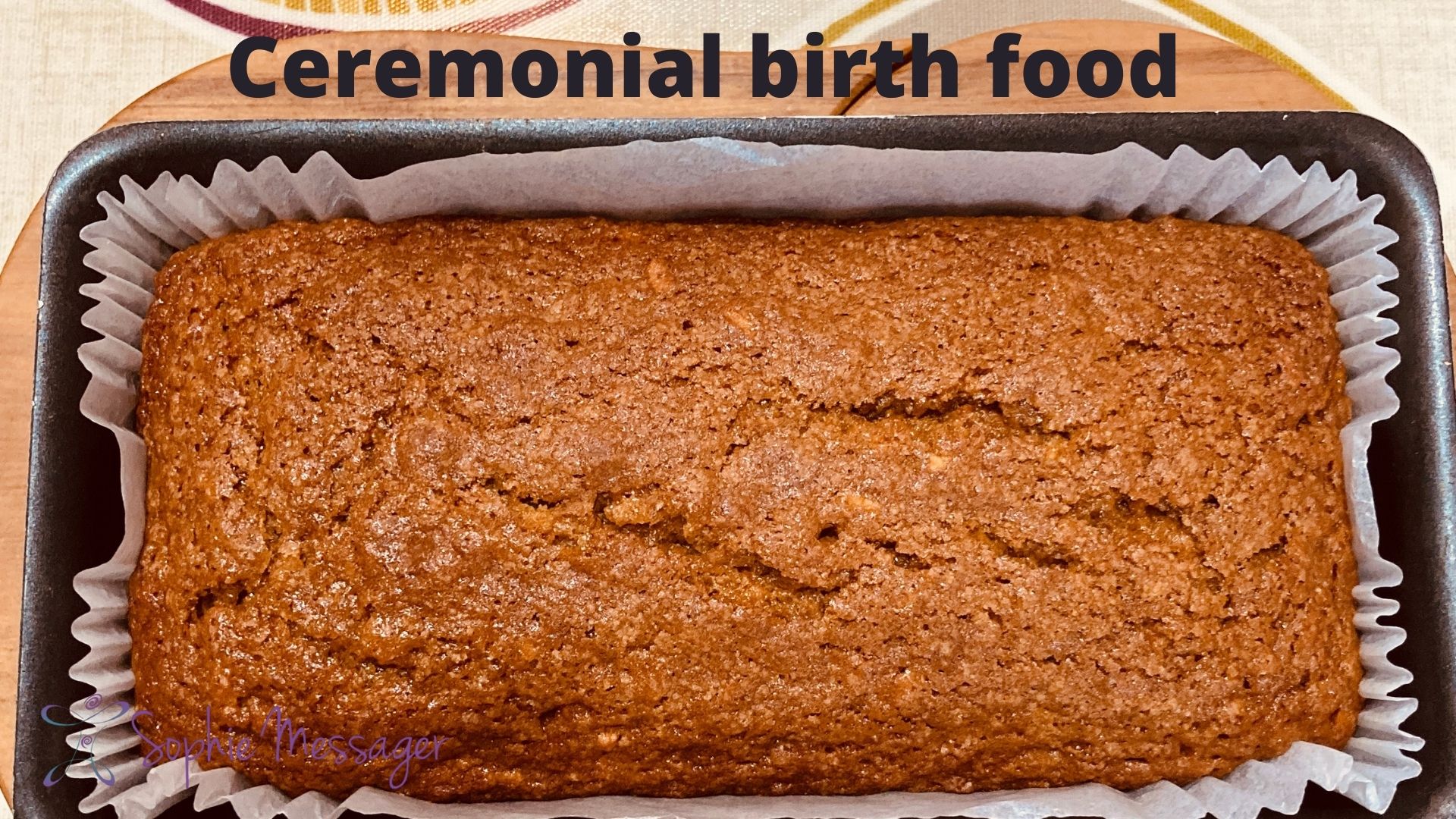
    I have baked groaning cakes for my clients for nearly ten years, since I came across it in the book The Birth House. Before I go on-call for a birth, I bake the cake, and then I freeze it, ready to take with me to the birth when I get the call. Most of the time, with the exception of a couple of super speedy births, the cake is thawed by the time the baby arrives, and I offer the cake to the mother as her first food after the birth (I offer some to the midwives too). I also bake this cake for my postnatal clients.

    It had never occurred to me that this counted as ceremonial food.

    Many of us are blind to our gifts, and take for granted the things we find easy. Baking is such a thing for me. I have loved baking for as long as I can remember. I was baking on my own by the time I was 8 years old. When I moved to university, I had to teach myself to cook savoury food because the only things I had cooked until then were cakes and sweets. Throughout the years I have loved making cakes for people. When I am asked to contribute to a shared meal, bringing something sweet is usually my first choice.

    When something comes easily to us it is easy to forget the love and care we put into it.

    Last week I was chatting with my friend Amanda. I complimented her on the love and care she puts in the stews she cooks. I told her about my groaning cake tradition, and she pointed out that this is ceremonial food. Her words had a big impact on me, because I had never stopped to consider that this was the case.Ā 

    I realised that, for me, ceremonial food was something that happened in a ā€˜special context’, like at a retreat. For instance I have taken part in cacao ceremonies run by others, and this counted as ceremonial food for me. Recently I attended a Cacao ceremony and I was excited because I thought that this was the first time that I would be taking place in a ā€˜proper’ cacao ceremony. Only when it happened I realised that I had already attended several similar ones, and that what I had labelled as ceremony in my head was a very narrow, restricted label.

    I find it fascinating how we pigeonhole things in our heads, despite ourselves, and define whether they fit or not, whether they are worthy. What is ceremony? What is sacred? If not simply the intention put behind the action and the care taken to do it mindfully?

    Until now, had never considered everyday food as ceremonial.

    Reflecting on this was very powerful for me. Many years ago I used to believe that spiritual magic only happened in retreat spaces, outside of the drudgery of everyday life. After attending retreats, I always found re-entering my normal life, especially with small children, hard, full of drudgery and somewhat boring. I longed for the feelings of specialness and connection that came with the retreats. A friend told me that I needed to bring this magic in my everyday life. I didn’t understand how this was even possible and dismissed it as ridiculous. I just didn’t know how.

    A few years ago I started paying attention to the small moments of grace and magic in my life and I finally understood what she meant. It had been right in front of me the whole time, the grace, the beauty and the magic, but I just couldn’t see it, because my mind had put a narrow label on it. Starting a daily gratitude practise really helped.

    In her book, Dare to Lead, Brene Brown use the analogy of a marble jar to symbolise building trust. When someone does something that makes us feel good, it adds a marble in our jar. She is surprised when she asks her daughter, what adds marbles to her jar, because she expected her daughter to talk about grand gestures, but it’s just tiny everyday little things, like someone remembering your name, or something important happening to you, on which trust is built. Brene tells of her research in the topic:

    ā€œAs a researcher, I start looking into the data. And it is crystal clear. Trust is built in very small moments. And when we started looking at examples of when people talked about trust in the research, they said things like, ā€œYeah, I really trust my boss. She even asked me how my mom’s chemotherapy was going.ā€ ā€œI trust my neighbor because if something’s going on with my kid, it doesn’t matter what she’s doing, she’ll come over and help me figure it out.ā€ You know, one of the number one things emerged around trust and small things? People who attend funerals. ā€œThis is someone who showed up at my sister’s funeral.ā€

    You can read the full story here.Ā 

    With food it is the same. What makes it a ceremonial, jar building process, is that it someone has made it for you for a special reason.

    Have you ever eaten food that has been cooked especially for you, and found it to be really special? Have you ever had this feeling that it was more than just food, that it was imbued with love? That it nourished the soul as well as the body?

    I remember eating such foods several times in my life. When I gave birth to my daughter, my midwife, Siobhan, brought a fruit cake she had baked for me. This was the first thing I ate after the birth, and it tasted like the most delicious thing I had ever eaten.

    Once, unexpectedly, a Chinese mum at my children school gifted me a Pandan cake she had baked especially for me. She said that I deserved it for all that I did for new mothers. I was very surprised, and very touched. This cake has also become a family favourite, and, when my new Chinese neighbours moved in a few weeks ago, I baked them the very same cake to welcome them. Kindness has a way to pay it forward.

    I also remember times in my life when I cooked food with love for others, in situations where nourishing was needed.Ā 

    When I was pregnant with my son, a new friend from my antenatal class gave birth unexpectedly at 32 weeks pregnancy. I visited her in the NICU, and I brought her a box of homemade beef bourguignon, because I knew that hospital food wasn’t the tastiest food, and I wanted to do something caring for her. 16 years late, Suzanne and I are still friends, and she recently told me that she still remembers that, out of all the people who visited, I was the only one who brought a casserole. Until she spoked these words, I hadn’t realised how much of an impact it had on her.

    More recently, my friend Amber was sick with Covid. I made her a traditional postpartum dish of a Chinese chicken and red dates soup for her, and I left the soup on her doorstep. Two years later, she tells me she still remembers how nourishing it had felt for her.

    It is easy to dismiss and to forget, but ceremonial food isn’t just something that happens in spiritual spaces and retreats. More than the special space in which it is shared, it is the intention behind creating the food that makes it sacred.

    Now that I know this, I look forward to putting even more intention when making nourishing food for others. I want to try and bring more of this in my everyday life too, when I cook for my family.

    I invite you to do the same. As you bake or cook for your clients, your friends or your family, tune into the intention and the love that you are imbuing into it. You too can make ceremonial food and bake sacred cakes. All you need is intention.

  • Why I created a postnatal closing ritual online course

    Why I created a postnatal closing ritual online course

    Everywhere around the world, there used to be a period of about a month after birth during which the new mother was taken care of completely. Members of the family or the community used to take charge of the household (chores, older kids etc), make sure the mother rested, provided specific nourishing foods, and well as give or organise some postpartum specific bodywork. It was a ubiquitous practice in every continent (and still is in many parts of the world today). This used to be part of Western culture too.

    I published my book, Why postnatal recovery matters, in order to start and support a movement towards returning to a nurturing postpartum. In my book I explain that a nurturing postpartum boils down to 4 pillars: social support, rest, food and bodywork.

    I have become acutely aware that bodywork seems to be the most neglected part of the 4 elements of postpartum nurture. I have started working towards creating courses to rectify this. The first of these course is the rebozo massage and closing ritual online course.

    Learning postpartum rituals such as the closing the bones massage was instrumental in my journey towards writing the book. I have given this massage to hundred of women since I first learnt it in 2013. I have also taught this massage in live workshops since 2014 and trained several hundred people in giving this ritual. I also co-created a new version of this massage, called the postnatal recovery massage, with an osteopath.

    Prior to 2020 I was asked many times to teach this remotely, but I felt I couldn’t teach this ritual without being physically present because of the need to adjust position and pressure whilst doing the hands on part of the massage. With the 2020 lockdown and many teachings moving online, and the publication of my book, the number of requests intensified, but I still felt I couldn’t do it justice without being present.

    Several events contributed to changing my mind. Firstly, as a doula, during 2020 I found myself having to teach rebozo techniques to couples via a mix of sharing video links and live zoom sessions. This taught me that it could be done quite well remotely. On several occasions, because partners restrictions meant that I couldn’t be in hospital with the couple I was supporting, the partner called me when there was a stall in labour. By suggesting positions and techniques, I found that several babies being born without obstetric interventions. These experiences showed me that remote learning could be very effective. Secondly, because of the isolation brought by lockdown, I saw new mothers suffer emotionally and physically more than ever before, with almost no access to support or physical therapists. Giving closing the bones to them showed me that this ritual was needed more than ever. Thirdly, I took part in trainings offering by other practitioners online which were only available face to face before, and in particular online rebozo training with Mexican Midwife Naoli Vinaver. I saw power in this, because, suddenly, I could learn from people anywhere in the world, and the learning was still powerful despite the remote aspect.

    However, I still felt that I couldn’t teach the ā€œhands on skinā€ massage part of the ritual remotely because it required precise observation and correction, so I had to create something new.

    Over the last couple of years I have supported new mothers who struggled with pain post caesarean, and whose belliesĀ  were too tender to massage so soon post surgery. I adapted the massage and used rocking and wrapping techniques with the rebozo only rather than my hands to provide comfort and relaxation. I found that this was still a powerful and effective ritual.

    The online course I have created, over a period of a year, is extremely extensive in content. I pre launched the course to a group of early adopters in 2021, and receiving feedback from them means that I have extensively refined the process (for example I reshot several videos based on what people told me that wanted to understand better, or when something wasn’t clear).

    The course also contains much deeper content in terms of preparation, equipment, and creating ceremony than any live courses I have taught, because I wasn’t limited by timing. The course includes an entire module on creating ceremony, ritual and sacred space. This is one of the most beautiful and important aspects of the rebozo massage and closing ritual. What you get is based on my years of experience as well as years of listening to questions about it from live workshop trainees. This is he first time that I am teaching this aspect in such depth. You will learn how to be attuned to your intuition to hold space and allow whatever needs to be expressed. This is a creative and sacred process that adds much to the experience for both you and the mother.

    I want to make sure that there is enough interest in this course before putting more energy into it starting it, and I also want to be able to run ideas via a group of early adopters as I develop the course, so I’m offering the future course as a pre-sale to early adopters for a discounted price.

    You can find out more about this here.

    Here is a video showing what the massage and ritual process looks like.

    Play

  • The postnatal recovery massage: a modern adaptation of a traditional ritual to nurture new mothers

    The postnatal recovery massage: a modern adaptation of a traditional ritual to nurture new mothers

    Since January 2019, I have taught a new postnatal massage called the postnatal recovery massage, together with osteopath Teddy Brookes.

    I want to tell you the history behind why and how we created this massage.

    It is very much needed, because in the Western world we no longer offer bodywork as standard to help new mothers heal during the postpartum. Yet, given the tremendous changes a woman’s body undergoes during pregnancy, birth and the postpartum, this is absolutely crazy. Read more on that in this blog post. https://sophiemessager.com/why-postnatal-bodywork-matters/

    The seed for this massage (and my book, Why postnatal recovery matters which includes a chapter on postpartum bodywork) was planted when I learnt the closing the bones massage, a traditional postpartum massage from South America, in 2013. People asked if I could teach them so I created a workshop and starting teaching it to birthworkers.

    It grew organically and together with a couple of other doulas, I ended up training over 500 people in offering this amazing nurturing ritual. I shared this knowledge in the hope to change the face of the postnatal support, towards a more mother centered and nurturing time.

    I have a theme in my professional life, in that almost always end up teaching stuff because people ask me to. Since discovering the Human design system, it makes sense to me because it is in my design to respond.

    After a few years of teaching closing the bones, more and more people who had trained with me asked if it would be possible to provide a version of the massage on a massage table instead of on the floor, because they had bad knees, or bad backs, and found working on the floor difficult.

    I’d learnt a lot from practicing the massage on my local osteopath friend Teddy Brookes (he provided all the anatomical and effectiveness knowledge for the closing the bones workshop handout, and therefore already knew the technique inside out), so it made sense that I asked him asking if he liked the idea of helping me develop a massage table version of the ritual.

    Teddy was enthusiastic about the idea and we started working on it in 2017. We are both perfectionists and it took us over a year and many sessions of practice and trial and error to get it right.

    At the beginning, I wanted to create the exact same treatment on the table as we did on the floor. However, the biomechanics of doing something from the side rather than standing over the person, meant that some things simply couldn't be done in the same way.

    Some techniques worked mechanistically but didn't feel good so we discarded them. It was at times a frustrating, but mostly an exciting exploration and experience and a huge learning curve for me, especially as Teddy also educated me on how to position and use my body for more power, less effort, and increases effectiveness around the table.

    As we progressed we also ended up modifying and adding several elements to the massage based on my experience of body changes in the postpartum that weren't treated as part of the original massage. For example I had noticed that new mothers often had flared ribs post birth, as well as hunched shoulders from feeding and holding their baby, so we added some new techniques to treat these.

    In the end we ended up with a massage which, whilst inspired from the original technique, was really quite different. Ā We named it the Postnatal Recovery Massage (PRM).

    We had our first practice on a group of birthworkers and therapists in Autumn 2018, and they all loved it.

    We started teaching it in January 2019. As of now we have run 10 workshops and trained 90 people in offering this massage! As our 11th workshop is planned for this month we are hoping to reach 100 trainees who can offer this amazing nurturing treatment to new mothers.

    Here is some feedback from people who have attended the workshop:

    ā€ This new version of the postnatal ceremony blends effective rebozo (shawl) massage techniques and lymphatic drainage massage to support post natal mamas. Rather fabulous it is too!ā€ Emma Kenny, Massage therapist.

    ā€œOne of the reasons I like the massage that you have developed for the table as it feels like a modern way of adapting the traditional massage. It feels like a new technique, a therapists technique. I also like being able to connect to the anatomical benefits. I want to practise giving the massage and feel newly inspired.ā€ Katie Oliffe, Doula

    “What a wonderful, professional, well constructed and instructive course with plenty of time for step by step practical, complemented by Teddy’s expertise and Sophie’s organic shamanism and such a wonderful community of like minded body workers. Thank you. Thoroughly recommended” Jenni Tribe, Therapist

    “Thank you so much for an informative and inspiring day. I can’t wait to use the techniques on my clients and support women more effectively. You are doing an amazing work and I’m so grateful ad excited to be part of it!” Grace Lillywhite, Pilates teacher.

    “I loved this course. It is just as nurturing as the closing the bones massage but much easier to do. Sophie and Teddy worked amazingly well together” Michelle Parkin, doula.

    “The course was well organised, very informative and easy to follow. The level of practical support was fantastic and I feel confident to take what I have learnt and help local women postnatally. Thank you!” Becki Scott, doula and massage therapist.

    “Amazing workshop! Loved being in a small group to work through techniques in enough details. As an osteopath this experience has been invaluable in improving my practise if postnatal patient , in fact all of my patients!” Rob Ballard, osteopath

    ” The massage is a wonderful reworking of the traditional Closing The Bones massage performed on a couch rather than the floor. Sophie and Teddy have taken all that is special about it and fused her energy-work approach with his osteopathic technique to create something extraordinary. It incorporates binding, rocking, jiggling and specific tension releases, with massage of the chest, abdomen and pelvis with warming oil. It is truly a celebration of the postpartum body!” Charlotte Filcek, doula.

    “The tutoring, the technique, the group, just exceptional!” Alison Duff, therapist and therapy centre owner.

    Here is a short video showing what happens during the workshops:

    Play