Category: ceremony & ritual

  • A little bit of background about rebozos and their use to support women

    A little bit of background about rebozos and their use to support women

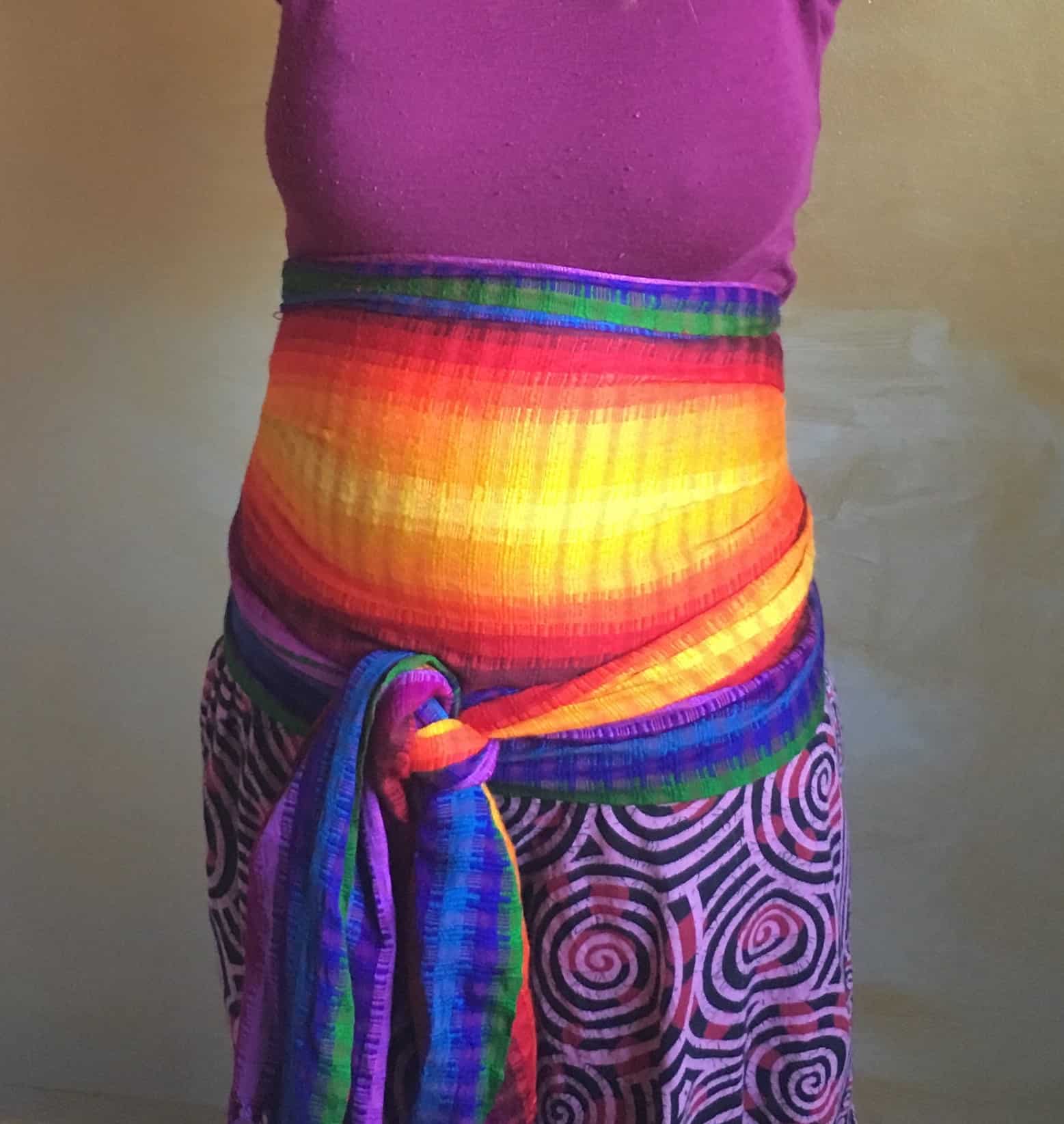
    I was introduced to the art of using the traditional Mexican shawl called the rebozo back in 2013 when I attended a workshop by doula Stacia Smales Hill on rebozo use for labour and birth. During the same year I also attended a workshop by Dr Rocio Alarcon, who taught a postnatal massage technique called closing the bones, some elements of which included rocking and binding with a rebozo.

    Over the course of the following years I pursued my knowledge further by doing several more workshops with Rocio, and several other rebozo workshops with different focuses, such as the rebozo for labour progress and malposition with Selina Wallis, micromovements with Francoise Freedman, 2 different spinning babies with Jennifer Walker and Gail Tully, and a workshop on healing diastasis rectiĀ  with Birthlight which included many rebozo techniques.

    I am also a babywearing instructor, and as such use rebozos and wraps to carry babies too.

    As I started teaching workshops around closing the bones and rebozo work as well as babywearing, the incredibly versatile use of the cloth really blew my mind.

    As I met people through teaching, I constantly questioned people I met about their culture’s practises, I started to build a picture in my mind of something much more universal than the rebozo.

    It seems that every culture had a piece of cloth of some kind, call it a shawl, a sarong, a scarf, or a wrap.

    Whilst the rebozo is a traditional shawl from Mexico and some South American countries, I found that other cultures used different pieces of cloths in the same fashion.

    Cold countries often us thick, woollen fabrics (think Welsh Shawl or Scottish plaid), and warmer countries, cooler, thin, cotton fabric (think African Kanga or Indonesian Sarong).

    There are almost too many fabrics to count, but one thing is for sure, women have used all sorts of cloths in incredibly versatile ways, and what I’m going to say below about the rebozo is true for many other cultures too. It’s a truly universal practise.

    I spent a few years believing that the use of the rebozo during labour was uniquely South American but I have since met a Somalian midwife who told me how they use their traditional shawl, called a Garbasar, in a similar way during labour. Supporting a pregnant woman from the same country confirmed this, and in fact her mother even showed me how it is used to bind the abdomen post birth.

    I trained a Moroccan birth worker in doing closing the bones, and she was surprised when she started offering the massage that women came forward and told her they’d had a similar treatment in the local hammam (Steam bath/wet room) after birth (using a traditional Moroccan cloth called a Mendil).Ā  Tunisia offers a similar practise called a fouta massage (the fouta is a hammam towel, which is very similar in nature to the Turkish towel-it has become a very popular alternative to beach towels in France recently).

    I am lucky to be part of a multicultural family, being French and married to a man from Hong Kong. In Hong Kong I’ve been told they use a long piece of muslin cloth to bind the woman’s hips and abdomen after birth, and my mother in law showed me how the midwifes taught her to wrap her belly with a towel post birth.

    It’s also quite fascinating to see how contact with foreign cultures can influence each other. For example I recently acquired a Dutch postpartum girdle called a Sluitlaken. I couldn’t help but notice how similar to Indonesian postpartum binding it looks, then a friend pointed out than Holland used to have Indonesian colonies!

    So, what can you do with a rebozo (or a scarf of shawl)?

    Pretty much all cultures on the planet, some kind of cloth is used to cradle and carry a baby. In some cultures is used to rock and soothe the baby too. Rocking is such a primal rhythm we all experienced it in our mother’s womb, that we find it soothing all through our lives. Ā Even in Europe there are pictures of women wearing their babies in Welsh shawls which dateĀ from the 1940s.

    Later, when the baby grew into a toddler and child, she would use the cloth to dress up, pretend play (including carrying toys and/or animals, pretending to carry a baby), make a den etc.

    As the child grew into a young woman she would use the cloth as a shawl to keep warm, as a clothing accessory, a blanket, to carry siblings ( in traditional cultures women learn baby care from a very young age as they tend to live with extended families), and to carry loads on her back or head.

    Later still when she became a woman, she might have been given her own shawl as part of a menarche ceremony. She might have worn a special cloth on her wedding day.

    When she became pregnant, she would have used the shawl to support her belly, and her midwives would have used it to alleviate the aches and pains of pregnancy, and maybe to help the baby move into the best position for birth.

    During labour she would have used the shawl to hang from, to pull on, and her birth attendants would have used it to provide comfort measures, such as sifting, rocking, shaking, and wrapping.

    After the birth she would have had a “baby moon”. Again this is something pretty much universal in the world-women the world around have been alleviated from household tasks and cared for by family members for the first 30 to 40 days postpartum. During this time they would rest so they could recover from growing and birthing their baby and get to know their baby and learn to care for them. Her birth attendants and the community of women would have come to feed her nourishing food, and help her body heal from the pregnancy and birth by using Ā a combination of their hands, massage techniques and using the cloth to help move and bind her hips and abdomen to help them back into place. In the West we used to have this practise called “churching” whereby the new mother was expected to rest for a month before rejoining the community and be welcome back during a special blessing at the church (you can read about it here). The research I have done for my upcoming book “Why postnatal recovery matters” has also shown me that the rest AND the binding still used to be part of the UK culture, less than 70 years ago.

    She then would have start to use the cloth to carry her baby and start the cycle all over again.

    Later as she grew old, her family members would have used the cloth to rock and soothe aches and pain.

    Women would have been buried with their shawl using it as a shroud.

    So you see, a traditional cloth, rebozo, shawl or cloth can be used to support a woman throughout her whole life. It is a universal phenomenon on our planet.

    As the shawl came out of fashion and modern practises like using pushchairs became seen as more fashionable and desirable, this skill was soon lost, and because like most traditional women-only practises, it was just passed on orally rather than written about, the knowledge was lost very quickly, in one or two generations. We also tend to embrace “modern” practises mindlessly, seeing traditional ones as backwards and old fashioned.

    Mexican and Chinese friends tell me that nobody wants to use the traditional shawl or carrier these days as only remote farmers or beggars still use them.

    This is Ā something that we need to reclaim and teach all women, as it is part of the essence of women circles and supporting women through life transitions.

    This is why I am so passionate about passing this skills to both expectant and new mothers, and to anybody who works with expectant and new mothers. It is our birthright!

    You can learn more about the Rebozo and its many wonderful uses to support pregnancy, birth and the postpartum in my online rebozo course.

    (This is an updateĀ  from a blog I published originally in 2018)

    If you have found this blog helpful and would like to support my work and help me continue provide valuable free information to birthworkers and expectant and newborn families, you can donate to my paypal account paypal.me/SophieMessager.

  • The vision board, an alternative way to plan what you want

    The vision board, an alternative way to plan what you want

    Today I’ve spent the whole morning making a vision board for this year.

    It feels Ā that I’ve been procrastinating doing this for over 2 weeks now, and suddenly felt the urge this morning, which is the first full moon of the year, and a powerful one at that, a good time to set intentions.

    I’ve been doing this for 4 years now.

    I started doing this as an alternative, no actually, as a rebellion against the typical masculine-orientated process of making a list/bullet point/gannt charts and suchlike.

    Once upon a time I was a control freak scientist who adored excel and Gannt charts. I was extremely process driven, I never forgot a thing, and was irritated beyond belief by people who didn’t prepare and plan things in advance or forgot stuff.

    The birth of my first child rewired my brain, and led to my leaving my scientist career to become a doula. You can read about that here.

    My creativity went through the roof and my organisation skills kind of decreased at the same time. I’m am so much happier for it!

    The only problem was, I didn’t know how to organise things except in the way I had been taught.

    The first couple of years of my self employed life I rode on the wave of excitement and novelty, so things were effortless and easy.

    Then a couple of years later, I felt overworked and out of control.

    What I didn’t realise at the time, was that the process I was using was a male one, a linear one, and that it didn’t suit who I was anymore.

    So I started experimenting with more fluid, intuitive, creative, and feminine ways of working.

    Making a vision board was such a process.

    Here’s how I do it:

    I gather a bunch of old magazines (I need quite a lot so I accumulate them over the years, many being free magazines I grab in local cafes etc).

    I set my intention of what I want this vision board to be for (for me, it’s what I’d like more of in my life this year, but you could use it for something entirely different).

    It’s nice to meditate before you start, especially about how you’d like to feel, rather than setting targets for now.

    Then I sit at my kitchen table with a cup of coffee, and flick through the magazine and rip any page that has a picture that appeals to me. I am completely intuitive about this, I’m not analysing it.

    After I’ve got enough pictures, I then cut them nicely using a rotary trimmer and scissors. As I do this I discard some pictures already.

    I lay a large piece of flipchart paper on the table, then arrange all by themes. Some pictures don’t make the cut.

    I visualise what each picture means for me as I set them in place. It’s quite vague at this stage but it feels important to do that. It doesn’t have to be logical or fully fledged either, usually at this stage it’s just an idea.

    Finally I glue all the pictures in place, and set the finished vision board in a prominent place in my house.

    Over the last 3 years I’ve been doing this, as I look at the board from time to time, it’s fascinating to see how what I visualised has manifested itself, often in different ways to what I had imagined, but manifested itself nevertheless.

    I wrote this to encourage others to try it and I’d love to hear, or even better, see, what you come up with and what effects it has for you.

    Here’s what the one I made today looks like.


  • Postnatal Recovery Massage, a new kind of postnatal massage inspired by closing the bones.

    Postnatal Recovery Massage, a new kind of postnatal massage inspired by closing the bones.

    I’ve been offering and teaching a postnatal massage called closing the bones since 2014.

    I never intended to teach this technique, I just wanted to share it with my community as we had been urged to do.

    But then women started to ask us to show them. So we put together a workshop.

    Since we started we have grown organically and have now trained nearly 400 people in providing this amazing nurturing ritual.

    I hope to use this media to help change the face of the postnatal support in the UK with this, towards a mother centered one.

    Over the last couple of years more and more people who had trained to do the massage started contacting me, asking if it would be possible to provide a version of the massage on a massage table instead of on the floor (we normally practise on yoga mats), because they had bad knees, or bad backs, and found working on the floor difficult.

    I have a bit of a theme in my professional life, that I seem to always end up teaching stuff because people ask me to!

    So I had a chat with my lovely local osteopath friend Teddy (who had already provided all the anatomical and effectiveness knowledge for the workshop handout, and therefore already knew the technique inside out), if he fancied the idea of developing a massage table version of the technique with me.

    He liked the idea a lot so we started working on it. This was about 18 months ago, in summer 2017.

    This was a true work of love, and in the end it took us over a year and many sessions of practise and hours of trial and error to get it working.

    This is how each session would go: I would setup both a massage table and a yoga mat on the floor. Teddy and I would try each technique on the floor then on the table, taking turns giving and receiving each technique.

    I would record the session and make some notes. After each session I’d listen to the recording paying attention to what Teddy said, and write down questions and make more notes for what to practise/change at the next session.

    At the beginning we did get plenty of stuff wrong. I think I was so intent of getting the exact same treatment on the table as on the floor, that this got in the way. Teddy has much deeper knowledge of body function than I do, so he had to explain to me repeatedly why some of the stuff that was done standing up or crouching over a person lying down simply couldn’t be done from the side of a table, due to biomechanics.

    We tried and tried. The most challenging part were the rebozo rocking and the hip squeezing. It was challenging because of the biomechanics (you can’t produce much force when you’re on the side compare to standing above a person), and because I wanted the technique to do the same thing to the body, but also to feel good.

    Teddy wanted to make sure the technique was safe and effective but also easy on the body of the therapist (a basic rule for bodyworkers).

    It proved extremely frustrating at time. Many times we thought we had got it but when we revisited it didn’t feel right and so we were back to square one. Some techniques worked mechanistically but just didn’t feel nice so they were discarded.

    It was also a fun experience and a huge learning curve for me, especially as Teddy educated me on how to position my body for maximum power and effectiveness around the table, something I am still learning to master.

    The real magic happened when I finally let go of it being exactly the same. Teddy had tried to explain to me repeatedly that it wasn’t necessary (that we were aiming for the same effect) but I am a perfectionist and like things to be “just right”

    One day we finally worked out a way to make the rocking work from the side.

    From then on everything seemed to flow magically.

    As we progressed we also ended up modifying and adding several elements to the massage.

    Some were based on discussion about the effectiveness of a technique and how to make it work more easily.

    Some were based on the changes in the pregnant body that weren’t treated as part of the original massage, namely treating the ribs (which flare during pregnancy), and the shoulders (which hunch during pregnancy and often during breastfeeding as well).

    Some just happened because it felt logical to add them to the flow of the movements we had created.

    In the end we ended up with a massage which is inspired from the original technique but is really quite different. I did it for the first time on a doula friend and she loved it. We added a few more movements after that. I also practised on my massage therapists friend Emma Kenny, a massage therapist, who loved it too.

    We named it the Postnatal Recovery Massage (PRM).

    We finished our individual practise work at the beginning of October, and we then went on teaching it to a small group of guinea pigs, composed of 2 doulas and 2 massage therapists.

    We all had a very fun morning of practise teaching this new techniques, and all our guinea pigs loved it.

    This is what they said:

    ā€œKnowing Sophie and Teddy as I do, I knew they would design something that is both relaxing and effective. I was not prepared for how beautifully the movements flow into each other, and how true to the spirit of Closing the Bones they have stayed. For people who find floor work tiring or painful, I highly recommend learning these new techniquesā€ Maddie, Doula.

    ā€ This new version of the postnatal ceremony blends effective rebozo (shawl) massage techniques and lymphatic drainage massage to support post natal mamas. Rather fabulous it is too!ā€ Emma Kenny, Massage therapist.

    ā€œI think one if the reasons I like the massage that you have developed for the table as it feels like a modern way of adapting the traditional massage. It feels like a new technique, a therapists technique. I also like being able to connect to the anatomical benefits. I want to practise giving the massage and feel newly inspired.ā€ Katie, Doula

    We are now putting the final touches to the handout for this new technique, complete with my signature set of description, pictures, videos, and an explanation of the effect of each movement on the body by Teddy.

    This should be ready by sometimes in December and we are looking forward to teaching this workshop together in the new year.

    The first workshop will take place in Cambridge on Saturday the 5th of January.

    I can’t wait to introduce more people to this amazing technique!

    Update January 2019.

    Teddy and I taught our first course last Saturday. The course was extremely well received by our trainees. Here is some of the feedback they gave us

    “What a wonderful, professional, well constructed and instructive course with plenty of time for step by step practical, complemented by Teddy’s expertise and Sophie’s organic shamanism and such a wonderful community of like minded body workers. Thank you. Thoroughly recommended” Jenni Tribe, Therapist

    “Thank you so much for an informative and inspiring day. I can’t wait to use the techniques on my clients and support women more effectively. You are doing an amazing work and I’m so grateful ad excited to be part of it!” Grace Lillywhite, Pilates teacher.

    “I loved this course. It is just as nurturing as the closing the bones massage but much easier to do. Sophie and Teddy worked amazingly well together” Michelle Parkin, doula.

    “The course was well organised, very informative and easy to follow. The level of practical support was fantastic and I feel confident to take what IĀ  have learnt and help local women postnatally. Thank you!” Becki Scott, doula and massage therapist.

    “Amazing workshop! Loved being in a small group to work through techniques in enough details. As an osteopath this experience has been invaluable in improving my practise if postnatal patient , in fact all of my patients!” Rob Ballard, osteopath

    “Amazing. Thank you both so much. More than the sum of the parts. Just lovely” Charlotte Filcek, doula.

    “The tutoring, the technique, the group, just exceptional!” Alison Duff, therapist and therapy centre owner.


  • The mother blessing -a mother centered alternative to the baby shower

    The mother blessing -a mother centered alternative to the baby shower


    Recently I had the privilege to organise a mother blessings for one of our local doulas who was pregnant.

    A mother blessing is an alternative to the “baby shower” were friends of the pregnant mother gather to give her presents.

    The big difference is that in the baby shower, all the presents are for the baby.

    In the mother blessing, it is the mother who is the center of attention, and the gifts are for her, not for her baby.

    It feels very important to me to facilitate such gatherings, because our culture focuses on the mother only has a vessel for the baby, and usually once the baby has been born, nobody focuses on the mother anymore.

    Therefore with the mother blessing we can help start a cultural shift towards a more mother centered culture.


    I have written before about what new mothers really need, and how much of a raw deal we get, once our baby has been born, our partner has returned to work, and we’re alone at home all day, trying to make sense of this new experience, whilst trying to understand the needs of this new life helpless being we have given birth to, whose needs come before ours, always. We’re not meant to be doing this without a support network.

    Organising a mother blessing does not have to be complicated. It can be simple yet beautiful and powerful.

    This is what we did for our doula sister:

    We sat in a circle with her.

    We sang to her

    We gave her a bead each to have during her birth and the postnatal period, and we said good wishes as we gave her our bead.

    We threaded the beads into a necklace, to remind her of her circle of sisters being there with her in spirit, holding her, through the birth of her baby and the early postpartum weeks.


    We boundĀ our wrists, in a circle, with some wool, then cut the thread, tied the individual bits around our wrists, and all agreed to keep our little wool bracelet until her baby was born.


    We readĀ poems about motherhood.


    We massaged her hands and feet with gorgeous scented oils.

    We gave her a candle and all took away little tealights to light when we would hear the news that her baby was soon to be born.

    We gave her a goody bag of nurturing gifts.

    And of course we shared some yummy food.


    It was simple, yet magical and powerful. It was, like birth, an everyday extraordinary event.

    She knew this was meaningful, and it was touching and special for her and all those involved.

    We reminded her she could call upon us after the birth of her baby for support and companionship, and we also offered to gather around her to give her a closing the bones ceremony after the birth of her baby.

    This is what Ceci wrote about her mother blessing


    Today my doula friends gave me a “mother blessing”, which is a day to share before the baby is born, like a baby shower but more focused on Ā mum, with food toĀ share, poems, songs, made me a necklace with beads and a wish of each one.Ā  They gave me a candle and they also got one each also for when I start labour. We also sat in cicrle, each one told me a few words and we were passing a thread that we all tied up on the wrist and that we will have until my daughter is born. They gave me massages and we laughed a lot! I am super grateful to have them and to have had this day for me”


    I would like to see the tradition of mother blessings to replace that of baby showers, I sincerely hope that it will help place mothers back were they should never have left, at the centre of the circle of support, with the reverence they deserve for bringing new life into the world.


  • How closing the bones can help after baby loss

    How closing the bones can help after baby loss

    When I started writing this post during baby loss awareness week, I thought I was going to write a post specifically about miscarriage. But when I started writing it, I felt that it needed to be about baby loss in general. Because you cannot measure grief by what it looks on paper.

    Your grief can be as real if your baby died when you just found out you were pregnant, or if your baby dies when he was several months old. Grief cannot be defined by numbers, and we cannot measure how sad, how hurt we are, or by comparing ourselves to others. By judging that some losses are more “worthy” of grief than others. It doesn’t work like that.

    Yet, god knows I’ve been guilty of doing this myself when it comes to my own grief. So I want to share my stories, and those of others, and I hope it helps. I have two different histories of baby loss. The first was when I was eight and my little brother, Julien, was stillborn.

    This was in the late 70s, and in those days people thought that brushing things under the carpet was the right thing to do, that to pretend it just hadn’t happened meant that, somehow, it would disappear from your brain. None of us where allowed to grieve or process our feelings properly. There was no funeral, and my brother’s little body was disposed of in clinical waste. There was no memory box, no pictures, no footprints. I never got to see my brother (neither did my mum). My mum hid in the toilets to cry. We didn’t share our sadness. I was left with all those unprocessed feelings, so unprocessed in fact that my mind’s choose to forget them to protect me. I have this big blank in my memory which I cannot retrieve. I can’t remember my mum being pregnant, or anything after the birth. Which is odd because, of course, I have plenty of memories of times before that. There is a part of my childhood I simply cannot reclaim because we weren’t allowed to grieve at the time.

    When I studied how children grieve as part of my antenatal education diploma, this led me to revisiting this in depth and I had some lovely healing conversations with my mother about it. In fact in 2017 I closed the circle by giving my mum a closing the bones session-she was very scared about what it would bring, in case it brought all the bad feelings flooding back I think, but it was gentle and beautiful and, honouring, nurturing and healing for both of us. A couple of years later, I would give her the massage again to help with back pain, only for my mother to tell me the day was the anniversary of the birth of my baby brother,

    My second loss, was when I miscarried my own baby (I went on to have 3 further miscarriages and 2 live children but I am only relating the story of my first loss in this blog).

    Ā I started to try and conceive when I was about 33. After over a year of trying and no pregnancy, we were fast tracked for fertility tests, due to my age and irregular cycles. Everything was normal but my cycles were very long and they wanted to give me drugs to induce ovulation. I wasn’t keen, so I investigated other options instead, and after 3 months of acupuncture, I fell pregnant for the first time. I can still feel the raw, amazing joy I felt when the test turned pregnant. I can still picture myself, alone in the bathroom. I looked at myself in the mirror, and I burst into tears of joy. I kept my little secret all day and then surprised my husband with the wrapped positive test in the evening. For 3 months I walked around in a constant state of bliss. Yes I was tired and nauseous at times, but mostly, I was so high on pregnancy hormones, and I felt that nothing could touch me.

    At 12 weeks we went for our first scan. We were very excited. Then the sonographer told us there was no heartbeat. She tried scanning me again. I was in denial, still hopeful that somehow, there had been a mistake, and that my baby would still be alive. But my baby had died. What ensued was disbelief, numbness and shock, followed by the deepest grief I had ever experienced. I cried like I had never cried before in my life. Big heavy howling sobs. My arms literally ached for my baby.

    It wasn’t helped by the lack of understanding of my own feelings, by the lack of acknowledgement our culture provides to women who miscarry, by the lack of support, or by the inappropriate, well meaning comments given by friends and relatives who didn’t know how to support a mother’s grief.

    • “It wasn’t a real baby” (to me it was)
    • “There was probably something wrong with it” (maybe, but this was implying I was wrong to grieve)
    • “You can have another one” (I wanted this one)
    • “At least you can get pregnant” (more grief dismissal)

    All these comments contributed to feeling that my grief wasn’t valid.

    Thankfully someone put me in touch with the miscarriage association. I rang lovely local volunteer lady Janet Sackman. She was the first person to put soothing, acknowledging words on my grief. I ended up attending miscarriage association meetings for a while. I helped me a lot with processing my feelings. But nothing was done to help heal my body, my spirit, my soul, in a holistic way.

    I carried this grief and this fear with me-nobody helped me with that. I never experienced that feeling of bliss in any of my subsequent pregnancies, because I was so scared that I was going to lose my baby again, that I didn’t dare let myself be happy again.

    In 2013 I was trained into doing a postnatal massage called Closing the bones. Ā I have been offering and teaching it since 2014 (read about that here). Having offered the massage to hundred of women, we started noticing some common threads in what this ritual does, and one of these thread is how helpful it is for loss. Amongst the women who received this massage, many, including the ones who had live births as well as loss, told me that the ritual felt especially significant for loss. To this day, women keep telling me this.

    This is what some of those women said:

    I came along to the Closing the Bones Training about a year after my baby had died. Towards the end of the ceremony, as I was being rocked deep shudders started going through my body and as the rebozo was pulled tight around my pelvis I felt a huge emotion that even now I am not sure what to call it. It felt as though the protective bubble I had formed around myself moved away and with that my baby – as if I was releasing him. Sobs racked my body all the grief, the anger, the exhaustionĀ  all the disbelief of what had happened came pouring out. I hadn’t realised how much I was holding on to. I felt the women form a circle around me and felt what it was like to have a safe space held for me, allowing me to just be there in my wild tumult of emotion. I heard someone singing the most beautiful song and someone stroking my hair, hands touching me sending love and support“. Rosie (you can read more about Rosie story and the beautiful poem she wrote here ).

    I have had 3 different losses. Ā All the years up to having children when I felt sad I realised I had empty arm syndrome. It was a deep sadness that as I was so young was not felt I had the luxury of acknowledging. (Wwhen I felt pregnant) I never fully bonded – just in case. I always felt doomed. After two more children in quick succession I learnt closing the bones and was lucky enough to be the subject for the full closing ceremony at the end. I could see golden light all around and I felt deeply relaxed and to have so many women touch me was a unique honour.Ā  When I got home I felt a far deeper connection to my children than I had before.Ā  A lingering barrier I was unaware of had been lifted.Ā  Since then I have felt a far deeper acknowledgement of my loss. And far less pretending all was ok. It feels far more authentic. ” Allison

    “Having the closing the bones massage helped me to accept my babies loss and start to move forward and also forgive my body and let go of all the negative feelings.” Claire

    This is also what some of the women who had losses, have either experienced or heard about closing the bones, but didn’t experience closing the bones at the time/or since their loss told us:

    “I think it could have helped me as it took a long time to fall pregnant again and I felt like I had to be pregnant again in order to process losing our second daughter. Maybe a closing the bones ceremony would have helped with saying goodbye to that pregnancy and feeling less stressed falling pregnant again. If that makes sense?” Ā Hannah

    “Instinctively I feel this is a worthwhile ritual/ ceremony to honour the mother and acknowledge her pregnancy and loss”. Molly

    “I had a miscarriage at 9 weeks. I think closing the bones would have helped me in so many ways, but mostly emotionally, being able to share it with another woman who understands or at least who can empathise and perhaps sympathise. Who could normalise it (I knew it was common, but it would still have been nice to be told again, several times!). A healing time with another woman. That’s what I would have liked”. Saveria

    ” I didn’t know about closing the bones until recently and had not really considered it with regards to my loss, but your post made me reflect and actually had (has!) me in tears thinking about how, at the time, a “ceremony” would have helped me so very much. I would have found a closing the bones ceremony beautiful in that situation, a celebration of my child, me as her mother, and a way of celebrating her life, however short it was.Ā  I would have found it healing and it would have allowed me the focus I so desperately needed to just be alone with her, and my thoughts, and my pain! ” Jo

    “I think it would have helped me after numerous miscarriages as a way of creating ‘closure’ but still keeping that love within me, honoured as a part of my body. I think of it whenever I wrap someone else, and today when I wrapped myself…” Katrina

    If I could go back in time and have women close my bones after my miscarriages, I know what it would mean to me. It would mean that I would be held by a group of loving, supportive women, and that they would witness and acknowledge my grief as valid, without judgment. THat I could let all my emotions out, within a safe space, whilst being held. This would have felt very significant for me at the time, the physical aspect of it, and I expect would have helped me heal faster, and better, than I did at the time. It would have been complimentary to the more “mental” side of the miscarriage association meetings. This is also why I feel so strongly passionate about supporting women through loss.

    In her recent book, Braving the Wilderness, Brene Brown states :

    ” The collective pain (and sometimes joy) we experience when gathering in any way to celebrate the end of a life is perhaps one of the most powerful experiences of inextricable connection. Death, loss, and grief are the great equalizers.”

    This feels like what this ritual is all about when honouring the loss of a baby.