Tag: plan

  • Shrinking Mountains: Practical Tools to Transform Overwhelm

    Shrinking Mountains: Practical Tools to Transform Overwhelm

    Every time I take a break from my routine, whether it’s a holiday or just some time off, I always struggle a bit to switch back into work mode. After a period of relaxation, it can feel challenging to return to the many tasks that come with running a small business and managing family life. It’s like the weight of both roles—the solopreneur and the “CEO” of my family—hits all at once.

    In the past, this shift often left me feeling grumpy and overwhelmed, but this time I approached it differently and was able to overcome the stress more quickly. Here’s how.

    Many years ago, I embarked on a journey to reduce overwhelm  (read about that here). The biggest two learning points in my de-overwhelming journey and process are as follow:

    • Put the self care in the diary first
    • Decrease the size of the mountain

    1) Put the self care in the diary first.

    I know this is going to sound counterproductive, but it really work. If you try to work harder out of overwhelm, if you wait until you’ve done all the stuff in your to-do list before you allow yourself to relax, to take the time to do the things that make you feel good (in my case, swimming, drumming, and dancing) then you never find the time to do these things. You are not only likely to remain stuck in the overwhelm cycle, but also to make things worse. You cannot create spaciousness from a place of scarcity. If you feel you never have enough time, the way to create more time is to give your mind and body the chance to experience what it feels like to be spacious and relaxed.

    I’ve found that practices such as  reflecting in a journal every time I feel stressed or overwhelmed, putting a timer on for 5 min, simply starting with “what does my soul wants to tell me today”. Or doodling myself as a stick figure and writing speech or thought bubbles works well to, putting a timer on for 5 min and drumming. All of these things help my overwhelm settle down. What comes up, with either of these practises, is usually that when I feel there is too much on my plate, I actually need to slow down instead of trying to flog myself to work harder. Overwhelms is often a sign that you need to slow down.

    When you feel stuck or stressed or overwhelmed, rather than trying to push through the stuckness, which usually doesn’t work, you can choose to do something that involves a bit of movement, and that makes you feel good instead. For me this means a walk in the woods, a swim in the river (I usually tell myself “fuck it I’m going for a swim!”) or a short 5rhythms dancing session (as in, just one short track I love).  This ALWAYS results in the stuck energy moving through and my being able to start seeing the forest for the trees, and starting to be able to get stuff done from a refreshed place.

    Building up your sense of achievement rather than focusing on what you aren’t doing is also important. Another practice that I’ve found transformative is to use a “ta-da” list. At the end of each week I write everything I’ve done that week, self care, family and  work wise. I’m always surprised by how much I have accomplished, even when I’ve felt that this wasn’t a very productive week.

    2) Decrease the size of the mountain.

    Since I started working with authentic business mentor George Kao I’ve learnt the importance of capturing the process whenever I start anything new. This is for three reasons:

    • It helps understand the large numbers of steps and time involved in creating something (see Ta-da list above)
    • It saves time for the future, as you already have all the steps and tasks captured if you want to do it again (for example, creating an online course)
    • But most importantly, it decreases the size of the mountain. It helps to break down the impossible ascent into tiny, do-able steps. It creates a path where there was none before.

    Imagine that you are facing climbing an enormous mountain. Or that you have to carve a track in a deep jungle with a machete. All the tasks, the thoughts about the tasks, they all get jumbled in your head and all you can feel is this enormous, impossible task. You feel exhausted just thinking about it, and you don’t know where to start or even want to start. It feels heavy, overwhelming and scary. Running away feels easier,  or pretending it’s not there. Yet you feel the weight of the “unclimbed mountain” on your shoulders all the time. Sounds familiar?

    This is because you cannot see your way through. You just see the top, or the impossibly far destination. And this keeps you stuck in fight and flight, or freeze mode, because our brains have evolved to be very good at protecting us. A perceived danger is experienced by our nervous systems in the same way as a real one.

    If you decrease the size of the mountain, as in capture all the tasks in small dividable steps, and then decide to maybe only do one, tiny step, as soon as you start to move, it creates a path, and the overwhelm gets resolved almost instantly. The energy starts to move, and you realize that the anxiety about doing the tasks was much bigger than the task itself. In fact, very often as soon as you start taking steps towards doing the task, the anxiety dissolves and you realized that you made a much bigger deal about it than it was.

    I’ve found that when I procrastinate, if I start writing a list of what needs to be done rather than doing the actual task, it feels more doable to write that list than to do the task. And then when I’m ready to tackle the task, the list I’ve written creates a simple path I just need to follow, so I no longer procrastinate about it.

    Here is one of George Kao’s blogs about it, and also a video about it.

    I have had such an incredible journey doing this that I plan to create a course to help others do the same. I am offering one to one mentoring sessions to start with so I can get feedback and experience. Do get in touch if this is something you would be interested in.

    Does this resonate with you? If so I’d love to hear about it.
  • How to write a postnatal plan

    How to write a postnatal plan

    You may have heard of a birth plan, but have you heard about a postnatal plan?

    In our culture we are often focused on the birth, and most of all, on the baby. It is clear from the focus antenatal classes have, there is preparation for the birth, and also preparation for the postpartum, but the postpartum aspect is usually mostly focusing on babycare rather than on the mother’s needs (and I should know about it because I taught antenatal classes for several years). It is also clear from the presents expectant and new parents receive, which are also usually all for the baby.

    It didn’t used to be this way. In every culture around the world, there used to be (and still is in many cultures even today), a period of at least a month post birth during which the new mother didn’t lift a finger. The community (usually female relatives), rallied round and took care of her household, so all she had to do was rest, eat nutritious food people prepared for her, receive healing bodywork treatments, and get to know her new baby. Compare this to what we get in the Western world: two weeks paternity leave, and then you’ve on your own.

    Because we no longer live in a culture that understands and supports the need for recovery post birth, writing a postnatal plan is a fantastic way to ensure that there is support in place for after the birth, and that you aren’t alone trying to meet your own needs and the intense needs of a newborn baby (as well as running a house, and maybe looking after older children too).

    I love this quote by Jojo Hogan, a postnatal doula who created the Slow postpartum movement.

    If birth is like a wedding day (lots of planning, high expectations, being the centre of attention, lasts for about a day or so, get something special at the end), then the postpartum should be like a honeymoon (Equal amounts of planning and investment. Time, space and privacy to relax, bond and fall in love. Lots of people and services around to care for and look after you and a peaceful and blissful environment where all your needs are met for a few days or weeks).

    As you would plan for your honeymoon, it is well worth putting plans in place for your baby moon, i.e. creating your own postnatal plan. Just like planning for birth, this isn’t about having a rigid plan. The magic isn’t in the finalised plan, or to have a ‘perfect’ plan, it is in the process of exploring options (some of which you may not even know exist) and getting informed so that you can have an experience which is as positive as possible, regardless of what happens.

    I use this analogy: you need to find what’s in a buffet, before you decide what you’d like to eat (I explain this process in my blog called The buffet curator).

    You don’t know how you’ll feel in advance. You don’t know what curveballs life might throw you (for example: your birth might happen sooner or later than you expected, it might unfold differently from what you had hoped, you might need to stay for a while in the hospital, your baby might need to stay for a while in the hospital etc).

    So just like for birth, it’s worth having thought about all the options, so that, regardless of how your birth unfolds, and how your baby comes into the world, and how you end up feeling once you’re home with your baby, you have at least some form of support in place.

    You may encounter people who dismiss your idea. “You can’t plan birth ” is a common phrase used to dismiss birth plans. Because a postnatal plan is an even newer concept than a birth plan, you may encounter some dismissiveness or negativity. People might say “what’s this newfangled thing, we didn’t need that in our time” or “you don’t need that” from people who don’t understand the point, because they did not do it themselves. Some of my clients who have written postnatal plan have encountered reactions from relatives who even said “I didn’t have support, I just got on with it”, implying that they suffered, and you should too. Therefore you might need to choose carefully who will be part of your postnatal support team, who to discuss it with, depending whether they are likely to be supportive or dismissive. In the vulnerable tender state of new motherhood, the last thing you need is being criticised for your choices. After all, you just single handed grew and birthed a whole new human, and you should be revered as the goddess that you are.

    How to you write a postnatal recovery plan? It’s simple really, because a nurturing postpartum boils down to 4 pillars: Social support, Rest, Food and bodywork.

    Here is a list of these topics with prompts, which you can use as basic to start write your postnatal plan.

    Rest

    • Help with household (chores, cooking, cleaning, other children etc make a list of potential helpers)
    • Visitors-list them/how to manage them so they do not interfere with rest/write a “new mother and baby sleeping” note for the door.
    • Naps/sleep when the baby sleeps/early nights/sleep with your baby
    • Relaxation: techniques and apps

    Food

    • Batch cook and freeze
    • Who can make/bring you some/meal trains
    • Deliveries (supermarkets, take away meals, frozen, fresh, meal boxes)
    • Nutritious non perishable snacks
    • Use a sling so you have your hands available to make yourself something to eat.

    Bodywork

    • Postnatal massages/closing the bones massage
    • Specialist manual therapists such as osteopaths, chiropractors, and physiotherapists
    • Wrapping your pelvis/abdomen
    • Keeping warm

    Social support

    • Friends, family, neighbours
    • Hired help (doulas, nannies, cleaners…)
    • Online support (social media, WhatsApp groups…)

    Planning for the unplanned:

    You might want to include a part on navigating possible curveballs. For instance if you end up giving birth by caesarean when this wasn’t part of your plan and what your recovery might look like if that’s the case.  If you end up having a longer than expected hospital stay after the birth, or if your baby needs to stay in hospital for a while.

    There are many ways to create a postnatal plan. You could write one, and you could also make a mindmap or a vision board, of draw something or whatever other modality appeals to you.

    You can download a free postnatal recovery plan template as a PDF on my website front page.

    If you’d like to learn more about this topic, feel free to browse my blog for more posts on this topic. My book, Why postnatal recovery matters has a whole chapter on writing a postnatal recovery plan, and my online course How to prepare for a nurturing postpartum, has a whole module on it.

    This coming Tuesday 28th of June I am also running a free Webinar called How to prepare for a nurturing postpartum.

  • Baby shower? Have a mother blessing instead.

    Baby shower? Have a mother blessing instead.

    What is a mother blessing?

    You probably have heard of a baby shower, but have you heard of mother blessing? It is a celebration and honouring of a woman’s transition into motherhood. A mother blessing is a celebration that takes place during pregnancy and which is designed to celebrate and support the mother and her upcoming birth and postpartum period. Contrary to a baby shower, where all the focus and presents are on the baby, a mother blessing places the mother at the centre of the attention and support. It is a gathering, usually of women, coming together to celebrate the expectant mother, to honour her and give her loving attention, good wishes and support for the birth and the postpartum period.

    I wrote about this in the past  but I want to expand and explain the process a bit more, as I have gained a lot more experience in running these rituals.

    What happens during a mother blessing?

    Altar centerpiece

    There is no prescriptive recipe. It is about having a gathering to celebrate the mother in a way that feels good for her. The most important aspect is that she feels loved and nurtured, and that the event is tailored to her needs. I used to think that mother blessings where always a hippy affair, but I have come to realize that, whilst they are powerful and spiritual in nature, it is not the way they look like that makes them special but rather it is the intention behind it and how people come together to hold it.

    Offering mother blessings through the years has taught me a lot. For example I organized one for a mother who is Christian, and she was worried that the event would involve spiritual aspects that would be incompatible with her religion. I reassured her that this wouldn’t be the case and that we would make sure that what happened was in line with her beliefs.

    A mother blessing is a gathering a friends and family of the mother. Here are some simple logistical aspects to think about:

    • Discuss the gathering with the mother
    • Plan the structure of the gathering, with a beginning, middle and end
    • Choose a venue and date
    • Invite the guests
    • Ask people to bring things to share such as reading a poem, or a singing a song, and meaningful gifts for the mother, and something to eat at the end
    • Run the event

    Here are some of the things I like to do to make a mother blessing special:

    Setting up the space

    I like to make the space special with colourful fabrics, flowers, candles, and lovely smells and sounds, like a sanctuary. Be guided by what the mother likes and tailor the level of woo accordingly.

    Starting the ceremony

    I like to have a simple ritual to mark the beginning of the ceremony, such as smudging or ringing a bell. Start the process with a short sharing circle, for example, having everyone introducing themselves saying their name, the name of their mother and maternal grandmother (in my case: I am Sophie, daughter of Michelle and granddaughter of Jacqueline).

    If it feels right, singing a short circle song can be lovely too. For example, I like the song The river is flowing.

    The ceremony itself

    Here are some simple ritual activities to build into the ceremony can involve:

    • Ask everyone to bring a bead to give to the mother. As each person presents her bead, they explain why they chose it, and what it represents. The beads get threaded on a string to make a necklace that the mother can wear or use like prayer beads during labour or the postpartum to remind herself of the circle of support around her.
    • Pass some wool or string around the circle and have everyone wrap it a couple of times around one of their wrists. Once everyone is bound by the thread, pass scissors around to cut it and have everyone knot the thread around their wrist or ankle and keep it until the baby has been born.
    • Gift a small candle (like a tealight) to everyone, and a bigger one to the mother. When the mother goes into labour, people will be notified (for example in a WhatsApp group) to light their candle and send love and good wishes for the birth.
    • Have guests read texts, poems or sing songs (some lovely examples here)
    • Do something nurturing for the mother, for example massaging her hands or feet.
    • Have people bring or pledge some gifts for the mother for the postpartum. For example vouchers for postnatal massage or closing the bones ceremony, postnatal doula vouchers, food delivery, feel good products like postnatal herbal baths or massage oils, promise to come and clean her house/hold her baby whilst she sleeps etc.
    • Have a final sharing circle at the end.

    Finally, have some informal time afterwards to share food, some tea and cake (a groaning cake would be lovely) or a potluck meal. It is always lovely to have some informal chatting and eating time after the ceremony.

    What are the advantages of having a mother blessing?

    The main point of the mother blessing, besides making the mother feel loved and cherished, is to redirect the focus of the support towards the mother rather than the baby. Encouraging the mother to write a postnatal recovery plan, and/or using said plan to ask friends to provide pledges for the postartum is a good way to think ahead about what the mother might need after the birth (you can use my free postnatal recovery plan download as a template for this).

    Beyond the mother herself I have found such ceremonies deeply moving for the facilitator and for all the people involved in the gathering. Western societies lack rituals to celebrate life transitions, and bringing this back into our culture is very powerful and meaningful. People often say that they had never taken part in something like this and how much they loved it, and wish they had one themselves.

    I especially love to bring the whole process full circle, by bringing back the same group of people to honour the new mother a few weeks after the birth in a closing the bones ceremony.

    In 2020 I have also participated in mother blessings over zoom. The process was the same e xcept that we sent cards and beads by post ahead of time. It was still very special and meaningful.

    I am offering an online course on how to run mother blessings.

    Here is a short video showing snippet of mother blessings and workshop I have run in the past

    Play

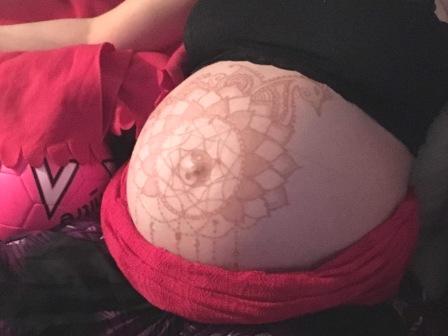
    (The Henna tattoo belly painting on the main picture, was designed by Jo Rogers as part of a mother blessing)

  • What is postpartum bodywork and why we need it back.

    What is postpartum bodywork and why we need it back.

    All around the world there are (or used to be) traditional practices to help a new mother’s body heal after birth.

    Regardless of the continent, these traditions usually include some massage and wrapping rituals, as well as binding the belly and pelvis, and keeping the mother warm.

    When you think about the tremendous changes a mother’s body undergoes, it makes so much sense! During pregnancy, the uterus grows from the size of a pear to that of a watermelon, the pelvis tilts forward and becomes wider, the ribs open, the spine curves increase, the abdominal organs get pushed up etc. To give birth, the mother’s body opens up on a physical and energetic level. After birth, these changes need to happen in reverse, whilst the body also undergoes the beginning of lactation.

    It seems crazy that we no longer have processes in place to support these changes, or at the very least, some kind of physical examination to make sure everything has returned to a healthy place. At the 6 weeks doctor “check” in the UK, there is no overall physical examination of the mother.

    With no checkup, and no sense of what is normal, we have a perfect storm of issues not being treated. The statistics are very telling: 1 in 3 new mothers experience urinary incontinence at 3 months postpartum and nearly one in 2 still has diastasis recti at 6 months postpartum. Research shows that it takes on average 8-10 years post birth for women to seek help for such issues.

    Yet, during the first 4-6 weeks postpartum, when the body is still plastic and resetting itself post birth, there is a unique opportunity for healing.

    Traditional massages and rituals, such as closing the bones, understand this need and the window of opportunity, and are designed to “close” a new mother physically, emotionally and energetically, after the widening and opening of pregnancy and birth. Because the needs of new mothers are the same regardless of where they are from, it makes sense all cultures have similar processes to support postpartum healing. This article from Innate traditions provides a beautiful overview of the topic.

    As no such treatment is available as standard within the health system, it makes sense to seek bodywork and healing from people who can provide it.

    What kind of postnatal bodywork can you have?

    When can you have postnatal bodywork?

    As soon as possible during the first 6-8 weeks postpartum or as soon as you are ready. In traditional wisdom, there is a window of healing opportunity and plasticity during this time when the body is designed to heal faster. The strange “don’t do anything before you’ve had your 6 weeks check” isn’t based on any evidence. Moreover, it makes no sense because the 6 weeks check doesn’t include a physical examination. Having massaged many new mothers, some as soon as 24h post birth, I can attest that this is when the bodywork is the most effective to speed up healing.

    What can you do for yourself?

    • Use the 4 pillars of postnatal recovery (Social support, rest, food and bodywork) to write a postnatal recovery plan (you can download a free template here) to include bodywork. You can ask for gifts vouchers towards postnatal bodywork.
    • Wrap your belly and hips. I wrote a blog about it which includes tutorials.
    • Keep warm (like a convalescent person would: wrap up, and consume warming foods and drinks)

    What can you do for new mothers?

    • If you know someone who is pregnant or recently had a baby, it would be a wonderful gift to give them a voucher towards such a treatment.
  • Maslow’s Hierarchy of needs for the postpartum

    Maslow’s Hierarchy of needs for the postpartum

    You have probably heard of Abraham Maslow’s hierarchy of needs pyramid ( if you haven’t here is a good introduction article)

    Maslow was a psychologist who introduced the concept of the hierarchy of human needs as something that underpins motivation. This hierarchy suggests that people are motivated to fulfill basic needs before moving on to other, more advanced needs.

    I’d like to introduce you to a version of Maslow’s hierarchy of needs adapted to the postpartum.

    Maslow’s theory dates back from 1943 and since it has been criticized to say that the needs depicted don’t necessarily come into an order as simple as this pyramid, and that they can be in any order. I personally feel that the needs described here are basic needs for any human to thrive, and even more important for a new mother during the first weeks post birth, whilst she learns to mother her infant and find her feet as a new mother.

    I like this model because it is well known within the Western world, and because it can be helpful to help supporters visualise what the needs of a new mothers are, and see how these needs aren’t usually met in the modern world. With this model in mind it’s easy to see why a new mother needs to be at the centre of a circle of support to be able to thrive.

    Survive

    The most basic needs, the surviving needs of a new mother are the physiological needs for sleep, food, water, and warmth. I’ve also added bodywork because for me it is fundamental to help a new mother recover and heal faster. Postpartum bodywork used to be (or still is in many parts of the world) given as standard in every culture around the world. When you imagine trying to meet all these needs whilst caring for a new baby, it is easy to see it is almost impossible without support from others. This is why social support is so essential during the postpartum. Another adult in the house to cook, clean, tidy up, and hold the baby whilst the new mother sleep is a basic need, and not a luxury.

    Live

    Feeling safe as a new mother only comes when there are enough resources, and enough support around so that her wellbeing and health doesn’t suffer. The need for safety is also met by community support, because it helps the new mother to regulate her emotions. Experienced mothers around her make a huge difference in terms of meeting the challenges of new motherhood.

    Love

    The sense of belonging that comes from having loving relationships is much easier to meet when it is provided by friends, family and the community rather than just the partner as it tends to be in the Western world. Showering a new mother with loving attention and nurture goes a long way into helping her to recover after the pregnancy and birth.

    Esteem

    Nurturing supporters make sure that they point out all the things that the new mother is doing right, rather than showering her with conflicting advice that undermines her flailing sense of competence

    Sense of self

    With all the bottom layers needs being met, the new mother can develop a healthy and strong sense of self in her new identity as a mother.

    When you look at this pyramid, it is easy to see that, in our modern culture, the most basic survival needs aren’t usually met, let alone the more complex needs in the upper part of the pyramid.

    If you know someone who is pregnant or who has recently given birth, I invite you to use this hierarchy of needs for the postpartum as a blueprint to offer them nurturing support.

  • You are the expert in what is right for you

    You are the expert in what is right for you

    You are the expert when it comes to making decisions in your life.

    This is one of the most important points I share with my clients. I think it applies to many things outside of pregnancy and birth too!

    It can be tempting to defer decisions to experts such as doctors and scientists, or anyone you perceive as an expert in the field, especially if you are trying to make a decision in a area of knowledge that is new to you.

    But the role of the experts is advisory.

    They cannot make the decision for you.

    This doesn’t mean that the role of the experts isn’t valuable, because they can curate options that suit you when trying to oversee the whole picture might feel overwhelming.

    I liken it to choosing dishes in a buffet. The role of the experts is to curate the buffet to your needs (for instance making sure there is no animal products if you are a vegetarian), but they cannot choose the dishes for you. You do.

    Not the scientists, not the doctors, not the experts. You are unique with your own unique needs and you get to live with the decisions you make, not the experts. The role of the experts is to lay options in front of you. It doesn’t mean that the a coach isn’t valuable, because they can curate through a lot of options for you, but their job is to lay options in front of you and your job is to choose what’s right for you.

    Because they aren’t the ones who are going to live with the consequences of the decision.

    You are.

    Play


  • Postpartum support and butterflies: what do they have in common?

    Postpartum support and butterflies: what do they have in common?

    In my book, Why postnatal recovery matters, I explain that postnatal recovery boils down to 4 pillars: social support, rest, food and bodywork.

    Social support is the foundation on which everything else is built. If you are going to rest, have some great nourishing, food and some bodywork after birth, it’s kind of impossible to do this alone. You need other adults around to be supporting you in order to do this.

    But postpartum support goes beyond the simple practical aspect of having other pairs of hands to hold the baby, cook you food or give you a massage.

    Yes, having another adult in the house means that there is someone to help with house stuff, but most importantly, it means that we aren’t alone. It means that there is someone else to keep us company, listens, and reassure us when we doubt ourselves.

    It means, most importantly, that there is someone to hold the space for us.

    Holding the space looks like someone is doing nothing, but it might be the most important aspect of all. Heather Plett explains this concept beautifully in her article.

    In the episode of the Midwives’s Cauldron podcast I did about postnatal recovery, I tell a story that illustrates this beautifully (you can listen to it here). When my daughter was a baby, she suffered from painful gas at night which left her inconsolable. I became aware that she reacted to certain foods I ate and had to eliminate these from my diet. On a holiday to France when she was 3 months old, I unknowingly ate some food she reacted really badly to, and she woke up in the middle of the night and cried for over an hour. As I got out of her bed to rock and soothe her, my mother heard her cry, and she came to keep me company. She didn’t do much; she just sat with me whilst I rocked my baby. But having another adult there, just being present for me, meant that I felt much stronger and able to support my daughter.

    Recently a new mother I supported as a doula told me something similar: she said you have help during the day, but at night, you’re alone and it’s so hard. I helped her find a night doula, and it made a world of difference to her wellbeing.

    As humans we are a social species, and we kind of intuitively know that we need community support through life transitions. This is why every culture used to have (and many still have) a set of rituals around big life transitions life becoming a parent.

    The polyvagal nervous system theory tells her that we need each other to regulate our stress levels, especially at times when we are vulnerable.

    Postpartum rituals around the world all have in common a period of about a month during which the new mother is nurtured and looked after, almost like a child, because there is an innate understanding that she needs to be surrounded and supported by experienced adults as she navigates her new role and identity.

    Western societies are so focused on productivity that we tend to only plan for practical things. I see a parallel with what people ask me about my doula role. They ask what does a doula do, yet most of my role isn’t easily quantified, because it is more about being than doing.

    An analogy often used for the transition to motherhood is that the change from a caterpillar to a butterfly.

    If you have ever seen a butterfly emerge from its cocoon, you’ll know that as the butterfly first comes out, its wings are crumpled and soft. The butterfly needs to hang upside down from its cocoon or a nearby branch, whilst it waits for the wings to unfold, dry and strengthen. Only then can it take its first flight. If you’ve ever witnessed this you may also know that if the butterfly falls before the wings are dried, the wings are usually damaged.

    Postpartum support is the same. It is about providing stable ground. One cannot help or speed up the wings unfolding and drying process, but they can be the strong cocoon on which the butterfly hangs whilst they unfurl.

    We need to introduce this concept in the postpartum too: that what new mothers need, most of all, are people to hold the space for them, and who trust that they can find their own path, and unfold and spread their wings by themselves, in their own time, once there have become strong enough.

    (PS: if you’re a birth geek like me you’ll be fascinated like I was to learn that there is a substance called meconium, which sounds quite similar to the human version, which the butterfly pushes through its wings to unfurl them.)

  • How to normalise rest and support after birth

    How to normalise rest and support after birth

    One of the reasons I wrote my book, Why postnatal recovery matters, is because I got fed up of witnessing new mothers struggle and blame themselves for it.

    As a society we are blind to the needs of new mothers. When they struggle to adapt and adjust to the intense demands of new motherhood, new mothers tend to think that something is wrong with them, rather than placing the blame where it belongs, which is in a culture that totally fails to support them.

    We also place an abnormal value on independence, which means that new mothers often hide their struggle as feel shame and guilt, mistakenly believing that they are the only ones who struggle. It’s a vicious circle.

    Since I published my book, I have been heartened by positive stories about it. One second time mother in particular, said that because of the book she didn’t feel guilty letting other people look after her after the birth this time around. But there is still SO MUCH we need to do to change things. In my doula work I still witness new mothers blaming themselves for their struggles, and who feel guilty asking for help, who feel guilty at having me to supporting them even!

    We need to normalize rest and support after birth. I believe than when as little as 15% of new families get given the support they need, this will become. I need your help in doing this.

    Please share the message that resting and being looked after the birth isn’t selfish but that it is the norm for our species.

    Encourage expectant families to plan for the postpartum as well as the birth. It’s easier to have support when you put plans in place in advance.

    Play your part in the revolution by giving gifts that actually support the new family, like food delivery, vouchers for a postnatal doula or mother’s help, or voucher for a postnatal massage.

    The more people experience true nurturing postpartum, the closer we will get to the goal of transforming our culture.


    If you’d like to read more, I started blogging about this topic in 2016, and you can read more posts below:

    What new mothers really need

    Motherhood is fucking hard and you aren’t meant to be doing this on your own

    Have you heard of a postnatal plan?


  • Why postnatal recovery matters online course: what’s so special about it?

    Why postnatal recovery matters online course: what’s so special about it?

    My name is Sophie Messager and I am on a mission to revolutionise the postpartum.

    Everywhere around the world, there used to be a period of about a month after birth during which the new mother was taken care of completely. Family members, or members of the community, used to take charge of the household (chores, older kids etc), make sure the mother rested, provided specific nourishing foods, and well as give or organise some bodywork, such as postpartum binding or massage. It was a ubiquitous practice in every continent (and still is in many parts of the world today). In the Western world, we used to have this too in living memory.

    I do not know why we forgot, but I know that what we have isn’t adequate, and that our lack of understanding of this fundamental need puts new mothers under intense stress. As a doula I have been witnessing new mothers struggle alone, trying to meet their own needs and the intense needs of their newborn babies. Not only this, but there is also intense pressure for new mothers to “go back to normal” as fast as possible, which contributes to feelings of inadequacy and suffering. Because we have lost sight of the needs of new mothers, mothers often blame themselves for their suffering, wondering what is wrong with them, instead of seeing that their struggle is caused by a culture that fails to understand and support them.

    Having witnessed this struggle over 10 years, I have wanted to do something to change it.

    In 2020 I published a book called Why postnatal recovery matters, which is a call to action for a change towards a more nurturing postpartum. I wrote it because I wanted to provide knowledge and practical ideas for both new families and the people who support them.

    I decided to create an online course based on the principles highlighted in the book. The course provides more of a held experience, as it is divided into bite sized modules and lessons, and because in each module there is a video where I introduce the topic. I have also expanded on the knowledge I gathered over many years as a doula and perinatal educator, and expanded to write the book and which I have carried on acquiring since. As well as all the videos and text to read, one of the entirely new aspects that the course provides are questionnaires in each of the modules, which you can download and print. These questionnaires encourage you to explore your beliefs and your hopes and fears on each particular topic. You can then revisit the questionnaire after each module, to see if anything has changed. This provides a deep enquiry process which can be transformative.

    After completing this course you will have:

    • Learnt about traditional postpartum wisdom, and why we need it back
    • Gained a solid understanding of why preparing for the postpartum is essential
    • Learnt about your own beliefs and needs for the postpartum.
    • Learnt about the 4 pillars of the postpartum: Social support, rest, food and bodywork, and how to make them work for you
    • Learnt why hiring help, in particular a doula, can be a game changer
    • Learnt how to write a postnatal recovery plan
    • Learnt about preparing for every eventuality, including the unexpected

    By the end of this course, you will feel confident and armed with the tools your need to have a supportive the postpartum recovery, one that places the new mother firmly at the centre.

    This course is for you if you are an expectant or new parent, or if you are someone who supports expectant and new parents.

    What makes this course, and my approach, unique?

    • I have a unique blend of scientific, theoretical and practical experience. I was a biology research scientist for 20 year prior to reconverting to being a doula. What I bring is my unique signature mix of scientific, traditional, and practical knowledge.
    • The course is full of scientific references, with clickable links you can follow, and also full of traditional wisdom.
    • I have extracted the fundamental principles of what constitues a good postpartum recovery, looking at what is common between cultures rather than specific in each individual culture, and divided them into 4 simple principles which are easy to apply. This means that you can make it work for you and your unique family and circumstances.
    • The course is full of stories from my clients and from mothers and birth professionals, which help illustrate the topic with real life examples, as well as give you ideas that you may want to try.
    • As well as being a scientist, I have gained practical experience in many traditional techniques, such as wrapping the hips and belly, which I share with you in the course.
    • Having gained a DiPhe in antenatal education, as well as facilitating hundred of courses and workshops for expectant parents and birth professionals over 10 years, I know how present information in a way that allows students to learn easily and enjoyably.
    • The course has also been co-developed with a group of 85 birth professionals, so you know that the content have been tried and tested by experts in the field.


    What’s in the course?

    • The course is divided in 11 bite size Modules
      • Introduction
      • History
      • What we are missing
      • Social support
      • Rest
      • Food
      • Bodywork
      • Hiring help
      • Postnatal recovery plan
      • Special circumstances
      • Conclusion
    • Each module is presented with an introduction video, and a mix of text, pictures, videos, and questionnaires for optimal learning, and to investigate your own beliefs and revisit them as your go through the course.
    • The course includes access to a private Facebook group for sharing knowledge and ongoing support.

    FAQ:

    How long do I have to do the course?

    As long as you need. You get to do the course in your own time.

    In which order do I do the modules?

    As you prefer. You can go through the course in a linear fashion, or go straight to a particular module you are interested in.

    How much does it cost?

    ÂŁ119

    How do I access the course?

    Here 

  • The buffet curator: an analogy for doula work

    The buffet curator: an analogy for doula work

    Imagine you were going to a buffet restaurant in a foreign country, and that you had no idea what the foods on offer tasted like, or what the dishes contained.

    Imagine that you didn’t speak or read the language

    Imagine that you had your own dietary restrictions, such as being vegetarian, or being gluten free, or allergic to nuts.

    Imagine that the buffet restaurant was this enormous place, with more than a hundred dishes on offer.

    Imagine that, as you started queuing in front of the dishes, that people kept moving in front of the dishes, and that you knew people behind you would become impatient if you didn’t move.

    Wouldn’t you feel stressed? Wouldn’t you worry that you are going to pick the wrong dishes, some that you will not like, or that could cause you a major allergic reaction?

    Now imagine if you had a guide, someone who knew the restaurant and all the dishes in it.

    Imagine if, because you even entered the restaurant, your guide had taken the time to find out about your needs, made sure they understood what you wanted (and didn’t want), and then explained to you which dishes you would be able to choose from. Imagine that they had even gone and asked the chef which dishes were safe for you to eat. What if the guide could even ask the chef to prepare a different dish especially for you? How much safer and enjoyable would the experience be?

    This is what a doula can and will do for you, as you enter the maze of choices that pregnancy, birth and the postpartum bring. The many options, including ones you didn’t even know existed. The conflicting advice you find on every single topic.

    A doula is like your own buffet curator. As your doula gets to know you, your unique needs and preferences, she can sift through the many options available to you and present you with a curated list of options which you can pick from.

    You doula cannot pick the dishes for you, only you can do that, but having the list tailored to your needs might save you a lot of time and stress.

    A doula then walks the path with you, supporting you along the way and always being available to any questions as you choose, and get to decide what’s right for you. You even can change your mind at any point! Imagine how empowering this feels?

    If this resonates with you and you would like to work with me, you can find out more about the education and support I provide for families and birthworkers in the form of one to one support, and online courses.