
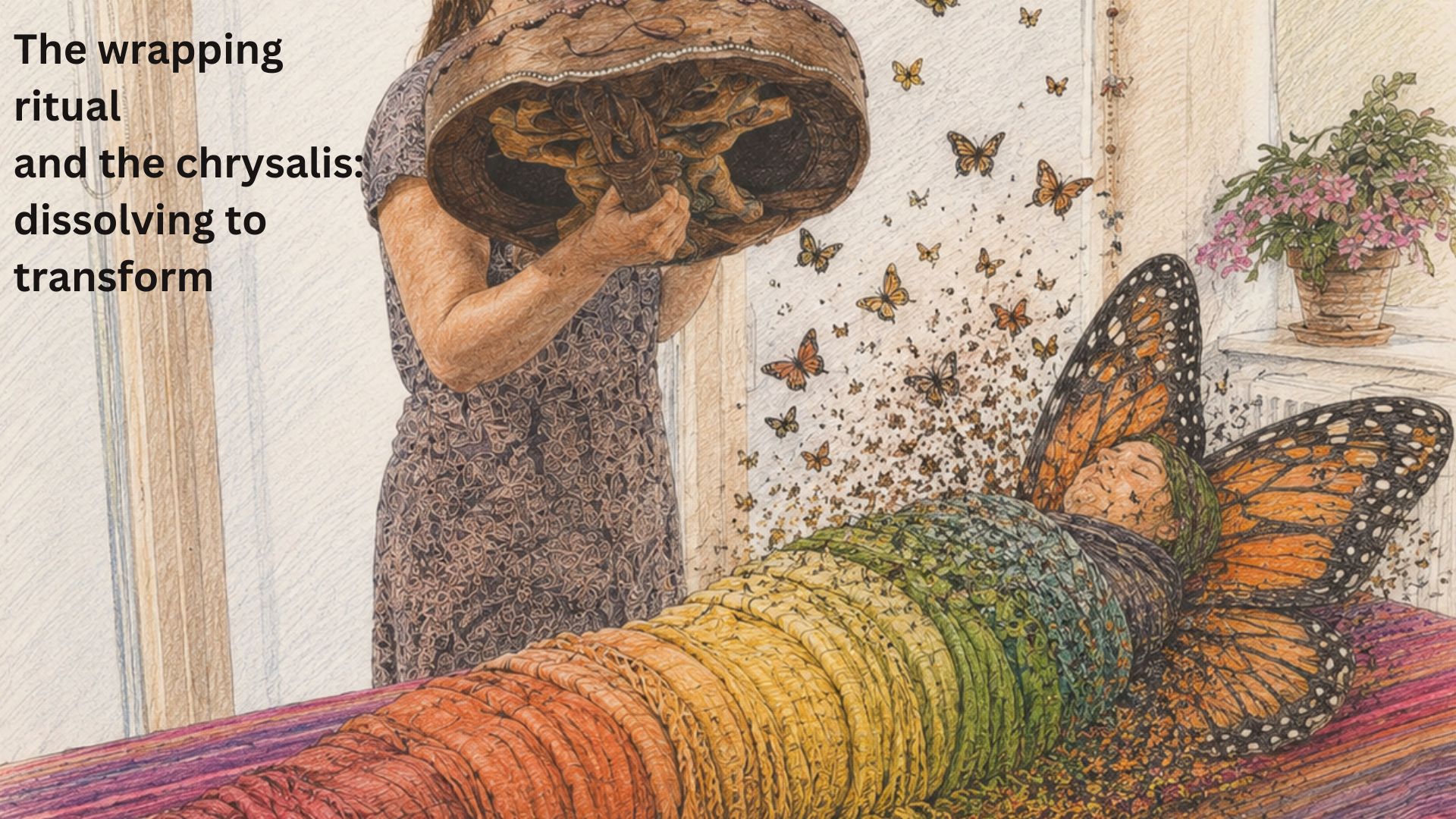
Everybody knows that when a caterpillar is ready, it forms a chrysalis around itself, and that through an amazing process, hidden from view, it emerges in the completely different form of a butterfly.
It is a beautiful and powerful metaphor for transformation, and for the moments in a woman’s life when we undergo deep, transformative change: menarche (the onset of puberty and our first period), matrescence (becoming a mother), perimenopause and menopause (the end of our periods), and other important thresholds. The caterpillar goes and hides somewhere enclosed and unseen, and emerges as a different version of itself.
What you may not know, however, is what has to happen inside the chrysalis for that change to take place. In order to become a butterfly, the caterpillar has to dissolve itself completely. If you were to open the chrysalis at that stage, you would find a sort of “soup” of dissolved caterpillar tissue. Inside this soup, clusters of cells called imaginal discs begin to develop and grow into the new butterfly.
In the phases of womanhood we don’t transform in such an extreme way on the physical level. But the woman who emerges through these thresholds is a completely different version of her previous self. And, inside, her transformation is just as deep, but in our culture at least, is also largely unappreciated and unseen.
Which brings me to rituals, and the lack of them in Western culture.
The rituals we have lost
Since the dawn of time, human cultures have had rites of passage to support the phases of people’s lives, and women used to have them to mark many thresholds. The role of these rituals is to offer a physical, tangible recognition and celebration of the transformation, one that is witnessed by the community, and that makes the change from one state to another clear and honoured.
For the last 15 years I have felt the need to recreate these rituals, both for myself and in my work supporting women, first as a doula and then as a ceremonialist, healer and teacher. During my first year as a doula, when I was recognised as experienced by my mentor, I didn’t want to simply have a drink or a meal to celebrate. I asked my doula trainer, my mentor and a doula friend to create a recognition ceremony for me, one that included stepping over a physical threshold. It was later used for other doulas in the community.
In the Western world, we no longer have the rituals to mark the passages in a woman’s life.
In his book Rites of Passage (first published in French in 1909), Arnold van Gennep observed that when the activities associated with such ceremonies were examined in terms of their order and content, three phases could be distinguished: separation, transition, and incorporation. If we look at this from the viewpoint of a woman giving birth, she separates herself from everyday activities as she enters labour, she transitions into a different version of herself during the birth, and she incorporates the process throughout the early postpartum period of a month or so, finally claiming her new role as a mother. Contrary to Western beliefs, this process is not completed by the birth, but about 4 to 6 weeks after birth, which is why we used to have rituals to celebrate this, known as churching, the end of confinement, or relevailles, in the Western world, up until the first half of the 20th Century, after which it started to fade.
I wrote at length about this topic and the lack of rituals for motherhood in my first book, Why Postnatal Recovery Matters, and the same is true for other phases in women’s lives. Without rituals to witness, anchor, support and recognise the transformation, we are left somewhat at sea. We often minimise or fail to understand the change ourselves. The depth of the process, the need for support through it, has disappeared from our shared awareness, and we do not talk about it.
Because it is not spoken about, let alone celebrated, we have no compass to navigate it. There is little recognition of what a new mother has accomplished in bringing a new person into the world, and little care, nurturing or reverence offered to her. All the attention goes to the baby instead, as if the mother did not exist. No one talks about or understands her need for support, and so many new mothers struggle not only with the lack of cultural holding, but also with blaming themselves for that struggle.
In The Beat of Your Own Drum, I wrote that rituals play a vital role in personal growth and healing by:
- Creating a sacred, intentional space for processing and integrating profound experiences.
- Calming the nervous system and facilitating grounding and connection.
- Tapping into the collective subconscious through symbolic elements and practices.
- Providing a structured framework for processing trauma or shock.
- Fostering a sense of community and shared understanding.
This is why I have become so passionate about bringing rites of passage rituals back to women. In a world where women often feel isolated during significant life changes, ritual offers a way to reconnect with oneself, with one’s community, and with the sacred nature of life’s transitions. And my favourite ritual for this is closing the bones.
What is closing the bones?
Closing the bones is a traditional postpartum massage ritual, most widely known from its Mexican and South American roots. Similar practices exist, or have existed, across all continents, including in Europe. It is a tool for healing and for honouring the transitions in a woman’s journey.
A closing the bones ceremony typically involves:
- A sequence of rocking the body using scarves.
- An abdominal massage, sometimes full-body.
- A sequence of tightening scarves around the whole body.
- In some traditions, a steam bath or sweat lodge.
- Drumming and/or singing, as incorporated by some practitioners.
(Watch this video to see what it looks like)
The ritual supports healing on multiple levels:
- Physical: it encourages movement in joints, muscles, tissues and fluids, aiding recovery and realignment.
- Emotional: it provides a safe space for rest, witnessing and release, allowing feelings to be processed and honoured.
- Spiritual: it facilitates closure, celebration and witnessing, creates space for letting go of what has been, and helps redirect energy back to the woman.
While it is traditionally associated with postpartum care, the ritual holds significance for many transitions and rites of passage. It can be particularly supportive during times of loss and trauma, whether that is the physical loss of a pregnancy or birth, the loss of a baby, the ending of a relationship, or the invisible yet deeply felt losses that come with change. In our modern culture, where such milestones are often overlooked, the ritual offers a chance to pause, reflect and honour the depth of a transformative moment.
Why I created Wrapped in Rhythm
This year I have changed the way I do and teach this work, simplifying it down to the rocking and wrapping, making more room for the space holding and for the drumming.
I did this for two reasons. The first is that I am working towards a deinstitutionalised and intuitive way of sharing this with women (read more about this [here] and [here]). The second is that so many women carry impostor syndrome and worry they can only do this work if they do it “right.” This simpler way allows their intuitive space holding and healing abilities to come through.
In this version (see video), we rock and wrap the body with rebozo scarves, and then intuitively drum over the wrapped woman.
Having taught it online since 2022 to over 400 students, and in person since November 2025, I have seen its effects. The case studies from my students show how deeply healing the ritual is, with self-reported wellbeing often moving from a 2 or 3 out of 10 to an 8 or 9 in a single session. One recent example came from a woman who uses the ritual to ease her partner’s neuropathic pain, which moved from a 9 out of 10 to a 2 out of 10 in twenty minutes. My own case studies show an average improvement in wellbeing of around 80 percent in one single session.
I have felt it myself, too. Back in 2022, when my mental health was in tatters, I received the wrapping during a training with Mexican midwife Naoli Vinaver. The depth of comfort and transformation I felt from just 15 minutes of wrapping in a group setting was hard to believe.
More recently, I asked a group of friends to give me the ritual for my birthday. We gathered in a yurt, they wrapped me, and several of them drummed. I dropped into such an altered state of consciousness from the combination of the two that I lost track of time and space in a way I had not experienced since giving birth to my children.
Since then I have reflected on why adding the drumming makes such a difference. The drum takes the brain deeper into an altered state, and that state is itself a kind of dissolution. The wrapping and the drumming together create a melting, much like what happens inside the chrysalis. And it is this dissolution that allows us to soften, let go, and re-form into the next version of ourselves.
Learn this with me
Wrapped in Rhythm (two-day in-person training) Learn the rocking, wrapping and intuitive drumming ritual, and bring it into your own work with women. All my in-person upcoming workshop dates are listed here
Online courses (self-directed) Learn the wrapping and drumming work in your own time, from anywhere in the world. Browse the rebozo massage and closing ritual course
Seen Into Wholeness (work with me one to one for three-months) A personal container for women moving through transition and wanting to find themselves and new confidence . Find out more here.
Have a question about any of these? I would love to hear from you. Either comment below or get in touch with me here.
Leave a Reply
You must be logged in to post a comment.