Your basket is currently empty!
Category: decision

The Power of Persistence: Changing Illogical Rules within maternity care
Twenty years or so ago, when I was swimming daily at my local public swimming pool, I managed to change the rules to allow the use of training fins.
Prior to this, the pool had a blanket ban on the grounds of “safety”, whilst also allowing the use of hand paddles. Hand paddles are often made of hard plastic, and people use them ahead of them as they thrust forward, therefore they are, in my opinion, much more likely to cause a potential injury to another swimmer,Ā than short training fins, which are made ofĀ soft silicone rubber, and trail behind a swimmer.
Keen to start improving my swim training drills by using fins, I discussed it with one of the managers by the pool side and he agreed to change the rules. Thatās all it took, and I guess that not many people who use fins to train in this pool know how it got changed.
Fast forward to today: about a month ago I joined a new gym/pool place nearer to my home. I went in as a guest of a friend who is a member and used my fins without issues. I decided to join because the pool, though not as nice as the private gym I had been a member of for year, was nice enough, much closer to my home, and much cheaper.Ā It was only after I joined as a member that another lifeguard told me it wasn’t allowed, citing once again the safety risk. I challenged the ruleās logic as someone was swimming in the same lane using very large hand paddles. I explained the lack of logic in terms of risks. But this lifeguard was insistent that rules are rules, and was not interested in engaging in logical debate, even inventing reasons on the spot to justify the decision (something Iāve seen happen a lot in my work as a doula-more on that later).
So I accepted that I would need to train without my beloved fins for now, since I had already joined this gym. However I also remembered my experience as the previous pool and knew that it was worth approaching the centre’s management. After all, I had nothing to lose by asking. I emailed the centreās manager. Contrary to my 20 years ago self, I had grown in knowing that kindness often works better than bluntly pointing out the lack of logic in the rule. Instead, I expressed my surprise, explaining that I have been swimming for over 25 years in 6 different pools in Cambridge and that they all allow short fins. I also pointed out that I fully understood that not allowing the longer scuba style fins made sense in terms of safety (giving people a chance to see that Iām reasonable), but that I could not see the danger of the type of fins I used. I also made sure not to mention the hand paddles as the last thing I wanted was for them to ban them too.
Amazingly, the manager replied to me within a couple of days, agreeing with me and telling me that theyādĀ changed the rules. This morning I took great delight in bringing my fins to the pool. The delight went further than the fins themselves. I felt proud that Iād managed to change a rule that made no sense. This also felt doubly important because the gym in question is part of my local hospital, the one in which I attended births and MVP meetings during my 10 years as a doula. I knew from experience that hospitals tend to be sticklers for rules.
Beyond the fin story, what I feel proud about and why I am sharing this, is that it take not take much to change the rules, and it has benefitted many people. It only takes one person to change silly rules that would otherwise remain. I’m allergic to rules that do not serve humanity and have no joined-up logic behind them. Iād like to encourage you to do the same.
During my ten years as a doula, I also learnt that there are techniques that work better than other when trying to change rules, in order to avoid being met by the typical responde of “I’m obligated to operate within the boundaries set by the existing rules”. Here’s what Iāve learnt from trying to change rules in my local maternity hospital:
- Find a champion
Itās much easier to change things if you can find someone who works within the system, and who shares your vision for change. This is how I got to train the NICU nurses in learning to use baby carriers, after banging my head against the system for years. The same happened when an NHS trust hired me to train their midwives in using rebozo techniques for labour.
- Use competitive pressure
What helped me convince my local hospital to allow partners to stay overnight in the induction and postnatal wards, after banging my head against it without success, was mentioning the number of other hospitals nearby who were already doing it.
- Stretch their minds
When the subject of cord ties was brought up in an patient advocacy meeting, because doula clients were often meet with plain refusal (by people misunderstanding that guidelines are not the law, and always choosing to abide by āthe rulesā),Ā most of the staff looked like we were crazy. I realised that they needed to stretch their minds a bit more, so I said āand have you heard of cord burningā then spent a few minutes explaining what it was. After that they seem to think that the cord wasnāt so crazy after all. In the same way I have sometimes encouraged clients to ask for something outrageous that they had no intention of actually doing in their birth plan, in order to appear to be negotiating down. Iāll never forget the expression on the face of the consultant when my VBAC client, pregnant with twins, told him she was thinking of having them at home.
- Call their bluff
I have helped several doula clients get offered something they were told was not possible this way. I was granted access inside the hospital with a repeat birth client despite lockdown restrictions only allowing one birth partner, by my client writing to them that sheād stay at home instead of going to the birth centre if I wasnāt allowed in. I also had a client 43 weeks pregnant gain access to the birth centre by using the same strategy.
- Pretend to follow the rules
Iāve found that if a pregnant woman says something like āIf I havenāt had the baby by x date Iāll have a caesareanā instantly removed the pressure of induction of labour. It doesnāt mean that you cannot change your mind again should said date comes and goesā¦.
I havenāt always been successful. On one occasion my attempt at changing the rules backfired. I was trying to encourage the hospital to change the illogical rule that only allows one partner inside the theatre. No doula was ever allowed in with her client and their partner (this rule was only bent once by a couple who were so assertive that they told staff they wouldnāt go in without me), and they used ridiculous claims of ālack of spaceā (whilst allowing in students and private phlebotomists from cord banking companies), or āsafety of mother and babyā (how exactly would a doula compromise this?). When I look back I could have gone about it in a more clever way (citing other hospitals doing it, and asking staff for the best person to talk to), and my discussions with the head of the delivery unit and the consultant anaesthetist resulted in not only no change to the rules, but a memo being circulated reminding everyone of the rule.
It always baffles me when people follow rules without questioning them, or wondering if they are based on solid evidence, and simply do as they are told. I guess questioning things and tenacity are my blood. I also have a very strong sense of justice and deep aversion to rules that do not serve humanity or make no sense.Ā I really like to support others in doing the same.
With persistence, kindness and strategic approaches, we can all be change agents – questioning unreasonable rules and advocating for what makes sense and serves humanity.
Does this resonate? Have you successfully changed rules, or banged your head against systems that refuse to change? Please comment below.

When It’s Time to Shed Your Skin: Letting Go of What No Longer Serves You
I’ve decided that it’s time for me to retire from selling rebozos.
I never intended to sell them, it’s just that, as I ran a lot of workshops, people kept asking. At first I only brought them to workshops and then through word of mouth alone, I got messages from people wanting them, there was so much demand that I found the process too time consuming (lots of taking pictures and emails). Eventually I had to ask my webperson build me a webshop.
Fast forward to today, 7 years later I’ve noticed over the last couple of years that the process of importing, taking pictures, putting listings on my website, packaging each rebozo, taking packages to the post office, plus the tallying of countless paper receipts for tax purpose, is not only a very time consuming process, itās no longer bringing me joy.
Not only that, but it’s taking me away from what I feel I am really gifted at, which is creating content. Courses, blogs, books etc. These things give me deep joy and feel part of my soulās purpose.
Plus the last audit I did of my business showed that the profit I make from selling rebozos represent less than 10% of my income, but it sure takes a lot more time than the things that earn me the most money (my online courses). So itās time for me to retire from selling them. When my current stock of rebozos is sold, I’ll close that part of my online shop. When Iām ready to close the shop, I’ll recommend another UK seller I trust and who imports from the same ethical suppliers as I do. I may still order a small batch when I run in person workshops (because this is still enjoyable and was less time consuming than online selling).
Reflecting on cycles of outgrowth and shedding
Iām sure you are familiar with the fact that some animals, like snakes or lobsters, grow by shedding their skin or shell. The sign that the old shell or skin has been outgrown is tightness and discomfort. I love this reflection about how lobsters grow in particular.
When I look back at my professional life there has always been a lot of outgrowing and shedding.
As a scientist, I did my PhD in two different labs, and then 2 postdocs in 2 different research centres. Then I worked for a start-up biotech company for 7 years. I wondered if it meant an unusual break in pattern, however over the course of these 7 years there was enormous evolution to my role, from bench scientist to team leader, with the organisation growing from 12 to 100, moving 3 times, merging with another company then being bought by a big pharmaceutical company. It was all quite exciting, and explains why I stayed so long in this company. Interestingly, when the job became boring after the company was bought by a large pharmaceutical company, and I agonised over leaving because I had a months old baby and negotiated a part time arrangement, I was made redundant and it was actually a big relief. After that I went back to academia for 4 years, and I had two completely different roles in two different departments in a very large research centre.
The last 4 years of my scientific career, I straddled two worlds. I trained as a doula, antenatal teacher, and babywearing instructor. I did sling consultations on my day off, and taught antenatal classes during evenings and weekends. What precipitated my departure was attending a birth as a last minute backup doula on my day off, and coming back to the office on Monday morning and thinking, what am I doing here? This is so much more exciting. When I handed over my notice, I felt completely elated.
When people tell me I was very brave to leave a successful scientific career behind to become a doula, I explain that it had nothing to do with bravery, I simply couldn’t not do it. My soul wouldn’t let me. Working in science those last few years felt excruciating; I was chained to something my passion had outgrown. My whole being knew it was time to shed that skin. So I wouldn’t call it brave to walk away. When I left, my spirit soared straight up as if finally set free. I simply had no choice but to change course and follow where my purpose was leading, to work that lit me up from the inside. I was no longer outgrowing that science skin – it had become dead weight.
For a few years I worked as a birth and postnatal doula, antenatal teacher and babywearing consultant. It was so exciting and rewarding! Never in my scientific career had I cried tears of joy before, and this was a regular occurrence in my new job.
I went to countless study days and training. I soon found myself offering workshops to birth professionals, and organically grew towards teaching professionals rather than parents.
As my interests and offerings grew, I soon found myself in a quandary: as a solopreneur, there was only one of me, and too many interests yet not enough hours in the day to meet them all.
What I noticed started to happen naturally, as my new interests grew, is that some of the stuff I had been doing for many years was no longer giving me joy. When this started to happen, I think I knew straight away, but I pushed the feeling away for quite some time. After all, I had invested significant time and effort in the training, and acquired a lot of experience along the way.
For example, in the case of teaching antenatal classes, I had trained with the NCT, and this had included getting a DiPhe in antenatal education, complete with graduation ceremony. When only about 4 years after starting teaching I started to get the unmistakable sign that it was time to move on (in my case the sign is always boredom), I really struggled with this, and carried on teaching for a couple of years after that. When I finally told my husband that I was going to stop teaching the classes, he reminded me that I had made the decision 2 years before.
Still I spent some time agonising over the decision because, whilst it was clear that this was no longer my path, there were aspects of the work I knew that I was going to miss. After stopping when Iād bump into couples who had attended my classes, and theyād ask me if I was still doing it, I would feel a pang of regret.
The same was true when I decided to stop teaching babywearing. I had started teaching closing the bones and Reiki workshops, and the spiritual element of this made my soul sing. I realised that teaching babywearing was no longer spiritual enough for me. Similar iterations happened over the last few years, some came from my spirit, some forced by circumstances (for instance when the lockdowns forced me to move from offering in person workshops to online courses).Ā
There were things I only offered for a couple of years before I felt that it was no longer right.
Stopping doula work was quite hard even if the message to stop was really clear. The message that came was that, unless I stopped this work which was taking so much time, mental space and energy, I wouldnāt be able to start offering the next chapter of what I was supposed to offer.
Even if I have no regrets because this is no longer my path, I still miss aspects of this work. This year I have supported a few families on an adhoc basis in one to one antenatal and postnatal sessions. When this happens, I notice two things: my depth of knowledge in this area, and my missing the deeper connection that comes with repeated meetings. This isnāt enough to make me go back, but these are bittersweet moments.
It feels so linked to the cycle of life, birth, growth, decay, death, and rebirth. There is a time for everything, and we need to let things go if we want to make space for new things. It takes time and acceptance.
As I walk in my favourite forest spot at this time of year, grateful for how much nature has taught me since I embarked on re-immersing myself in it a few years ago, I look at the trees shedding their leaves, and I think: they arenāt holding on, or scared of letting go.
To me itās the natural cycle of life. A time and season for everything. Only by releasing the worn and outgrown shell of the past do we make room for the new growth waiting to emerge.Ā
How do you know when itās time to shed something you have outgrown in your work or personal life? What are the signs for you? Please comment below.

Why I created a podcast called The Wisdom Messenger
I just launched a new podcast. It took me a while to decide on the name because I wanted the name to reflect the eclectic range of topics that I intend to cover. I didnāt want to niche myself. Iām a multi-passionate person with a multilayered, forever evolving business (the official name is a polymath but I find that term too dry), and therefore the podcast needs to reflect this.
Iām a sharer. I always have been. Itās in my name after all, Sophie is the French version of the Greek name Sophia means wisdom, and Messager means messenger in French. If you know me you know I can talk the hind leg off a donkey. I share because I want to help make the world a better place. I started blogging in 2015 and Iāve written about 200 posts, with an acceleration at a rate of a post every week or every other week since 2021. I published my first book, Why Postnatal Recovery Matters in 2020. The book has now been translated into 2 other languages, and soon will be available in a third. Iām writing my second book about how drumming can support the birth journey and life transitions.Ā
For every person or family who reads my writing and feels heard, supported and helped by it, I feel Iām achieving my soul purpose.
Over the last couple of years Iāve discovered that consuming knowledge via audio works better for me than reading, because I can listen whilst doing other tasks such as driving, or cooking. It has changed long boring drives into transformative moments. Iāve got a Bluetooth speaker in my kitchen and it has transformed prepping meals from something tedious into something Iām looking forward to. Iāve listened to countless books and podcasts episodes, and itās a great way to feed my ADHD hyper focus when it drives me to explore new topics in extreme depth.
So it makes sense that I chose to share my stuff via audio too. I didnāt do it sooner because I didnāt know how and I thought it would be really complicated. Mastering new tech is my nemesis, and I often procrastinate for ages when an element of this is involved. I am very grateful for authentic business coach George Kao, because last week I started his new course called Interview Mastery, and it gave me the impetus to start the podcast.
Once I started, I realised (this has been true pretty much every time Iāve procrastinated over tech stuff) that the process was actually a lot easier and faster than I had expected. I like to compare processes to giving birth, with conception, gestation, birth and the postpartum (read my post about this here). I had a long conception and gestation, then the birth had some stop starts (mastering adding music to the beginning and end of the episodes took a lot of trials and errors, it felt like a stop start labour!), but in the end it was a fairly speedy, smooth and joyful birth. Iām now basking in the afterglow of high oxytocin and dopamine.
My signature approach, what I feel I am really gifted at, beyond sharing stuff, is bridging the scientific and the spiritual. I feel humanity is at a crossroad and unless we re-learn to become connected to each other, our inner wisdom, and the planet, we are headed for extinction.Ā
In this podcast I am going to share conversations with pioneers in womenās health and personal development to reclaim lost knowledge and restore inner wisdom. I want to help bridge insights from ancient traditions and modern research, question stale cultural narratives and midwife a new paradigm around birth, life transitions, and womenās autonomy. Expect stories and studies that empower women to reconnect with their inner voice and live their truths, to fully trust ourselves and shape our collective future.
With this in mind, what better first guest could I have asked for than Jane Hardwicke Collings. Jane is a grandmother, former homebirth midwife for 30 years, a teacher, writer and menstrual educator and the founder of the school of Shamanic WomanCraft. Join us as we discuss how drumming can support the birth journey. Highlights of this episode include how making a drum can provide the medicine a woman needs during pregnancy birth and life; Janeās own birth story and how drumming helped her experience an ecstatic birth; how drumming can help us communicate with our babies during pregnancy, and can effectively reduce pain during birth, and how it can help us connect with our great great grandchildren to know what do to now change the world to become a better place.My podcast is called The Wisdom Messenger, a literal translation of my name. You can find it on Spotify, Apple Podcast and YouTube.Ā
I would love to hear what you think of the first episode, and also please get in touch if you fit the description of my ideal guest and would like me to interview you.
Play
Push back: challenging the alarming rise of non-medically indicated inductions
A couple of days ago, I got a call from a woman in early labour. Her waters had broken a few hours before, and she was having mild contractions. She wanted to give birth at home, and was reluctant to let her midwife know about her waters breaking, because she knew that after 24h, there would be pressure to go to the hospital to induce labour. I reminded that it was her right to choose to stay at home, even if induction was offered. I also explained that she could either tell the truth (and be prepared to stand her ground), or chose not to, if having to argue during labour felt like too much.Ā
She went into established labour shortly after our call. When her midwife arrived, she told her that her waters had broken 3h prior. The midwife said that she needed to transfer her to the hospital immediately for induction because, she said āyour waters are GONE and there is a high risk of infectionā.Ā
This woman was a second time mum, and was having strong contractions every ā minutes at this stage. She refused to transfer, insisting she wanted to give birth at home. The midwife left shortly afterwards, saying that she wasnāt in established labour. Five minutes after the midwife left, the woman started to push. She gave birth at home in the end, and the midwife came back, but what should have been a beautiful and joyful experience left her feeling angry and stressed instead.
The induction coercion
Over the last few weeks, I supported several births even though Iām not officially working as a doula anymore. People find me and I just canāt leave them without support in such a damaged system. Everytime I find myself supporting people, it is because they are being coerced by the system. In some cases I do home visits, officially to offer techniques for labour, but in reality I spend most of my time reminding people of their human rights.
The women I supported recently were either ālateā to give birth, having a long prodromal labour, or had their waters break before contractions started.
What was the answer to all of these situations? You guessed it, induction of labour.
What prompted me to write this was the extreme unusual circumstance of the birth in the intro paragraph. The midwife who turned up at her homebirth was adamant that she needed to go to hospital to be induced, but there was no clinical rationale to do so, even within the very tight hospital guidelines.
In my nearly 15 years in birth work, I had never heard something as ludicrous. I suspect the midwife was a delivery unit midwife sent to cover for community midwives, and that she was not feeling safe supporting a homebirth. When this had happened in the past, and I saw spurious reasons used to suggest hospital transfer, at least there was some tiny something that was outside of guidelines, like an increased temperature 0.5 degrees over the upper limit. But here there was none, zero, nada.
The rise of induction of labour
When you have been around this field for as long as I have, you can see trends in plain sights.
Birth centre rates are dropping. In my local hospital, when the birth centre opened in 2012, the goal was that 30 to 40% of all births would take place there. In 2014, the rate of labour started in the birth centre was over 30%, and 25% of births taking place there. Based on the last 3 years of infographics, the current birth centre rate is only 13%.
Homebirth rates are also at an all time low. Before my local birth centre opened, the local homebirth rate was 6%. It is now below 1%. This is despite plenty of evidence showing that homebirth, for healthy pregnancies, is as safe as hospital birth, and with a much lower rate of intervention than in the hospital (90% chance of vaginal birth at home versus 58% in an obstetric unit, for the same category of low risk women). When the birth place study was published in 2012, I rejoiced thinking that we would see homebirths and birth centre births skyrocket. Instead, the exact opposite has happened.
This means that 85% of births are taking place inside an obstetric unit, an environment completely ill-suited to supporting the physiology of birth. Bright lights, no curtains, noise, tiny cramped rooms with no ensuite bathrooms, and staffed by people who have become deskilled at supporting physiological birth.
This also means that the percentage of women going into labour naturally is only 47%, the rate of vaginal birth is only 47%, and the rate of caesarean birth is 41%.
We are in the midst of an epidemy of unjustified induction of labour. With the recently updated NICE induction of labour guidelines, it is only going to get worse. My local hospital had an induction rate of 38% in their last infographic, and with the new guidelines making induction happen earlier in pregnancy, because induction doubles the change of having a caesarean, it is likely to be over 50% within the next few years.
Logically, it makes no sense.Ā It is not biologically possible that less than half of women are able to start labour by themselves or give birth vaginally.
Scientifically it makes no sense, because the main reason to induce labour is to avoid stillbirth, yet rates have remained the same over the last ten years, despite rates of induction in the UK going up from around 21% to 34% on average (the latest UK maternity statistic available are from 2021, I suspect itās already higher than this now).
The trauma induction causes
Induction of labour is not a benign intervention.
Recent research shows that induction can cause harm to both women and children
- “Women with uncomplicated pregnancies who had their labour induced had higher rates of epidural/spinal analgesia, CS (except for multiparous women induced at between 37 and 40 weeks gestation), instrumental birth, episiotomy and PPH than women with a similar risk profile who went into labour spontaneously.
- “Between birth and 16 years of age, and controlled for year of birth, their children had higher odds of birth asphyxia, birth trauma, respiratory disorders, major resuscitation at birth and hospitalisation for infection.”
- “IOL for non-medical reasons was associated with higher birth interventions, particularly in primiparous women, and more adverse maternal, neonatal and child outcomes for most variables assessed.”
Induction of labour can also be long, painful and traumatising. This isnāt explained to family when this option is āofferedā. Nobody explains that it might take 5 days and you have about 50% chance to end up with a caesarean at the end. Nobody explains the process in detail, and the fact that the hospital is so busy, that they often stop the process half way through because there is no space in the obstetrics unit, leaving women in the ward, in limbo, sometimes for as long as 3 days. I wrote about this in my article, Induction of labour, do you know what youāre letting yourself in for?
Families Iāve supported have sometimes gone home for 24h in the middle of an induction, so they could rest, because nothing was happening. They were told off for this, told this was dangerous. Yet they were just being parked there, to quote a local midwife, ālittle cattleā.
How to push back
The system is so unfit for purpose, and the level of coercion is so rife within it (itās gotten much worse since 2020 and this was one of the reason I stopped working as a birth doula) that whenever families call me for support, I have to tell them how to counter coercion with extremely assertive statements, lies, or legal threats. This is so wrong.
Educating yourself or people you support about your human rights, and reading or listening to people who look at the research and challenge medical guidelines, especially when they are harmful, can really help you feel stronger in sticking to what’s right for you.
My blog is full of articles on the subject. I also love both Dr Rachel Reed, her midwife thinking blog, her book about induction, and her podcast the Midwives’ Cauldron (there is an episode where I talk about the postpartum), and also Dr Sara Wickham, her blog, newsletter and many books, including What’s right for me.
A new model
Change will not come from within the system. Reading the book Closure really cemented this. I am no longer willing to waste my precious time and energy trying to make change happen from within. I have given 10 years of my life to maternity patient committees. It was an incredibly frustrating experience. I used to feel bad because I mistakenly believed that things didnāt change because I didnāt work hard enough.
I recently listened to podcasts from Australian midwife Jane Hardwick Collings. What is happening to women during birth, she said, is āinstitutionalised acts of abuse and violence on women and babies masquerading as safety.ā
This really hit me hard. I had to pause and rewind and re-listen this sentence as I let it land. Because it felt so hard, and yet so true.
In my work I have heard and seen it so many times. The coercion, the abuse, so many horror birth stories. I hold trauma from witnessing these. Itās so ingrained that people inside the system do not even see it.
Over ten years ago, traumatised by the second birth I supported as a doula, I read Marsden Wagnerās paper, Fish canāt see water: The need to humanize birth in Australia. The paper was published in 2000, and yet everything he wrote is still true:
Ā āHumanizing birth means understanding that the woman giving birth is a human being, not a machine and not just a container for making babies. Showing women ā half of all people ā that they are inferior and inadequate by taking away their power to give birth is a tragedy for all society. On the other hand, respecting the woman as an important and valuable human being and making certain that the womanās experience while giving birth is fulfilling and empowering is not just a nice extra, it is absolutely essential as it makes the woman strong and therefore makes society strongā
Tricia Anderson wrote her article, Out of the Laboratory: Back to the Darkened Room
Ā in 2002, and her conclusion is also more apt than ever:
āSadly most midwives and doctors working today have trained and worked for most of their lives in that laboratory: and in that laboratory ā which is of course, a modern consultant maternity unit ā childbirth is a mess. In this day and age of evidence-based practice, we talk so much of the importance of evaluating every intervention. Yet, no one is saying that we desperately need to evaluate the biggest intervention of them all ā asking women in labour to get into their cars and drive to a large hospital where a stranger takes care of them.ā
I used to try and make change happen from the inside, now my perspective has changed, I want to use my precious time and energy to facilitate change from outside the system. To help people stand up to institutionalised abuse. This is why I still support families, this is why I share rebozo techniques.
When I receive quotes like these, I know I am making a difference:
āMy daughter is a week old and my wifeās labour went like this: contractions started at 6am one morning and at 9pm our midwife came to see us and my wife was only 1cm dilated. She said baby wasn’t in a great position and that we would wait until morning to see how things were going. Before she left she mentioned about ‘rebozo’ which we had both never heard of.
This led to us searching for the technique where we stumbled upon your website. A quick look at one video and a bit of information I attempted this on my wife. The next contraction she had we heard an audible clunk and her water broke. Contractions instantly got longer and stronger. This was about 10pm and 2 hours later we were holding our baby girl. Dan
This is why I write articles like this one, or like The Myth of the aging placenta. This is why I am currently teaching about using shamanic drumming to support pregnancy and birth. Because once a woman has, through the change of consciousness that drumming helps facilitate, communicated with her baby repeatedly, she has access to her intuitive knowledge and power. She knows she doesnāt need a machine to connect with her baby, and is therefore not likely to let an āexpertā stranger dictate what she should do.
There is change brewing, and people are starting to take matters into their own hands. As my Chinese husband says, when you push the pendulum too far one way, it always swings back the other way.
I invite you to look at things from a birdās eye perspective, and ask yourself: what can I do to facilitate a shift. I would love to hear your ideas.

How to choose and buy a shamanic drum
In this article I want to share the options available if you’d like to get your own frame/shamanic drum. There are many options to choose from and I hope I’ll make nagivating that decision easier for you!
As I created the content for my Drumming for Birth course, I had one of those beautiful “aha” moments while explaining how to choose a drum. You know those times when you suddenly realise just how much expertise you’ve accumulated, but you did not know until you stopped to reflect on it ? As someone with ADHD, one of my superpowers is the ability to hyperfocus on subjects that fascinate me – and drums have certainly been one of those subjects!
At the time of writing this, I own over 30 drums. I’m going to tell you about the categories, the pros and cons of each, and how much a drum cost to buy, including some real unexpected bargains. I’m also going to tell you about what to avoid.
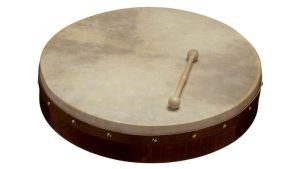
The type of drums I use are frame drums. One of the oldest known musical instruments, frame drums are found in various forms across many cultures worldwide and play significant roles in spiritual or ceremonial contexts. They are sometimes referred to as shamanic drums. A frame drum is a simple percussion instrument, typically circular in shape, consisting of a round wooden frame 2-4 inches deep, with a single drumhead stretched over one side. They can be played with the hand, or with a beater. The drumhead is traditionally made from animal skin, but synthetic materials are also used. The skin is usually secured to the frame with lacing. Frame drums produce a warm, resonant tone and are capable of a wide range of sounds, from deep booms to crisp, high-pitched tones.
In my work I use frame drums with a handle, the kind that is played by hitting it with a soft beater.
Frame drum categories:
Frame drums come into 2 main categories: the ones that are made of animal skin (known as hide), and ones that are made of synthetic skin (plastic material, or sometimes canvas type fabric).
Size matters: the bigger the drum, the deeper the sound. As a rule of thumb, I would suggest you start with something no smaller than 14 or 16 inches for a good sound. Tiny drums do not usually sound great. Really big drums (20 inches and above) have a beautiful deep sound by they can be unwieldy to carry and hold.
Synthetic drums

I have 2 main synthetic drums: A 16 inches Remo Buffalo drum (A misnomer as the drum is made of a synthetic skin) and a 16 inches Remo Bahia Bass Buffalo drum (it has a deeper sound than the normal Remo Buffalo). I also have a couple of synthetic Kanjiras (a small Indian drum with a jingle), and a small 8 inches hand held synthetic Remo which I mostly use for travel.
Synthetic drum Advantages
- Good, reliable sound (this applies only to reputable brands, see below on what to avoid)
- Sounds remains the same regardless of weather/water/temperature
- If you play outdoors like I do, and live in a cold and wet country, youāll be grateful to have a synthetic drum. You can play it in all weathers, even in the pouring rain, without the sound being affected. I’ve even taken mine inside sweat lodges and saunas.
- These drums are typically cheaper than a skin drum, a Remo Buffalo Drum costs about £115 for a 16 inches drum
Synthetic drum disadvantages
- Remo drums are made in a factory. Although all drums have their own spirit, and you can connect to the spirit of a drum even made of synthetic material, I feel that they have less āspiritā than hand made drums.
German company Thomann has sound samples of Remo drums (and many other drums) on their website.

Drums made from animal hide
I own 24 different skin drums, 7 of which I made myself in drum birthing workshops or on my own, and the others I bought or received as gifts.
Skin drums advantages
- Unique, beautiful, individual drums
- Handmade by cottage industry businesses or with your own hands
- Unique spirit and energy (and different hides from different animals, each with their own unique energy)
- You can buy them ready made, have them custom made, or make them yourself to your own preference and style (including adding symbols, crystals, painting them etc)

Skin drums disadvantages
- The quality can vary a lot & there are fakes (more on that below)
- They are sensitive to weather, moisture & temperature. In winter you need a fire to warm them up if outdoors or in cold weather
- They can get damaged by heat or moisture (you cannot play them in the rain and you have to the careful not to leave them somewhere hot, for example in the car)
- Because they are handmade, they tend to be pricey (from £150 to £300 or more)

I have skin drums from the following makers, and I trust and recommend their work:
- Melonie Syrett at The Drum woman (UK)
- Jonathan Weekes at Heron Drums, UK
- Painted drums at The Sea Crow, UK
- Veleslav Voron at Shaman drums (Ukraine)
- Juha Jarvinen at Yxpila Art (Finland)
- Ayas Irgit, (Russia)
There are many other makers of drums both in the UK and around the world. Ask for recommendations and see whose work you resonate with.

One affordable skin drum option I often recommend is the Irish Bodhran. Whilst it is not officially designed as a shamanic drum it works perfectly for that purpose (read my article where I share how I overcame the misguided idea that there was only one right way to play this drum). A bodhran usually comes with a wooden stick called a tipper, and youāll need a soft beater instead but these are very easy to make (a foraged stick and a stuffed sock or piece of felt attached to the stick with a string or elastic, or watch this video). Or you could buy a beater to go with your drum. Drum beaters come in factory or handmade versions. There are plenty of handmade ones on Etsy.
My first drum was a Bodhran, bought by my parents in Ireland from the oldest bodhran maker in Ireland, Malachy Kearns, and gifted to me. Malachy Kearns bodhrans start at 130 euros, however I have found such bodhrans available second hand on Ebay or Facebook marketplace for as little as £30 to 40. Another well known bodhran brand is Waltons. Just make sure to buy one that is a decent size, at least 12 to 14 inches.
When it comes to acquiring a skin drum, you can either buy one ready made, have something make a custom drum for you, or (the ultimate experience in my opinion), attend a workshop with a skilled drum making teacher, and make your own. When someone makes a drum for you, or you make your own drum, this drum carries the medicine that you need.
Size matters
With any drum, the bigger the drum, the deeper the sounds ( though I have sometimes seen smallish drums with surprisingly deep sound). For a starter drum I recommend something between 12 and 16 inches diameter. Really big drums (20 to 22 inches diameter) have beautiful, deep, resonant sound, but they can be tricky to hold and carry.
A few other people I have either seen drums made by (some run drum birthing workshops and also sell kits to make your own drum)
General instruments shops that sell drums and other musical instruments in the UK:
A list of makers recommended by knowledgeable friends (but I haven’t seen these drums myself)
- Hollowbone sacred drum (UK)
- Lyn Gosley (UK)
- Wendy Ravenowl (UK)
- Deborah Ann Grant (UK)
- Louise Karuna (UK)
- Hollie Hope (USA Utah)
- Melonie Cannon (USA Utah)
- Cedar mountain drums (USA)
- Blacksage woodwork (Canada)
- Suka Waka (netherlands)
- Open your drum (Ukraine)
What to avoid when buying a drum
Quality matters. If at all possible try to listen to the sound of the drum before you buy. There are many cheap drums on Amazon for example, which are poor quality. They would be ok for a small child to play with. I was surprised when visiting Djoliba, a big percussion shop in Toulouse, France, to see a tiny drum cost more than some much bigger ones. The shop keeper explained that the tiny one I was looking at was handmade by a very well known drum company called Cooperman in the US, whereas the shelf of bigger drums I was looking at where factory made in India.
Sadly there are also fake drums. A lot of whatās sold on Facebook ads, Ebay or Amazon are often fakes/copies of real drum, made in China. People simply copy the artistās pictures, and print and glue them on a plastic drum the size of my hand. Because they use the real artist pictures in the listing, what you think you’re getting and the reality are completely different, The drums made by Velenslav Voron for example, are so distinctive in style that I instantly recognised one of his designs on a Facebook ad for Ā£30 on Facebook. I knew something wasnāt right, so I contacted him and he told me about the stealing of pictures, and the cheap copies, and about not being able to do anything about it because if he reports a shop, another shop pops up the next day. A friend bought such a drum and she sent me pictures of a crappy plastic drum not even good enough for a child, with the picture and surrounding tape peeling off. Currently you can buy drums that look like the Shaman Drums from Ukraine for under Ā£10 on Aliexpress. Remember: if itās too good to be true, it probably is. Get recommendations, and if possible, get to see and try before you buy.

I hope this is helpful, and if you end up buying a drum with the help of this post Iād love it if you posted a picture of your drum in the comments
Happy drumming!

If this speaks to you and you’d like to find out more about the work I offer with the drum, from one to one work, to healing, drum circles, workshops, and courses, you can find out more on this page.

The importance of switching off when you work for yourself
I’ve been working as a solopreneur for 10 years.
The first year I went away on holiday, as a newly self-employed birth worker, I noticed that I was still responding to work emails, something I never did when I was an employee. I didn’t resent it but I was very conscious of the difference. As an employee, I used to truly switch off when I was away, and I rarely worked outside of my contracted hours.
Sure, in my pre-parent years whilst working a postdoc and then for a biotech start up I worked very long hours, including weekends and evenings, but chose to do so myself and didn’t resent it. After becoming a parent, I did the odd bit of work in the evenings and at the week end, but mostly I went home and did not work, and certainly never worked whilst on holidays.
Since I left science and started working for myself, my business has kept growing. There is always stuff to do, and at the beginning I was rarely switching off in the evenings or during the week-end.Ā I also interact with a lot more people than I did at the beginning, so there are messages coming from many different sources and apps, messages on my business page, comments and questions, and so on, which need replying to.
In the digital age with live in, where the boundaries between work and home are somewhat blurred, I might have ended up there anyway if I’d remained a scientist. I read Cal Newport’s book, A world without email, and his description of the corporate world of today certainly seems fitting with a constant barrage of messages.
As I’ve grown older and a more experienced self employed person, I have become more conscious than ever of the need to establish firmer boundaries in my life between work and play, to be more present to myself and my family, and to resist the desire to answer yet one more email or message. The downside of being self employed (the upsides far than make up for it however!) Ā is that I used to have an underlying feeling of guilt when I was not working.Ā I found myself thinking that I ought to work 9 to 5 and be productive all the time, something that I now see as a hangover of our education and workplace system.
About 4 years ago I embarked on a journey to get out of this productive overwhelm, and I blogged about it here. I ended up writing a whole collection of posts on the topic, which you can find listed in this post. It has been so utterly transformative that I am think I may end up creating a course to help others do the same.
The other important aspect to consider is, when you have chosen a path that involves giving and caring for others, you need to spend time away from that, refilling your own tank and giving to myself, before I am ready to give again to others (I wrote a post about that too).
During my first summer break as a self employed doula/birth educator, I was quite shocked to notice how tired I was, because for the first for the first 3 or 4 nights of my holidays I slept for nearly 12h each night (a normal night for me is usually between 6 and 7h of sleep).
In recent years, I’ve learnt to plan for time off work by putting in in my diary so I know what my availability is and I also know not to over commit myself. I’ve also become much better at feeling my body’s energy and wellbeing, that when I need to slow down I feel the need before I reach crashing point. February to April this year were an intense time for me, supporting my last doula clients, and having a new puppy to care for, and launching 3 online courses (the postnatal rebozo closing ritual course, updated rebozo for pregnancy and birth course, and my new How to run a mother blessing course). I really feel the need to slow down and recharge deep in my bones.
Ahead of my holidays, I plan my work so that I can truly switch off. I am going to have long leisurely days with a lot of time outdoors, some long, social family diners, I’m going to read more books and swim in as many bodies of water as I can. Bliss.
And when I’m back at my desk, I am going to continue refining my work-life balance, so that I am in a state that works for me, keeps me purposeful and happy, to keep putting the things that keep me fuelled like drumming, wild swimming and dancing as the most important things in my to-do list,Ā and spend as much time as possible being joyfully present.

New NICE induction of labour guidelines. Have we taken leave of our senses?
The National institute for clinical excellence (NICE) has published new draft guidelines for induction of labour. They are open for consultation until the 6th of July 2021.
The part that is most concerning is this:
Consider induction of labour from 39+0 weeks in women with otherwise uncomplicated singleton pregnancies who are at a higher risk of complications associated with continued pregnancy (for example, BMI 30 kg/m2 23 or above, age 35 years or above, with a black, Asian or minority ethnic family background, or after assisted conception).
You read that right. The new guidelines propose that everyone whose body mass index is over 30, above 35 years old, who is black, brown or any non white background, who have conceived through IVF, should all be induced at 39 weeks of pregnancy. I couldn’t help but wonder: how many people does this leave, who do not fall in these categories?
I had a look at the office of national statistics, to check what percentage of the population these groups represent together. I havenāt been able to find detailed enough data to remove overlaps between the groups. However, I have found the following:
- About 50% of pregnant women are classified as overweight or obese in the UK
- Black, brown and ethnic minorities represent about 10% of the UK population
- About 25% of babies born in the UK were conceived by IVF
- About 25% of babies born in the UK are from mothers over 35
I know that some of these categories overlap, but Iām guessing that not many people will still fall within the ālow-riskā people being āallowedā to go into labour naturally if this guideline passes at it is. Especially as, in my experience, few people question the “guidelines” and apply them as if they were the law.
Worryingly the rate of induction has already just gone through a major rise. Since March 2020 many trusts have seen steep rise in induction (and cesarean) rates. (this is easy to find in the infographics shared from various trust pages on social media). In my local trust, the induction rate has gone from being between 25 and 30% prior to March 2020 to 39% in May 2021. Doesnāt it feel extremely odd to you that nearly 40% of the population already needs to have their labour artificially started? Isnāt it possible that this rise wasnāt justified by evidence, but rather by a knee jerk reaction to the covid crisis?
If the above guideline goes ahead as it is, what rates of induction are we going to see? Are we headed towards in a situation where everyone has their labour induced? How is this logical? How is this balanced? Have we taken leave of our senses?
The draft guidelinesĀ are open for consultation until the 6th of July 2021. If you wish to comment, you are welcome to copy and paste some of my comments to issue your own reply to the NICE consultation. Just email InducingLabourUpdate@nice.org.uk
Dr Sara Wickham has published an extensive blog about it too.
Dear Nice labour induction team
My name is Dr Sophie Messager. I am an ex biology research scientist turned doula and perinatal educator.
Over the last ten years in this role I have seen theĀ rate of induction of labour in my local trust rise from 24% to 39% without an improvement in maternal or fetal outcomes.
What I have witnessed however, is that induction of labour often causes trauma for mothers and their partners. I have also witnessed time and time again that true informed decision rarely takes place because the majority of parents rarely get told what induction of labour entails (in primips often a 3 to 5 days process which ends up in a caesarean). They rarely get told that it is a choice (most get told āweāll book you in for an inductionā), and they also rarely get told of the risks that are involved in inducing labour (increased risk of caesarean birth and fetal distress amongst other things). I also see a lot of coercion in making sure people consent to having their labour induced, and in particular implying that the baby might die if they do not agree. I wrote in more details about it in this blog post.
Since March 2020, most hospitals trusts banned the access of partners to antenatal wards, only allowing them during established labour, I have witnessed women being induced for 5 days, alone in antenatal wards with no support from myself or their partners. This is dehumanising and traumatising for women and their partners.
Since March 2020, I have also seen rates of induction and caesarean rise by about 10% in many hospital trusts, with no evidence behind the change. In my local trust, the induction rates was 40% in May 2021, when it was between 25% and 30% prior to March 2020. Carrying out a survey of the rise of induction rates since 2020 across UK hospital trusts since March 2020, and the reasons behind them, and whether this rise improved outcomes or not would probably prove very informative. Surely the percentage of women who go into labour spontaneously has not decreased by 10% in less than a year?
I am worried that the people who are making the recommendation in the guidelines have no experience of supporting women and their partners in labour, and in particular, induced labour, or that if they do, they have no experience of what happens in the aftermath. Most health professionals only get to see people for a few days after birth, until they leave the hospital. Doulas and other private perinatal practitioners often support new families for weeks after birth, and they may be the only ones who truly understand how traumatising induction of labour can be, especially when the process hasnāt been communicated adequately ahead of time.
The draft guidelines state the following:
Consider induction of labour from 39+0 weeks in women with otherwise uncomplicated singleton pregnancies who are at a higher risk of complications associated with continued pregnancy (for example, BMI 30 kg/m2 23 or above, age 35 years or above, with a black, Asian or minority ethnic family background, or after assisted conception).
Yet the guidelines also state that āAs there was no evidence to identify the optimal timing of induction in these groups, the committee made a research recommendationā.
I had a look at the office of national statistics, to check what percentage of the population these groups represent together. I havenāt been able to find detailed enough data to remove overlaps between the groups. However, I have found the following:
- About 50% of pregnant women are classified as overweight or obese in the UK
- Black, brown and ethnic minorities represent about 10% of the UK population
- About 25% of babies born in the UK were conceived by IVF
- About a quarter of all babies born in the UK are from mothers over 35
Which percentage of the population does this leaves that still falls within a low risk group? Has this been assessed as part of the drafting of the guideline?
If the draft guideline gets published as it is we are very likely to see a further rise in an already alarmingly high induction rate, and a concomitant rise in caesarean rate, as despite some flawed research claiming that induction of labour doesnāt increase caesarean rates, in practise (and according to some recent research), induction of labour usually leads to doubling of the rate of caesarean. See https://www.sciencedirect.com/science/article/abs/pii/S0301211521002463.
I am worried that we are headed for the same rates of caesarean as countries like Brazil or China (which are around 50%), without improvement in birth outcomes.
Experience and history (for example in the case of the Hannah breech birth trial) shows that when new guidelines like this one get published, they tend to get adopted widely without question within maternity care, and that, even when new evidence disproves the original results, it is very hard to get the system to change, because the belief about what is “normal” has become entrenched within maternity care.
The long term impact of a rise induction of labour on the health of the general population is this happens is greatly concerning. As concluded by the author of this study explains:
āIOL for non-medical reasons was associated with higher birth interventions, particularly in primiparous women, and more adverse maternal, neonatal and child outcomes for most variables assessed.ā
More worryingly, there appears to have been no consultation of the interested party, i.e people having to undergo the actual induction of labour (women and their partners) in the drafting of this guideline.
I urge you to reconsider these guidelines, and in particular, ensure that a consultation of the experience of induction of labour for mothers and their partners takes place prior to any new recommendations being made. I would also like to see the long term physical and mental health implications for families and babies taken into account to balance the recommendation.
Regards
Dr Sophie Messager

You are the expert in what is right for you
You are the expert when it comes to making decisions in your life.
This is one of the most important points I share with my clients. I think it applies to many things outside of pregnancy and birth too!
It can be tempting to defer decisions to experts such as doctors and scientists, or anyone you perceive as an expert in the field, especially if you are trying to make a decision in a area of knowledge that is new to you.
But the role of the experts is advisory.
They cannot make the decision for you.
This doesnāt mean that the role of the experts isnāt valuable, because they can curate options that suit you when trying to oversee the whole picture might feel overwhelming.
I liken it to choosing dishes in a buffet. The role of the experts is to curate the buffet to your needs (for instance making sure there is no animal products if you are a vegetarian), but they cannot choose the dishes for you. You do.
Not the scientists, not the doctors, not the experts. You are unique with your own unique needs and you get to live with the decisions you make, not the experts. The role of the experts is to lay options in front of you. It doesnāt mean that the a coach isnāt valuable, because they can curate through a lot of options for you, but their job is to lay options in front of you and your job is to choose whatās right for you.
Because they arenāt the ones who are going to live with the consequences of the decision.
You are.
Play
Inducing labour with Castor oil : is it safe?
Castor oil induction has bad press in the UK. Negative stories abound, claiming severe negative effects on mother and baby. For years, I too believed this to be true. I took it for granted that it was dangerous.
A couple of years ago a doula told me that several of her clients had successfully induced their labour with it, and that the stories didnāt match their experience. She also said that, faced with the prospect of a long induction in an antenatal ward, some women felt that it was a lesser evil. This conversation spurred me to look for the research. I was very surprised to find that it was actually quite safe, and that the stories didnāt match what the published research said.
Birthworkers often talk about strongly held beliefs within maternity care, that turn out to be myths. You know, the kind of belief that everybody seems to have, without question, that gets perpetuated through stories, yet when you analyse the research you find that there is very little evidence to back it up (theĀ placenta āfailingā at the end of pregnancyĀ being one of the most common ones). After reading the research on induction with Castor oil, I was embarrassed to admit that Iād fallen prey to this myth believing myself.
I cannot help but wonder how Castor oil came to have such bad press in the UK. For some reason it has fallen out of fashion here (Midwife Becky Reed told me that it used to be used in the UK in the past), and yet it is still more commonly used in the USA.Ā A survey of 500 US midwifesĀ in 1999 showed that it was the most commonly used natural substance used to induce labour.Ā American Midwife Ina May Gaskin mentions it in her Guide to Childbirth. When Ina May came to a the Doula UK conference in 2017, doulaĀ Sue BoughtonĀ asked her what she thought of it and she said that it was perfectly safe and that they used it all the time.
This is what Ina May says in her book, Ina Mayās guide to Childbirth:
āIndigenous peoples all over the globe have used castor oil to induce labor for centuries. Taken orally, castor oil acts as a laxative, and the stimulation of the digestive tract often starts labor at term. No one knows why castor oil works to start labor. When there is little or no money to be made as a result of research, generally little or no research is done. Nobody has figured out how to make an appreciable amount of money from castor oil, so this subject has received virtually no research attention. Nevertheless, castor oil seems to be quite safe. Nearly nine percent of nearly eleven thousand pregnant women in a large birth center study used it to start labor, with no adverse outcomes. At The Farm Midwifery Center, we recommend beginning a castor-oil induction at breakfast after a full night of sleep. One tablespoon of castor oil is added to scrambled eggs or is mixed with fruit juice to make it more palatable for the women. If necessary, she takes one more tablespoon one hour after ingesting the first.ā
I want to share what the research says, to help you decide whether you think that castor oil induction is a good idea or not, and also so that there is an up to date review of the evidence to signpost women to, if they feel that it is an option that they would like to explore.
Before I do this I need to give an important disclaimer: I believe that our cultureās obsession with inducing labour as soon as a certain date has reachedĀ is not only unhealthy, it is also not based on solid scientific evidence. I wrote about this beforeĀ in this blog. Therefore I want to be clear that I havenāt written this blog to encourage women to induce labour with castor oil. It is designed to provide a review of the evidence so that people can make truly informed decisions.
what is Castor oil?Castor oil is an oil extracted from castor beans, which are produced by the castor plant, Ricinus communis. It has laxative properties. (It is often used toĀ empty the bowel in a medical setting prior to examinationsĀ )
How does Castor oil work?
The way Castor oil stimulates labour was only elucidated in 2012. Contrary to popular belief, castor oil doesnāt only work by only stimulating the gut (though this might play a role in the process as well). After being ingested, castor oil is broken down in the intestine, releasing ricinoleic acid, the main fatty acid in castor oil. Ricinoleic acid attaches directly onto receptors which are present in both the bowel and the uterus. As well as stimulating contractions of the smooth muscles in the bowel, research has shown thatĀ it causes uterus tissue to contract, and that in mice that lack its target receptor (prostaglandin receptor EP3) it does not produces uterine contractions.
How is it taken?Castor oil is taken orally. Although Ina May Gaskin suggest a tablespoon or two (A tablespoon is about 15ml), most of the research studies used a dose of about 60 millilitres (so 4 tablespoons). It is usually suggested to mix it with fruit juice to make it more palatable. Interestingly, in one paper the authors used sunflower oil as a placebo and said that women couldnāt taste the difference between Castor oil and sunflower oil once it had been mixed in orange juice. One publication refers to a cocktail or smoothie as follow:
- 2 ounces castor oil
- 1 cup champagne
- 1 cup apricot nectar
- 4 tablespoons of almond butter.
How effective is it?
There is aĀ Cochrane reviewĀ of the literature from 2013, which includes 3 studies: . The three trials included in the review contain small numbers of women. All three studies used single doses of castor oil. The results from these studies should be interpreted with caution due to the risk of bias introduced due to poor methodological quality. Further research is needed to attempt to quantify the efficacy of castor oil as an induction agent.
- InĀ one study of 47 women, there was a significant increase in labour initiation in the castor oil group compared with the control group (54.2% compared with 4.3%)
- InĀ one study of 100 womenĀ , 52 women received castor oil and 48 no treatment. Following administration of castor oil, 30 of 52 women (57.7%) began active labour compared to 2 of 48 (4.2%) receiving no treatment. When castor oil was successful, 83.3% of the women had a vaginal birth.
- InĀ one study of 80 womenĀ (37 in the treatment group and 43 to the control group) the odds of entering the active phase of labour within 12 hours of administration was 3 times higher among women receiving castor oil compared to women receiving a placebo.
Two other papers not included in the review, were published in 2018. InĀ one of these papers, 323 women (who birthed in a birth centre) used castor oil to induce labour showed that 81% of the women gave birth vaginally, and the authors stated that this was significantly higher than the national average. They concluded that āĀ Our results show women who consumed a castor oil cocktail to induce labor experienced adverse fetal and maternal outcomes at very low rates. Further research, including a clinical trial, should be conducted to test the safety and efficacy of castor oil as a natural alternative to labor induction.ā
InĀ the other paper, 82 women were divided in 2 groups of 38 and 44 , and respectively received castor oil and a placebo (sunflower oil). Of the women who received castor oil, 42.1% entered labour within 24 h, 50.0% within 36 h and 52.6% within 48 h compared with 34.9%, 37.2% and 39.5% in the control group. The authors also found that castor oil was effective in stimulating labour in multiparous women (women who had already had at least one baby) but not in first time mothers. No differences in rate of obstetric complications or adverse neonatal outcomes were noted.
I tried to find some research to compare the effectiveness of Castor oil versus the most common form of drug used to start the induction process in the UK : Prostaglandins, which are usually administered vaginally. This proved complex because theĀ Cochrane reviewĀ cites many different studies, all with different populations and different outcomes. For example one study with women of mixed parity (first time mothers and multiple pregnancies mothers mixed together), found that, in a study of 343 women with a favourable cervix (this means their cervix was already in a condition close to labour) and a 3mg dose of prostaglandins, found that 12% of women were still pregnant after 24h versus 100% of women who didnāt have the induction. In a smaller study of 39 first time mothers with an unfavourable cervix and a smaller dose of prostaglandins (2mg) compared with a placebo, 79% of the prostaglandin group and 90% of the placebo group were still pregnant after 24 hours. When combining the data the reviewers could not reach statistical significance.Ā The reviewers conclude after looking at all the studies that āĀ Overall therefore, although not certain, it is likely that vaginal prostaglandin E2 compared with placebo or no treatment reduces the likelihood of vaginal delivery not being achieved within 24 hours.ā
This gave me pause for thought, because on one hand, our culture can be quick to dismiss natural remedies as quackery and non evidence based. Yet I was surprised to discover that the research doesnāt show prostaglandin pessaries as being a very effective drug when it comes to labour induction, but because this is part of the normal maternity care, this doesnāt get questioned. You might be surprised to hear thatĀ only 9-12% of the royal college of obstetrician guidelines are based on high quality evidence. I also couldnāt help but wonder how many of the women who get offered an induction of labour get given the statistics about how successful the process is likely to be.
What are the side effects of Castor oil?
The most common side effects are diarrhoea (which is to be expected as Castor oil is a laxative) and nausea.
- In the study of 47 women, 45.8% experienced nausea versus 0% in the control group.
- In the study of 100 women , 100% of women who took the castor oil reported nausea compared to 0% of the women in the control group.
- Contrary to the high level of nausea and diarrhoea described in the studies above, in the first 2018 study, out of 323 women, only 7 (2.2%) experienced nausea. The authors concluded that āĀ In the current study, the low incidence of maternal and fetal adverse effects suggest castor oil may be a safe and agreeable way to stimulate labor and avoid unnecessary caesarean birth. Although previous studies cited adverse maternal effects (e.g. nausea, vomiting, diarrhea) as a barrier to castor oil use, participants in this study who received the castor oil cocktail reported a low rate of these effects. In fact, less than 4% of the sample experienced nausea, vomiting, or extreme diarrhea.ā
- In the other 2018 study, 32 out of 81 women (40%) experienced an increase in bowel movement, 4ā6 h after ingestion of the oil (42.1% in the intervention group and 37.2% in the control group (who received sunflower oil). The authors did not observe any serious adverse events, and concluded that āCastor oil is an effective substance for induction of labor, in post-date multiparous women in an outpatient settingā.
Castor oil does not appear to cause severe side effects on the mother or baby. The Cochrane review authors concluded that āThere was no evidence of a difference between castor oil and placebo/no treatment for the rate of instrumental delivery, meconiumāstained liquor, or Apgar score less than seven at five minutes.ā
What else matters when it comes to decision making?
Beside the science showing that Castor oil appears to be pretty safe and effective, there are other aspects to consider. As I explain inĀ this blogĀ , induction of labour is an intervention that has many pros and cons, and you have to weigh the balance of pros and cons for you as a unique individual, with your own unique circumstances. And it is also important to remember that Castor oil IS a form of induction, regardless of the fact that it is a natural substance.
What are the possible advantages of using castor oil to induce labour?
- It can allow women to remain in control of the start of the birth process, and to choose where they give birth. When labour is induced in a hospital ward, you are committed to a process, which restricts your birth options. In most hospitals, being induced means the only option is to labour in the antenatal ward (though some hospital offer outpatient induction), then give birth in the labour ward. If you induce labour at home then you remain in control of the choice of place of birth, whether at home, in a birth centre, or in a labour ward.
The authors of the first 2018 paper stated that āĀ By stimulating labor and decreasing the necessity for intervention via cesarean section, castor oil as a method of labor induction may enable women to adhere to their birth plans (e.g., at a birth center, vaginally, etc.), benefitingĀ from these positive outcomesā
- It can allow women to remain in their own environment, with their support partners of choice.Ā Induction of labour can take days, and it is sometimes stopped or delayed half way through if the induction or labour ward becomes full. Because of this, in the recent past IĀ saw many women undergoing induction lasting up to 5 days. Now in 2020, the new visitor restrictions due to Covid19 mean that partners arenāt allowed in the hospital until women are in established labour. For the mother this may mean days of early labour without any support from anyone she knows and trusts, as well as having no one to help advocate for her.
I have supported such births recently and they felt very frustrating for the mother, her partner and myself. I provided remote support over the phone, but in my experience the induction felt more upsetting than usual with the lack of face to face support from the partner and myself. I know this frustration is shared by others, and aĀ recent publicationĀ has highlighted how womenās rights in childbirths are not being respected since the beginning of pandemic:
āThe position of the rights of women in childbirth is in this context a precarious one. Stories have emerged in mainstream media ā supported by personal accounts received by global and European birthrights organizations ā of women having their labor induced, being forced to have cesarean sections, giving birth alone, and being separated from their babies immediately after birth.ā
- Impact on support after the birth
Women whose labour is induced are more likely to end up with medical interventions such as caesarean or an instrumental birth, which may mean a longer stay in the hospital post birth. With Covid restrictions in place, partners are only allowed in postnatal wards for a 1 to 2h visit daily. If a new mother is recovering from a caesarean, or if she is very tired after a long labour and birth, this simply isnāt enough support for a her to get some rest and recover after the birth. Nobody is there to comfort her, or to hold the baby whilst she sleeps. I have listened to many harrowing such stories from new mothers to know that this is a very difficult situation to be in.
What are the possible disadvantages of using castor oil ?
- The side effects mentioned above might not be acceptable to some women or their partner.
- Some women may feel safer being induced in a medical setting.
In conclusion:
Using Castor oil to induce labour can cause side effects such as diarrhoea and nausea but it appears to safe for mother and baby. It is also a fairly effective, especially when women have already had one or more babies. Some families may perceive that it is important for them to retain control over the induction process, and may decide that having the diarrhoea and nausea might be an acceptable side effect, compared to the reality of being being induced in a hospital setting.

Are you focusing too much on what you’re not doing?

I’m writing this as a reflection on myself, but really hope it helps others too.
I have noticed this dichotomy between how I perceive myself professionally and how others perceive me. I tend to focus more on what I’m not yet doing, rather than what I’m doing. This means I beat myself up very often with feelings of procrastination and not doing everything I “ought” to be doing.
So it surprised me recently when I ran a workshop in London and the host asked me how I managed to “do it all”. It was interesting to hear how she perceived my work, versus how I perceive it, because I didn’t think I did that much at all.
This isn’t the first time I explore this topic, in fact, I wrote this blog about this topic a while ago, called “are you full of should?”.
I would like to invite you as the end of the year draws near, to sit down for a while and reflect on what you have achieved this year.
I did a bit of it recently as I did my accounts, and looking through receipts reminded me of lovely things I’d done through the year and forgotten about.
I like to sit down with my diary and a good cup of coffee, and write down everything I did in the last year.

Lists, bullet point style, don’t really work for me, so writing as it comes, mindmap style, is a better choice for me, especially with lots of different colours.
I’m thinking of doing some kind of collage of special moments pictures too. So I when the “not doing enough” gremlins attack I can look at it and remind myself of what I’ve achieved.
I also keep a file where I copy and paste all the lovely feedback I receive from clients. It’s a very uplifting read on a low day.
I’d love to hear what you do, and how you get on!
In the meantime I am myself permission that it’s ok that I’ve “only” booked my 2018 workshops for January so far.
I have plans for many more for 2018, and I will book them in the new year.
I’ve kind of learnt that although I don’t necessarily book things in advance as much as my inner critic would like me to, I always get things done when the deadline looms, and it’s what matter.
This week IĀ
only had a 2 day week as school finished on Tuesday, and I had much to do before starting the holidays.I gave myself permission toĀ tick less stuff offĀ my to-do list, becauseĀ they were short of volunteers at the local breastfeeding clinic on Monday, and I wanted to go an deliver cakes to the midwives at my local hospital on Tuesday afternoon, which a Cambridgeshire doulas tradition.
I had to remind myself that doing stuff which feels good, which fills the soul, like giving to others, was going to have more impact on my well-being than ticking stuff off my list.
I guess in this time-pressured time of the year, taking time to do this amounted as self care.
I’m looking forward to a time of rest and enjoying the quiet time with my family.
Have a lovely holiday season.


With this in mind, what better first guest could I have asked for than 


what is Castor oil?
How is it taken?


only had a 2 day week as school finished on Tuesday, and I had much to do before starting the holidays.