Category: closing the bones

  • The lost art of postnatal wrapping

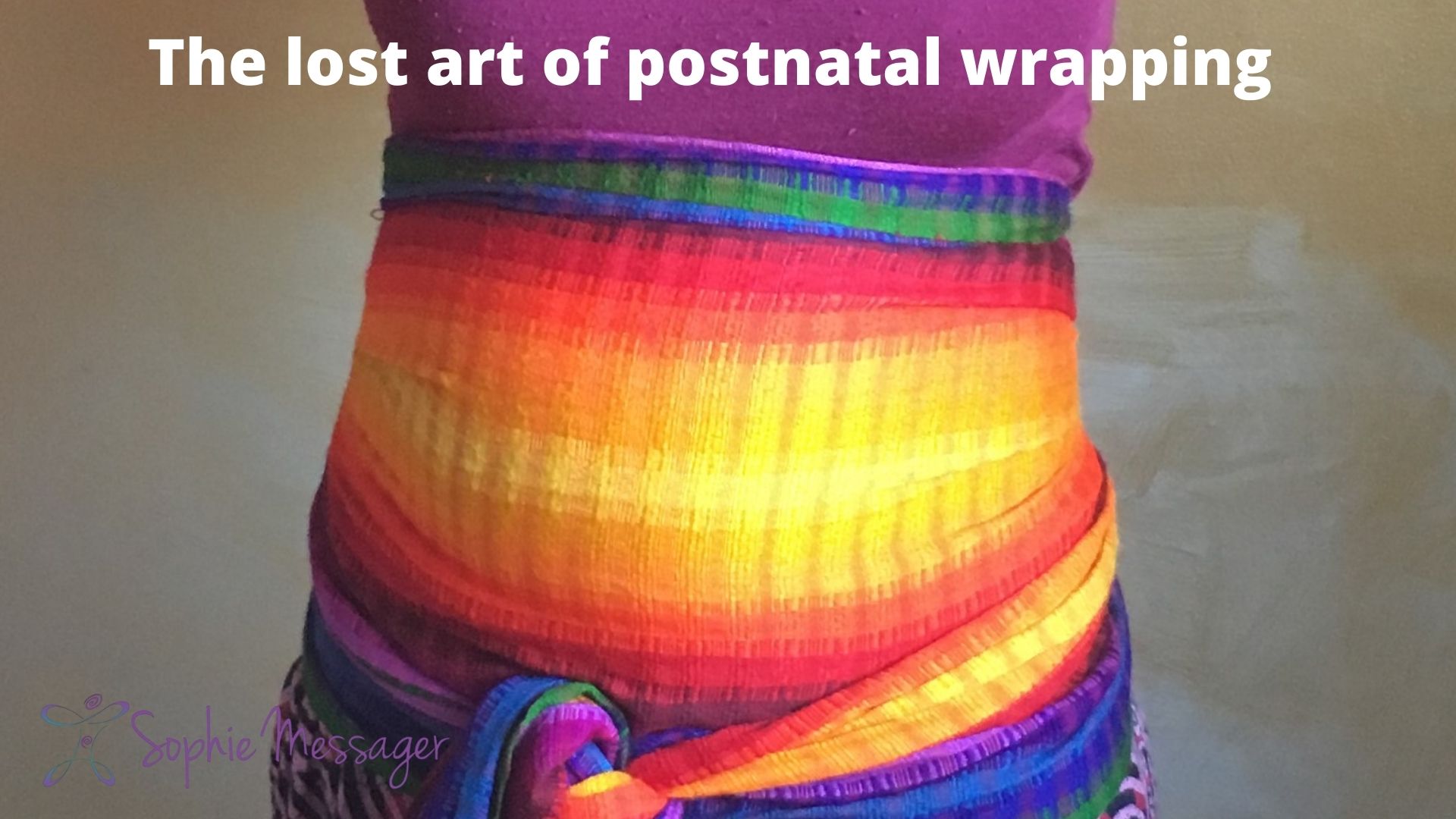
    The lost art of postnatal wrapping

    All around the world, there is a custom of binding the hips and/or the belly for the first few weeks after birth.

    It makes sense when you think about the changes the body undergoes. During pregnancy, the body adapts to accommodate the growing baby: the pelvis tilts and widens, the spine curvature increases, the abdomen stretches to accommodate the growing uterus, which in turn also pushes all the internal abdominal organs up. During the birth the pelvis opens. Then after the birth all of this has to happen in reverse. In particular, as the uterus shrinks back to its pre-pregnancy size, and the abdominal organs descend back into place.

    New mothers areĀ  also open physically, emotionally and spiritually, and therefore the wrapping is part of the nurturing support to bring them back to their centre. On a simple physical level wrapping provides support to unstable joints and muscles. It also provides comfort and warmth. On an emotional level it brings us back to our bodies and provides a sense of being contained. On a spiritual level it feels containing and helps us come back to ourselves.

    An example which illustrates this beautifully is the story of Rowena Hazell who gave birth to triplets vaginally. She found that she couldn’t breathe properly after the birth: ” As I tried to get back out of the pool, I had a weird sensation of not being able to breathe, as if all my body was suddenly too heavy. That was odd. On the postnatal ward I couldn’t sit up or stand for more than five minutes without finding breathing difficult. I was having to be wheeled across to NICU in a wheelchair because I couldn’t walk far. The midwives didn’t know why, didn’t take it seriously, and looked at me quite oddly when I said I needed to use a wheelchair. One of the other mums I met had brought a corset in, because she said that she had had severe diastasis recti before. This is when the stomach muscles have separated so much that for a while after birth they simply don’t hold your organs properly in the right place. The mum described it to me as your diaphragm not holding everything in, so it falls out of the bottom of your tummy. This was exactly what it felt like was happening to me! The midwives on the ward didn’t seem to have heard of this, but they did send a physio to see me. The physio made a corset out of a double layer of their largest Tubigrip, and immediately I could breathe, sit up, and walk again with ease”. (you can read her birth story here)

    Postnatal binding used to be part of Western culture too. Whilst doing the research for my book, Why postnatal recovery matters, I found a UK midwifery book from the beginning of the 20th century (An introduction to midwifery”, Donald, 1915) which says: “The binder should consist of a piece of stout calico, or other strong material, about 18 inches wide and 4 feet long. When applied, the lower border should reach a hand’s breadth below the widest part of the hips and should be drawn tightly and fastened securely with a safety pin or long straight pin, so that it may not work up above the hips. The middle part of the binder must be made sufficiently tight to give a sense of support, but the upper border should be rather lose as to not interfere with the patient’s respiration. The binder is used merely to give external support to the loose abdominal wall.”

    In the western world we abandoned the practice of binding, it fell out of fashion somehow. Sadly this means that it is now seen as an old wife’s tale. Midwife Siobhan Taylor tells me that when she gave birth in the 1980s, her grandmother told her to wrap her belly, but that everyone else dismissed it as old fashioned and unnecessary. I fell prey to this belief myself, before I discovered the stories and research that showed me how compelling this practice is.

    In the book Le mois d’or, medical doctor and yoga teacher Bernadette de Gasquet explains the importance of closing the pelvis, and quotes the dissertation of a French midwife who chose to study the subject. I obtained a copy the dissertation, and as far as I’m aware this is the only scientific study of postpartum binding that exists. The author, Juliette Danis, used a simple binding around the pelvis, applied the day after the birth for an hour. She used a set of written and visual questionnaires to evaluate its effect on pain in the pelvic area on a group of 160 women (80 receiving the wrapping and 80 controls). 64% of women described an improvement in their pelvic and perineal pain after the treatment. 79 out of 80 of the women who received the binding said they would recommend it. The author concludes that the care given to the women after the birth using massages or wrapping has a positive effect both physically and psychically, and that it symbolically helps to redraw the contours of the body. She concludes her dissertation saying that midwives should suggest the wearing of pelvic belts for 21 days after birth as recommended by traditional societies.

    I have also found evidence of the usage of pelvic belt in ancient Greece, via French ancient Greece historian Odile Tresch.

    I see postpartum wrapping as a source of comfort, support and warmth. Done in accordance with the mother’s comfort and preferences, it can feel very good indeed.

    This matches my experience of giving closing the bones massages to new mothers: the binding provides much needed nurturing and relaxation. The purpose of the binding is one of wellbeing and nurturing rather than to help new mothers look slimmer. The focus is on healing and comfort. It is part of a process which put the new mother at the centre of receiving loving support, and of postpartum attention to be focused on the new mother and her well-being, rather than on the baby. I talk about it at length in my book Why Postnatal Recovery Matters. Postpartum wrapping is a source of comfort, support and warmth. Done right, in accordance with the mother’s preferences, it can feel very good indeed.

    How do you wrap?

    I want to demystify the process and show you that it is simple and something that doesn’t require expert knowledge, and that you can do yourself. I also want to show you why it isn’t a one size fits all process, and that there isn’t a kind of binding that is better than the others. For example, one kind of binding that seems to be especially popular is an Indonesian type of binding called Bengkung belly binding. Bengkung is sometimes perceived as ‘the’ binding to aspire for. However, as I have done in my book, I want to encourage people to move away from the idea that one type of binding is ‘right’, or better than the others. Choosing a method of binding is like choosing a pair of jeans: you cannot be prescriptive about what fits one person, and you may have to try before you buy. It needs to fit with your lifestyle, and it needs to feel good and comfortable for you as a unique person with a unique body and needs.

    I used to believe that soft fabric was best, until I realised that it didn’t suit everybody. I supported a new mother of twins who was already used to carrying her first child in a woven wrap, therefore already experienced in manipulating fabric. She asked me to show her how to wrap her belly post birth using a rebozo. However, regardless how much we tried, she just couldn’t get it tight enough by herself. She loved one of my velcro wraps, however, so she ordered one.

    We need to remember that many traditional binding methods are usually done by someone else for you. Since few of us have the luxury to have someone come wrap us every day at home after birth, it makes sense that we learn techniques we can use on our own.

    What can you use?

    There is a plethora of tools to use-from simple pieces of cloth, scarves, rebozos, pashmina, babywearing wraps (both stretchy and woven ones) and more. There are also many different velcro belts and girdles, and other simple tools to use, like supportive underwear and clothing.

    I am going to list a collection of types of wrapping that I have tried. You cannot go wrong if you start with what appeals to you more and try that first. You can wrap your abdomen or hips by using a scarf (such as a rebozo, a pashmina, of any scarf you happen to have that does the job). You wrap the fabric around you and either twisting and tucking the fabric, or twisting and knotting it, depending on how much tension you prefer, how long your scarf is, and what feels good. I show one way of doing it in the video below.

    Play

    With a long enough cloth, you can wrap your belly, twist at the back, then wrap your hips and tie a knot at the front, wrapping your hips as well as your belly. If you’d like to wrap with a Mexican rebozo, I have some in my onlineĀ  shop. You can also use a babywearing wrap to wrap your belly and hips after the birth.

    I have had Womb belts specially woven for me by a rebozo supplier, based on the design of the traditional Colombian Chumbe belt that my friend Laura Leongomez introduced me to. It feels incredibly supportive and my postpartum clients love it too. You can see me demoing it in the video below. and Laura and I did a long video about pelvis wrapping where we talk about this belt. which you can watch here.

    Play

    With a very long, narrow cloth (about 15cm wide and 7 m long), you can do the Bengkung style binding, which goes from the hips to the ribs. Here is a video tutorial for it. If you like the idea of the Indonesian belly binding but not the process of wrapping a long cloth around you, there are Dutch postpartum girdles, called sluitlakens, some of which look uncannily like the Indonesian binding. Australian brand Unina has created a Velcro wrap (pictured on the left) which reproduces the effect of the Benkung binding, and which is very easy to use and adjust, and is very pretty.

    If you prefer something a bit more structured, there are many velcro belts and girdles. From what I have experienced, you really get what you pay for: cheap ones are often made of scratchy and/or uncomfortable material. Also a good postpartum belt won’t be too tight at the top, supporting the lower abdomen and pelvis without adding pressure to the pelvic floor. The easiest and comfiest belts also have a double velcro system that allows you to tighten the belt/girdle effortlessly (an important point when one has weak core muscles).

    There are two brands I really like and recommend for pelvic and or pelvic/abdominal support: For pelvic support only : The sacroiliac pelvic belt from Belly Bands, or the Serola sacroiliac belt. For both pelvic and abdominal support : the pregnancy and caesarean 3 in 1 belly band from Belly Band, which can be used for pregnancy support, postpartum support, and post caesarean too. This is a truly amazing product which has been designed especially with mothers in mind. It is extremely comfy and easy to use, and its standard size fits from a size 6 to 16 (they have smaller and bigger sizes too).

    You can see me demonstrate this velcro belt as well as rebozo wrapping in the video below

    Play

    Talking about caesarean, I was surprised about the post caesarean binding myself, as I didn’t know it was a thing. When my friend Kate had her baby by caesarean in Bangkok, they bound her abdomen the next day. She says she healed much better than when she had her next child in Norway, were there was no binding. I found a published paper which shows that binding post caesarean reduces pain. The Belly Band caesarean wrap has a video explaining how you can use it in a hospital setting.

    There are a couple of gentle support options available to you if you’d rather not use a scarf or a wrap: You could use a belly band like a Haramaki. A Haramaki is a Japanese belly warmer. It’s like a boob tube for your waist. Or you could buy a belly band such as the ones that some people use during pregnancy. H&M sells a pack of three.

    You could try high waisted postpartum support underwear, and there are also some brands that offer postpartum support shorts or leggings. Just make sure you don’t use something too tight to avoid putting pressure on your pelvic floor. If you used maternity leggings, they might still work to provide some gentle support after the birth too. H&M has a pair which costs under Ā£10.

    How to choose the right way to wrap/bind for you?

    If you can, try before you buy. With online items, you can try and return items if needed. Only you can tell whether it is comfortable and right for you, so it’s worth trying a couple of options to see which you find easiest to use and most comfy. Some women prefer using a soft piece of cloth, and some women get on better with a velcro belt.

    How long to wear it for?

    Use it like a treatment ie not 24/7, see how it makes you feel, and probably not any longer than for the first 4 to 6 weeks postpartum.

    PS: I have been working with wraps, rebozos, shawls and scarves for several years now and I see them as something that has a lot of use beyond the childbearing years. When it comes to wrapping for example, I now see my period as a mini postpartum time with similar needs, and I find that wrapping my hips or my abdomen or both during this time is extremely comforting. Try it and tell me what you think.

    If you feel drawn to learning more, my book Why postnatal recovery matters has a chapter on postpartum bodywork. I have an online course dedicated to The Art and Science of Postpartum wrapping. I also offer a rebozo online course , a closing the bones rebozo massage online course.


  • Closing the bones : a universal postpartum healing practise

    Closing the bones : a universal postpartum healing practise

    Closing the bones is a postpartum ritual that is designed to help nurtureĀ  and heal a new mother. It usually involves a massage followed by a tightening of scarves around several points on the body. Depending on the culture it can also incorporate bathing and sweating rituals. At its heart, it is a process to bring the mother back to herself after the birth.

    I first learnt Mexican and Ecuadorian versions about 10 years ago. Doing research over this time has shown me that it is not restricted to South America, and is present around the world. In this article I share the countries in which I have found versions of this ritual ,along with links illustrating this.

    It makes sense to have the same practice around the world, because the changes new mothers undergo are the same regardless of culture. During pregnancy, the body undergoes tremendous modifications to accommodate the growing baby: the pelvis tilts and widens, the spine curvature increases, the abdomen stretches to accommodate the growing uterus, which in turn also pushes all the internal abdominal organs up. The ribs also flare up to make room for this. During the birth the pelvis opens. Then after the birth all of this has to happen in reverse: the uterus shrinks back to its pre-pregnancy size, and the abdominal organs descend back into place.Ā 

    Closing the bones rituals are designed to provide much needed nurturing, as well as speed up the healing process on a physical, emotional and energetic/spiritual level. New mothers are very open, as the bones and soft tissues are stretched and loose after the birth. On the physical level, the massage and the tightening helps to move the tissues around and support the process of moving from opening to closure.

    New mothers are also open emotionally and spiritually, and the tightening of scarves around the body helps on this level too.Ā  The wrapping helps us feel the contour of our bodies, provides a sense of being contained, and brings us back to ourselves. On an energetic and spiritual level, the ritual helps new mothers come back to themselves, and provide a much needed space to process the complex feelings and emotions that can accompany new motherhood.

    American continent

    • Mexico
      • The Mexican postpartum ritual that I learnt from Mexican midwife Naoli Vinaver includes a full body massage, followed by a steam bath (called a Temazcal), a period of sweating under blankets, and finally the tightening with rebozos around 7 points on the body.
    • Ecuador
      • I learnt the closing the bones ritual from Dr Rocio Alarcon.
      • The ritual involves a rocking of the pelvis with a rebozo (or Manta as its called in Ecuador), followed by a massage of the abdomen, chest and arms, and then the tightening of scarves around the pelvis (or around several points around the body)
      • Gabi Pezo, a doula from Ecuador also shares this comment: Closing of the Bones (Encaderamiento) Fajada is something that has been practised for millenia in Ecuador. In rural parts of my country (Ecuador) Traditional Midwives have done this.Ā 
    • Colombia
      • My friend Laura Leongomez, a doula from Colombia told me the following: I learned this technique in Colombia where it is practised by different indigenous groups and traditional Afro-Colombian communities.Ā 
      • Laura also introduced me to the Chumbe belt which is used during menstruation, pregnancy and the postpartum and was the inspiration for my womb belts.
      • I have heard accounts of various versions being practised in most countries in South America.

    European continent

    • UK
      • In an old midwifery book I found this reference to the use of a binder during the postpartum
      • ā€œThe binder should consist of a piece of stout calico, or other strong material, about 18 inches wide and 4 feet long. When applied, the lower border should reach a hand’s breadth below the widest part of the hips and should be drawn tightly and fastened securely with a safety pin or long straight pin, so that it may not work up above the hips. The middle part of the binder must be made sufficiently tight to give a sense of support, but the upper border should be rather lose as to not interfere with the patient’s respiration. The binder is used merely to give external support to the loose abdominal wall.ā€
    • France
      • I found reference to postnatal binding in an old French medical dictionary, which talks about applying cotton on the belly then a bandage around the whole belly.
      • I have also talked to Doula Celia , who has done extensive research and found evidence of a European version of the traditional ancestral postpartum traditions, including closing the bones, called Le soin des matrones (Matrones being the equivalent of traditional midwives). Her instagram account is full of knowledge around these practices. (use google translate or AI for translation from French into your language). It includes a steam bath, a full body massage, and tightening of a cloth around the pelvis.
    • Holland
      • Dutch friends mentioned an old fashioned binder called sluitlakens, and acquired such a wrap myself. It looks a lot like the traditional Malaysian binding, which is perhaps not surprising given theĀ  colonisation of Malaysia by the Duch.
    • Malta
      • A massage therapist friend has worked there and found reference to it being practised in the past
    • Greece
      • Odile Tresch, an ancient Greece historian, mentions a traditional Greek postpartum belt. She has teamed up with a French seamstress to recreate it and she offers training in using it.Ā 

    African continent

    • Morocco
      • I attended a workshop in London with Layla B who explained and demonstrated the process. The wrapping is preceded by some time in the traditional wet room/steam bath (called a Hammam), and the scarves used are called Kourziyas. I have also found reference to the Moroccan tradition in the thesis of French midwife Juliette Danis
    • Somalia
      • I was the doula of a Somalian mother and her mother showed me how to do the binding after birth. I also met a Somalian midwife who told me the traditional shawl, called a Garbasar, is used in very much the same way as rebozos.
    • Ghana
      • I met a new mother who told me of steam baths, vaginal steaming, and binding done with the sarong type fabric used to carry babiesĀ 
      • I have also found accounts of it in Ivory Coast, South Africa, and Uganda (from books, blog posts, and articles)
    • Tunisia
      • The closing the bones massage and wrapping is done using Fouta towels (similar to Turkish towels)
    • Mauritius
      • I massaged a new mother from Mauritius. Her grandmother was present and she told me the practice back home was quite similar to what I did.

    Asian Continent

    • Israel
      • An Israeli doula told me of finding out it was practised back home after learning the practise with me
    • Afghanistan
      • This article shows closing the bones with cloths done in a very similar way to the Mexican ritual.
    • Russia
      • There is a similar practice to the Mexican closing which is called seven locks. The text is in Russian but you can see the process in the video.
    • India
      • I have massaged several Indian mothers who told me of similar practises.
    • Ā Malaysia
      • The Bengkung belly binding treatment involves a massage, herbal paste applied to the belly and binding of the hips and belly with a long cloth.
      • A similar massage/binding combos called Jamu which origin from Malaysia is found in most of SouthEast Asia (Hong Kong, and Singapore in particular)
      • My husband is from Hong Kong and when I visited I found out that the Jamu massages are available in packages of 5, 10, 15 and 20 massages during the postpartum. My mother in law also showed me how she had been shown how to wrap herself with a towel in the hospital after she gave birth.
    • Thailand
      • A mother who gave birth in Thailand told me how they wrapped her in the hospital the day after her caesarean.
      • I have also found evidence of uterine massage and binding in Vietnam (from midwife Juliette Danis’s thesis), and in Thailand, Cambodia and Burma wrapping (scientific papers)
    • Japan
      • The binder used which is called a Sarashi.Ā 


    Here is a couple of other overview articles that cover the same overview topic as this blog post:

    I hope you find this as inspiring as I did, and if you know of other countries or stories, I would love you to share them so I can add them to this post.

  • Closing the bones massage: why it is so expensive?

    Closing the bones massage: why it is so expensive?

    I recently massaged a new mother, who told me she felt she could only justify the expense because it was also her birthday.

    I get it, because I charge £150, It seems like a lot right? 

    Despite the fact that I have been offering and teaching this massage for nearly 10 years, and giving it to hundreds of women, there is a voice in my head which worries that I am charging too much.Ā  And this is not even taking into account the huge investment I have taken in both time and money to attend training, and to buy equipment in order to offer the best treatment I can.

    We often take for granted what we are skilled at. And we dismiss the time, training, experience and effort it has taken us to get there. And when we start something new we often have impostor syndrome.

    Because of the new mother who felt she couldn’t quite justify the price, I found myself worrying if I was charging too much, and this led me to a reflection about what I charge for this work.

    I want to explain what goes into the cost to help both clients and therapists understand what is entailed. As well as new mothers struggling to justify spending money on themselves, many of my students struggle to charge enough for this work.

    First, a little of of history about how much I used to charge:

    When I started offering closing the bones in 2013, I gave it to my doula clients for free. Then a client asked me what she owed me for the massage. I said it was part of the services, but that if she wanted to pay me more she could. She added £30 to my postnatal doula fee for that week, so for a while I charged this. I then slowly put my prices up to £40, then slowly worked my way up to £120 over the course of ten years.

    Every time I put my prices up, it was after I had done a much longer massage ritual than I expected, especially when there was a lot of trauma. Often, the whole process would take half a day, including driving to my client and back (but not including packing and washing, more on that below).Ā 

    Until today I had never broken down the price for myself like this,Ā  and to be honest, writing it down came as a bit of a shock, and it was a very useful learning experience for me, as I finally understood how much work and love I put into this.

    For reference, people who offer the closing of the bones or the postnatal recovery massage in the UK charge range from about  £80 to over £300.

    Here is what organising and having a closing the bones or postnatal recovery massage entails.Ā 

    Here is the process :

    1. Before the massage, I exchange calls and/or emails with the mother, about timings, and which version of the massage she prefers. Often this may take a 30 min phone call.
    2. I pack a huge bag of kit every time. I check and refill what needs refilling (like the massage oil, essential oils and herbal tea bags). This can easily take about 30 min.Ā 

    My pack includes the following:

    • 2 memory foam yoga mats (or a massage table and table cover for the postnatal recovery massage) Ā£70
    • A bolster to put under the knees Ā£25
    • A padded memory foam mat to kneel on Ā£20
    • 8 rebozos Ā£250
    • 2 sarongs Ā£10
    • 2 blankets Ā£60
    • A bag full of massage oils, and essential oils, smudging products, herbals teas, and healing toolsĀ  Ā£100
    • An essential oil diffuser Ā£40
    • A Bluetooth speaker Ā£100
    • A frame drum Ā£300
    • A closing stick (I had mine custom hand-painted by an intuitive healer), Ā£100

    Total cost: over £1000.

    Here are pictures of my equipment

    Then here is what I do in order:

    1. I drive to the mother’s house, up to 30 min (I’ve done longer drives on a few occasions too)
    2. When I get to the mother’s house, I listen to her birth story, and what she hopes to get from the massage (at least 30 min)
    3. I setup the mat or massage table and rebozos, the essential oil diffuser, the music, I set the room and myself up energetically and using smudge, 10 min
    4. I do the massage itself: rocking, massaging and binding (60 min or more)
    5. When the mother lays wrapped up, I read a poem, I sing, I drum over her, and I finish with some Reiki on her head and feet. 20 to 30 min or more
    6. While she rests and integrates, I make her a drink and bring it to her. 10 min
    7. I then allow another 30 min to unwrap, release the lower back, then debrief and chat
    8. I pack my gear, and say goodbye (10 min)
    9. I drive home (another 30 min)

    I always say the ritual takes 2h from start to finish but for me it almost always takes longer, because I do not want to rush listening to the birth story, doing the ritual, holding whatever emotions needs to be held, and a debrief afterwards. It’s not unusual for me to spend 3h there. I am generous with my knowledge, and I often also show new mothers to wrap their belly and hips afterwards.Ā 

    When I get home, I unpack my bag. I wash all the rebozos and blankets, then dry them, fold them up, and repack my back. This takes another 20 to 30 min.

    The total time the average process takes is over 5h, which at a cost of £150, is only £30 per hour, which way below the cost of a typical massage per hour. In my area in Cambridge, a one hour massage starts at around £60 per hour. If I was to charge this much, a closing the bones ritual would cost £300. 

    I hope this helps you understand what offering this ritual entails, why it is priced at this cost. And I also hope it inspires you to get together with friends to buy such massages as gifts to new mothers & women.

  • Postnatal bodywork is a need not a luxury

    Postnatal bodywork is a need not a luxury

    I just gave a closing the bones massage to a new mother. She was only one week post birth.

    When we sat down to have the pre-massage chat (I always want to hear about how the birth went, and what the mother is hoping to get from the ritual), she explained that she only felt able to justify the cost of the massage to herself because it happened to be on her birthday.

    I felt so many emotions when I heard her say this. I felt sad for her (she just grew and birthed a whole new person, and yes didn’t feel she deserved nurturing). I also didn’t feel surprised, because in our culture we don’t value motherhood, we place value on the baby only, all the presents are for the baby, and it can be hard to justify spending money on yourself. I also felt brought back to my own experience as a new mother (and so had a lot of empathy for her), and finally I was reminded why we need to change our culture so much around what normal postpartum support looks like.

    There is still so much work to be done so that nurturing new mothers becomes seen as the norm once more, rather than an indulgent luxury.

    When I was a new mother myself, I didn’t feel able to justify hiring a postnatal doula, but I bought tons of useless stuff for my baby. Not having hired my birth doula during the postpartum is one of my biggest regrets, and I wroteĀ  about it in my blog, I wish I had hired a postnatal doula.Ā 

    Before booking the massage, whilst still pregnant, this mother had already voiced her hesitation at paying so much money for a massage.

    Ā£120 might seem like a lot, right? But compare this to the cost of the average pram, or of all the gifts that people buy for the baby. Wouldn’t that money be better spent on nurturing the mother? If a bunch of friends got together to buy a new mother a voucher for this type of bodywork post birth, it would cost them the same amount each as some of the bouquets of flowers or baby toys that most new families receive, and if would have much more of an impact.

    (note: because I too worry about charging too much, and it is a theme I see within the cohort of students I train to offer this ritual, I have also written a separate blog in which I break down the price of the massage, and you’ll see that, for what I provide, it really isn’t a lot of money.)

    Every time I give a closing the bones or a postnatal recovery massage, I can see how it is a need, not a luxury, and this instance was no exception. The changes a mother’s body undergoes whilst pregnant, and somewhat in reverse after birth, plus the process of birthing itself, surely these warrant giving the body some love, some nurturing, some reverence even? And surely, having a treatment designed to help the body feel good and heal faster, and to give a window of deep rest, especially whilst battling with the demands and tiredness that looking after a newborn entails, should be the norm rather than the exception? After all, the mother singlehandedly grew and birthed a whole new person, surely she should be celebrated as the goddess that she is?

    Today, after the massage was finished, the mother said it was amazing, and way beyond her expectations. She said she loved everything, and that she couldn’t find the words. She said that it was so much more than a massage. She mentioned telling quite a lot of people about it. I was grateful that she loved it, and also grateful that it reminded me why this work is so important.Ā 

    Much more than a massage is a word I had heard many times when I had given this ritual. It isn’t something one can be told about, it has to be experienced for oneself. The experience is different for everyone. It is a ritual, a slice of time for yourself, to be held and nurtured, to feel heard, to have your feelings and experience validated, to remember what it feels like to be safe. It is a gentle, nurturing and healing process of rocking, massaging, and wrapping, which can have healing effects at every level, physical, emotional, and spiritual. I should know, especially as I’ve had similar massages done on me recently by other people, and it was deeply healing.

    PS: I was delighted to be booked for a repeat massage by this mother a week later. She said that this time she wanted it just for herself, not because there was a special occasion.

    If you want to learn to offer this ritual, I offer an online course called the Postnatal rebozo massage and closing ritual, and I am running a rare live postnatal recovery massage course near Cambridge on the 18th of July with osteopath Teddy Brookes.

    Here is a little video of what the closing the bones and the postnatal recovery massage look like.

    Play

    Play

  • Why I created a postnatal closing ritual online course

    Why I created a postnatal closing ritual online course

    Everywhere around the world, there used to be a period of about a month after birth during which the new mother was taken care of completely. Members of the family or the community used to take charge of the household (chores, older kids etc), make sure the mother rested, provided specific nourishing foods, and well as give or organise some postpartum specific bodywork. It was a ubiquitous practice in every continent (and still is in many parts of the world today). This used to be part of Western culture too.

    I published my book, Why postnatal recovery matters, in order to start and support a movement towards returning to a nurturing postpartum. In my book I explain that a nurturing postpartum boils down to 4 pillars: social support, rest, food and bodywork.

    I have become acutely aware that bodywork seems to be the most neglected part of the 4 elements of postpartum nurture. I have started working towards creating courses to rectify this. The first of these course is the rebozo massage and closing ritual online course.

    Learning postpartum rituals such as the closing the bones massage was instrumental in my journey towards writing the book. I have given this massage to hundred of women since I first learnt it in 2013. I have also taught this massage in live workshops since 2014 and trained several hundred people in giving this ritual. I also co-created a new version of this massage, called the postnatal recovery massage, with an osteopath.

    Prior to 2020 I was asked many times to teach this remotely, but I felt I couldn’t teach this ritual without being physically present because of the need to adjust position and pressure whilst doing the hands on part of the massage. With the 2020 lockdown and many teachings moving online, and the publication of my book, the number of requests intensified, but I still felt I couldn’t do it justice without being present.

    Several events contributed to changing my mind. Firstly, as a doula, during 2020 I found myself having to teach rebozo techniques to couples via a mix of sharing video links and live zoom sessions. This taught me that it could be done quite well remotely. On several occasions, because partners restrictions meant that I couldn’t be in hospital with the couple I was supporting, the partner called me when there was a stall in labour. By suggesting positions and techniques, I found that several babies being born without obstetric interventions. These experiences showed me that remote learning could be very effective. Secondly, because of the isolation brought by lockdown, I saw new mothers suffer emotionally and physically more than ever before, with almost no access to support or physical therapists. Giving closing the bones to them showed me that this ritual was needed more than ever. Thirdly, I took part in trainings offering by other practitioners online which were only available face to face before, and in particular online rebozo training with Mexican Midwife Naoli Vinaver. I saw power in this, because, suddenly, I could learn from people anywhere in the world, and the learning was still powerful despite the remote aspect.

    However, I still felt that I couldn’t teach the ā€œhands on skinā€ massage part of the ritual remotely because it required precise observation and correction, so I had to create something new.

    Over the last couple of years I have supported new mothers who struggled with pain post caesarean, and whose belliesĀ  were too tender to massage so soon post surgery. I adapted the massage and used rocking and wrapping techniques with the rebozo only rather than my hands to provide comfort and relaxation. I found that this was still a powerful and effective ritual.

    The online course I have created, over a period of a year, is extremely extensive in content. I pre launched the course to a group of early adopters in 2021, and receiving feedback from them means that I have extensively refined the process (for example I reshot several videos based on what people told me that wanted to understand better, or when something wasn’t clear).

    The course also contains much deeper content in terms of preparation, equipment, and creating ceremony than any live courses I have taught, because I wasn’t limited by timing. The course includes an entire module on creating ceremony, ritual and sacred space. This is one of the most beautiful and important aspects of the rebozo massage and closing ritual. What you get is based on my years of experience as well as years of listening to questions about it from live workshop trainees. This is he first time that I am teaching this aspect in such depth. You will learn how to be attuned to your intuition to hold space and allow whatever needs to be expressed. This is a creative and sacred process that adds much to the experience for both you and the mother.

    I want to make sure that there is enough interest in this course before putting more energy into it starting it, and I also want to be able to run ideas via a group of early adopters as I develop the course, so I’m offering the future course as a pre-sale to early adopters for a discounted price.

    You can find out more about this here.

    Here is a video showing what the massage and ritual process looks like.

    Play

  • The postnatal recovery massage: a modern adaptation of a traditional ritual to nurture new mothers

    The postnatal recovery massage: a modern adaptation of a traditional ritual to nurture new mothers

    Since January 2019, I have taught a new postnatal massage called the postnatal recovery massage, together with osteopath Teddy Brookes.

    I want to tell you the history behind why and how we created this massage.

    It is very much needed, because in the Western world we no longer offer bodywork as standard to help new mothers heal during the postpartum. Yet, given the tremendous changes a woman’s body undergoes during pregnancy, birth and the postpartum, this is absolutely crazy. Read more on that in this blog post. https://sophiemessager.com/why-postnatal-bodywork-matters/

    The seed for this massage (and my book, Why postnatal recovery matters which includes a chapter on postpartum bodywork) was planted when I learnt the closing the bones massage, a traditional postpartum massage from South America, in 2013. People asked if I could teach them so I created a workshop and starting teaching it to birthworkers.

    It grew organically and together with a couple of other doulas, I ended up training over 500 people in offering this amazing nurturing ritual. I shared this knowledge in the hope to change the face of the postnatal support, towards a more mother centered and nurturing time.

    I have a theme in my professional life, in that almost always end up teaching stuff because people ask me to. Since discovering the Human design system, it makes sense to me because it is in my design to respond.

    After a few years of teaching closing the bones, more and more people who had trained with me asked if it would be possible to provide a version of the massage on a massage table instead of on the floor, because they had bad knees, or bad backs, and found working on the floor difficult.

    I’d learnt a lot from practicing the massage on my local osteopath friend Teddy Brookes (he provided all the anatomical and effectiveness knowledge for the closing the bones workshop handout, and therefore already knew the technique inside out), so it made sense that I asked him asking if he liked the idea of helping me develop a massage table version of the ritual.

    Teddy was enthusiastic about the idea and we started working on it in 2017. We are both perfectionists and it took us over a year and many sessions of practice and trial and error to get it right.

    At the beginning, I wanted to create the exact same treatment on the table as we did on the floor. However, the biomechanics of doing something from the side rather than standing over the person, meant that some things simply couldn't be done in the same way.

    Some techniques worked mechanistically but didn't feel good so we discarded them. It was at times a frustrating, but mostly an exciting exploration and experience and a huge learning curve for me, especially as Teddy also educated me on how to position and use my body for more power, less effort, and increases effectiveness around the table.

    As we progressed we also ended up modifying and adding several elements to the massage based on my experience of body changes in the postpartum that weren't treated as part of the original massage. For example I had noticed that new mothers often had flared ribs post birth, as well as hunched shoulders from feeding and holding their baby, so we added some new techniques to treat these.

    In the end we ended up with a massage which, whilst inspired from the original technique, was really quite different. Ā We named it the Postnatal Recovery Massage (PRM).

    We had our first practice on a group of birthworkers and therapists in Autumn 2018, and they all loved it.

    We started teaching it in January 2019. As of now we have run 10 workshops and trained 90 people in offering this massage! As our 11th workshop is planned for this month we are hoping to reach 100 trainees who can offer this amazing nurturing treatment to new mothers.

    Here is some feedback from people who have attended the workshop:

    ā€ This new version of the postnatal ceremony blends effective rebozo (shawl) massage techniques and lymphatic drainage massage to support post natal mamas. Rather fabulous it is too!ā€ Emma Kenny, Massage therapist.

    ā€œOne of the reasons I like the massage that you have developed for the table as it feels like a modern way of adapting the traditional massage. It feels like a new technique, a therapists technique. I also like being able to connect to the anatomical benefits. I want to practise giving the massage and feel newly inspired.ā€ Katie Oliffe, Doula

    “What a wonderful, professional, well constructed and instructive course with plenty of time for step by step practical, complemented by Teddy’s expertise and Sophie’s organic shamanism and such a wonderful community of like minded body workers. Thank you. Thoroughly recommended” Jenni Tribe, Therapist

    “Thank you so much for an informative and inspiring day. I can’t wait to use the techniques on my clients and support women more effectively. You are doing an amazing work and I’m so grateful ad excited to be part of it!” Grace Lillywhite, Pilates teacher.

    “I loved this course. It is just as nurturing as the closing the bones massage but much easier to do. Sophie and Teddy worked amazingly well together” Michelle Parkin, doula.

    “The course was well organised, very informative and easy to follow. The level of practical support was fantastic and I feel confident to take what I have learnt and help local women postnatally. Thank you!” Becki Scott, doula and massage therapist.

    “Amazing workshop! Loved being in a small group to work through techniques in enough details. As an osteopath this experience has been invaluable in improving my practise if postnatal patient , in fact all of my patients!” Rob Ballard, osteopath

    ” The massage is a wonderful reworking of the traditional Closing The Bones massage performed on a couch rather than the floor. Sophie and Teddy have taken all that is special about it and fused her energy-work approach with his osteopathic technique to create something extraordinary. It incorporates binding, rocking, jiggling and specific tension releases, with massage of the chest, abdomen and pelvis with warming oil. It is truly a celebration of the postpartum body!” Charlotte Filcek, doula.

    “The tutoring, the technique, the group, just exceptional!” Alison Duff, therapist and therapy centre owner.

    Here is a short video showing what happens during the workshops:

    Play

  • What is postpartum bodywork and why we need it back.

    What is postpartum bodywork and why we need it back.

    All around the world there are (or used to be) traditional practices to help a new mother’s body heal after birth.

    Regardless of the continent, these traditions usually include some massage and wrapping rituals, as well as binding the belly and pelvis, and keeping the mother warm.

    When you think about the tremendous changes a mother’s body undergoes, it makes so much sense! During pregnancy, the uterus grows from the size of a pear to that of a watermelon, the pelvis tilts forward and becomes wider, the ribs open, the spine curves increase, the abdominal organs get pushed up etc. To give birth, the mother’s body opens up on a physical and energetic level. After birth, these changes need to happen in reverse, whilst the body also undergoes the beginning of lactation.

    It seems crazy that we no longer have processes in place to support these changes, or at the very least, some kind of physical examination to make sure everything has returned to a healthy place. At the 6 weeks doctor “check” in the UK, there is no overall physical examination of the mother.

    With no checkup, and no sense of what is normal, we have a perfect storm of issues not being treated. The statistics are very telling: 1 in 3 new mothers experience urinary incontinence at 3 months postpartum and nearly one in 2 still has diastasis recti at 6 months postpartum. Research shows that it takes on average 8-10 years post birth for women to seek help for such issues.

    Yet, during the first 4-6 weeks postpartum, when the body is still plastic and resetting itself post birth, there is a unique opportunity for healing.

    Traditional massages and rituals, such as closing the bones, understand this need and the window of opportunity, and are designed to ā€œcloseā€ a new mother physically, emotionally and energetically, after the widening and opening of pregnancy and birth. Because the needs of new mothers are the same regardless of where they are from, it makes sense all cultures have similar processes to support postpartum healing. This article from Innate traditions provides a beautiful overview of the topic.

    As no such treatment is available as standard within the health system, it makes sense to seek bodywork and healing from people who can provide it.

    What kind of postnatal bodywork can you have?

    When can you have postnatal bodywork?

    As soon as possible during the first 6-8 weeks postpartum or as soon as you are ready. In traditional wisdom, there is a window of healing opportunity and plasticity during this time when the body is designed to heal faster. The strange ā€œdon’t do anything before you’ve had your 6 weeks checkā€ isn’t based on any evidence. Moreover, it makes no sense because the 6 weeks check doesn’t include a physical examination. Having massaged many new mothers, some as soon as 24h post birth, I can attest that this is when the bodywork is the most effective to speed up healing.

    What can you do for yourself?

    • Use the 4 pillars of postnatal recovery (Social support, rest, food and bodywork) to write a postnatal recovery plan (you can download a free template here) to include bodywork. You can ask for gifts vouchers towards postnatal bodywork.
    • Wrap your belly and hips. I wrote a blog about it which includes tutorials.
    • Keep warm (like a convalescent person would: wrap up, and consume warming foods and drinks)

    What can you do for new mothers?

    • If you know someone who is pregnant or recently had a baby, it would be a wonderful gift to give them a voucher towards such a treatment.
  • Postnatal Recovery Massage, a new kind of postnatal massage inspired by closing the bones.

    Postnatal Recovery Massage, a new kind of postnatal massage inspired by closing the bones.

    I’ve been offering and teaching a postnatal massage called closing the bones since 2014.

    I never intended to teach this technique, I just wanted to share it with my community as we had been urged to do.

    But then women started to ask us to show them. So we put together a workshop.

    Since we started we have grown organically and have now trained nearly 400 people in providing this amazing nurturing ritual.

    I hope to use this media to help change the face of the postnatal support in the UK with this, towards a mother centered one.

    Over the last couple of years more and more people who had trained to do the massage started contacting me, asking if it would be possible to provide a version of the massage on a massage table instead of on the floor (we normally practise on yoga mats), because they had bad knees, or bad backs, and found working on the floor difficult.

    I have a bit of a theme in my professional life, that I seem to always end up teaching stuff because people ask me to!

    So I had a chat with my lovely local osteopath friend Teddy (who had already provided all the anatomical and effectiveness knowledge for the workshop handout, and therefore already knew the technique inside out), if he fancied the idea of developing a massage table version of the technique with me.

    He liked the idea a lot so we started working on it. This was about 18 months ago, in summer 2017.

    This was a true work of love, and in the end it took us over a year and many sessions of practise and hours of trial and error to get it working.

    This is how each session would go: I would setup both a massage table and a yoga mat on the floor. Teddy and I would try each technique on the floor then on the table, taking turns giving and receiving each technique.

    I would record the session and make some notes. After each session I’d listen to the recording paying attention to what Teddy said, and write down questions and make more notes for what to practise/change at the next session.

    At the beginning we did get plenty of stuff wrong. I think I was so intent of getting the exact same treatment on the table as on the floor, that this got in the way. Teddy has much deeper knowledge of body function than I do, so he had to explain to me repeatedly why some of the stuff that was done standing up or crouching over a person lying down simply couldn’t be done from the side of a table, due to biomechanics.

    We tried and tried. The most challenging part were the rebozo rocking and the hip squeezing. It was challenging because of the biomechanics (you can’t produce much force when you’re on the side compare to standing above a person), and because I wanted the technique to do the same thing to the body, but also to feel good.

    Teddy wanted to make sure the technique was safe and effective but also easy on the body of the therapist (a basic rule for bodyworkers).

    It proved extremely frustrating at time. Many times we thought we had got it but when we revisited it didn’t feel right and so we were back to square one. Some techniques worked mechanistically but just didn’t feel nice so they were discarded.

    It was also a fun experience and a huge learning curve for me, especially as Teddy educated me on how to position my body for maximum power and effectiveness around the table, something I am still learning to master.

    The real magic happened when I finally let go of it being exactly the same. Teddy had tried to explain to me repeatedly that it wasn’t necessary (that we were aiming for the same effect) but I am a perfectionist and like things to be “just right”

    One day we finally worked out a way to make the rocking work from the side.

    From then on everything seemed to flow magically.

    As we progressed we also ended up modifying and adding several elements to the massage.

    Some were based on discussion about the effectiveness of a technique and how to make it work more easily.

    Some were based on the changes in the pregnant body that weren’t treated as part of the original massage, namely treating the ribs (which flare during pregnancy), and the shoulders (which hunch during pregnancy and often during breastfeeding as well).

    Some just happened because it felt logical to add them to the flow of the movements we had created.

    In the end we ended up with a massage which is inspired from the original technique but is really quite different. I did it for the first time on a doula friend and she loved it. We added a few more movements after that. I also practised on my massage therapists friend Emma Kenny, a massage therapist, who loved it too.

    We named it the Postnatal Recovery Massage (PRM).

    We finished our individual practise work at the beginning of October, and we then went on teaching it to a small group of guinea pigs, composed of 2 doulas and 2 massage therapists.

    We all had a very fun morning of practise teaching this new techniques, and all our guinea pigs loved it.

    This is what they said:

    ā€œKnowing Sophie and Teddy as I do, I knew they would design something that is both relaxing and effective. I was not prepared for how beautifully the movements flow into each other, and how true to the spirit of Closing the Bones they have stayed. For people who find floor work tiring or painful, I highly recommend learning these new techniquesā€ Maddie, Doula.

    ā€ This new version of the postnatal ceremony blends effective rebozo (shawl) massage techniques and lymphatic drainage massage to support post natal mamas. Rather fabulous it is too!ā€ Emma Kenny, Massage therapist.

    ā€œI think one if the reasons I like the massage that you have developed for the table as it feels like a modern way of adapting the traditional massage. It feels like a new technique, a therapists technique. I also like being able to connect to the anatomical benefits. I want to practise giving the massage and feel newly inspired.ā€ Katie, Doula

    We are now putting the final touches to the handout for this new technique, complete with my signature set of description, pictures, videos, and an explanation of the effect of each movement on the body by Teddy.

    This should be ready by sometimes in December and we are looking forward to teaching this workshop together in the new year.

    The first workshop will take place in Cambridge on Saturday the 5th of January.

    I can’t wait to introduce more people to this amazing technique!

    Update January 2019.

    Teddy and I taught our first course last Saturday. The course was extremely well received by our trainees. Here is some of the feedback they gave us

    “What a wonderful, professional, well constructed and instructive course with plenty of time for step by step practical, complemented by Teddy’s expertise and Sophie’s organic shamanism and such a wonderful community of like minded body workers. Thank you. Thoroughly recommended” Jenni Tribe, Therapist

    “Thank you so much for an informative and inspiring day. I can’t wait to use the techniques on my clients and support women more effectively. You are doing an amazing work and I’m so grateful ad excited to be part of it!” Grace Lillywhite, Pilates teacher.

    “I loved this course. It is just as nurturing as the closing the bones massage but much easier to do. Sophie and Teddy worked amazingly well together” Michelle Parkin, doula.

    “The course was well organised, very informative and easy to follow. The level of practical support was fantastic and I feel confident to take what IĀ  have learnt and help local women postnatally. Thank you!” Becki Scott, doula and massage therapist.

    “Amazing workshop! Loved being in a small group to work through techniques in enough details. As an osteopath this experience has been invaluable in improving my practise if postnatal patient , in fact all of my patients!” Rob Ballard, osteopath

    “Amazing. Thank you both so much. More than the sum of the parts. Just lovely” Charlotte Filcek, doula.

    “The tutoring, the technique, the group, just exceptional!” Alison Duff, therapist and therapy centre owner.


  • Rebozos, shawls and scarves : the lost art of supporting women through the childbearing years

    Rebozos, shawls and scarves : the lost art of supporting women through the childbearing years

    RebozosI was introduced to the art of using a traditional Mexican shawl called a rebozo to comfort birthing women at my doula course by Maddie McMahon in 2008.

    Whilst I developed my antenatal and doula career, in my usual, knowledge junkie style, whislst I learn to use the tool for myself, I decided to learn as much as I could about this magic tool by attending training.

    Over the my first few years as a doula, I pursued my knowledge further by learning from several doula colleagues (I am especially grateful to doula Bridget Baker who showed me how to properly wrap a rebozo around a pregnant woman’s belly during a doula UK AGM).

    I attended my first formal workshop with Stacia Smales Hill on rebozo use for labour and birth in 2013. In the same year I also attended a workshop by Rocio Alarcon called closing the bones, a postnatal massage techniqueĀ  which included rocking and binding with a rebozo.

    Frustration over long and difficult labours, and especially malpositioned babies led me to seek more specialist training,Ā  such as the rebozo for labour progress and malposition with Selina Wallis, micromovements with Francoise Freedman, and 2 iterations of different levels of spinning babies with Jennifer Walker and Gail Tully.

    As my experienced developed I also brought more focus towards postpartum support, and recently attended a workshop on healing diastasis recti with Birthlight which included many rebozo techniques.

    I am also a babywearing instructor and tutor, and as such use rebozos and wraps to carry babies too.

    I started facilitating workshops around this topic because people asked me to. Repeatedly.Ā  At first, I refused, as I didn’t feel qualified or experienced enough. But after a few years of constantly using this amazing tool in my birth work and my antenatal and babywearing classes, and seeing howĀ the incredibly versatile such a simple piece cloth could be, and the miraculous experiences that ensued, I finally felt ready to start teaching workshops around this topic, because I had so many positive experiences I felt I needed to share this skill with others.

    As I met people through teaching, I constantly questioned people I met about their culture’s practises, I started to build a picture in my mind of something much more universal than the rebozo.

    It seems that every culture has (or had) a piece of cloth of some kind, call it a shawl, a sarong, a scarf, or a wrap.

    Cold countries have thick, woollen fabrics (think Welsh Shawl or Scottish plaid), and warmer countries, cooler, thin, cotton fabric (think African Kanga or Indonesian Sarong).

    There are almost too many fabrics to count, but one thing is for sure, women have used all sorts of cloths in incredibly versatile ways, and what I’m going to say below about the rebozo is true for many other cultures too. It’s a truly universal practise.

    I spent a few years believing that the rebozo use for labour was uniquely South American but I have since met a Somalian midwife who told me how they use their traditional shawl, called a Garbasar, in a similar way during labour.

    I trained a Moroccan birth worker in doing closing the bones, and she was surprised when she started offering the massage that women came forward and told her they’d had a similar treatment in the local hammam after birth (using the traditional Moroccan cloth called a Mendil).Ā  Tunisia offers a similar practise called a fouta massage (the fouta is a hammam towel, which is very similar in nature to the Turkish towel).

    I am lucky to be part of a multicultural family, being French and married to a man from Hong Kong. In Hong Kong I’ve been told they use a long piece of muslin cloth to bind the woman’s hips and abdomen after birth, and my mother in law also showed me how she was taught how to use a towel to bind her hips and abdomen after birth.

    It’s also quite fascinating to see how contact with foreign cultures can influence each other. For example I recently acquired a Dutch postpartum girdle called a Sluitlaken. I couldn’t help but notice how similar to Indonesian postpartum binding it looks, then a friend pointed out than Holland used to have Indonesian colonies!

    So, what can you do with a rebozo, shawl or scarf of shawl?

    Pretty much all cultures on the planet, some kind of cloth is used to cradle and carry a baby. In some cultures is used to rock and soothe the baby too. Rocking is such a primal rhythm we all experienced it in our mother’s womb, that we find it soothing all through our lives. Ā Even in Europe there are pictures of women wearing their babies in Welsh shawls which date from the 1940s.

    Later, when the baby grew into a toddler and child, she would use the cloth to dress up, pretend play (including carrying toys and/or animals, pretending to carry a baby), make a den etc.

    As the child grew into a young woman she would use the cloth as a shawl to keep warm, as a clothing accessory, a blanket, to carry siblings ( in traditional cultures women learn baby care from a very young age as they tend to live with extended families), and to carry loads on her back or head.

    Later still when she became a woman, she might have been given her own shawl as part of a menarche ceremony. She might have worn a special cloth on her wedding day.

    When she became pregnant, she would have used the shawl to support her belly, and her midwives would have used it to alleviate the aches and pains of pregnancy, and maybe to help the baby move into the best position for birth.

    During labour she would have used the shawl to hang from, to pull on, and her birth attendants would have used it to provide comfort measures, such as sifting, rocking, shaking, and wrapping.

    After the birth she would have had a “baby moon”. Again this is something pretty much universal in the world-women the world around have been alleviated from household tasks and cared for by family members for the first 30 to 40 days postpartum. During this time they would rest so they could recover from growing and birthing their baby and get to know their baby and learn to care for them. Her birth attendants and the community of women would have come to feed her nourishing food, and close her bones and help her body heal from the pregnancy and birth by usingĀ  a combination of their hands, massage techniques and using the cloth to help move and bind her hips and abdomen to help them back into place. In the UK we used to have this practise called “churching” you can read about it hereĀ 

    She then would have started to use the cloth to carry her baby and start the cycle all over again.

    Later as she grew old, her family members would have used the cloth to rock and soothe aches and pain.

    Women would have been buried with their shawl using it as a shroud.

    So you see, a traditional cloth, rebozo, shawl or cloth can be used to support a woman throughout her whole life. It is a universal phenomenon on our planet.

    As the shawl came out of fashion and modern practises like using pushchairs became seen as more fashionable and desirable, this skill was soon lost, and because like most traditional women-only practises, it was just passed on orally rather than written about, the knowledge was lost very quickly, in one or two generations. We also tend to embrace “modern” practises mindlessly, seeing traditional ones as backwards and old fashioned.

    Mexican and Chinese friends tell me that nobody wants to use the traditional shawl or carrier these days as only remote farmers or beggars still use them. And certainly my recent trip to Hong Kong showed me that it took less than 15 years for the traditional baby carriers to have been almost forgotten andĀ  superseded by more modern, yet less ergonomical, models.

    This is Ā something that we need to reclaim and teach all women, as it is part of the essence of women circles and supporting women through life transitions.

    This is why I am so passionate about passing this skill to both expectant and new mothers, and to anybody who works with expectant and new mothers. It is our birthright!

    How fitting is it that my friend Awen Clement just wrote this poem, for me it sums up everything the use of the rebozo is about.

    We are all weavers

    Life is a cloth
    our stories the threads
    carried across the warp by breathĀ 
    and memory
    Every soul
    unique in its tapestry
    with tangles unpickedĀ 
    and rewoven anew
    A rainbow of colour
    where our threads meet others
    and when we take our last breath
    love will weave the ends”

    (C) Awen Clement 2018

    You can learn more about rebozo and its many wonderful uses in my online course

  • How closing the bones can help after baby loss

    How closing the bones can help after baby loss

    When I started writing this post during baby loss awareness week, I thought I was going to write a post specifically about miscarriage. But when I started writing it, I felt that it needed to be about baby loss in general. Because you cannot measure grief by what it looks on paper.

    Your grief can be as real if your baby died when you just found out you were pregnant, or if your baby dies when he was several months old. Grief cannot be defined by numbers, and we cannot measure how sad, how hurt we are, or by comparing ourselves to others. By judging that some losses are more “worthy” of grief than others. It doesn’t work like that.

    Yet, god knows I’ve been guilty of doing this myself when it comes to my own grief. So I want to share my stories, and those of others, and I hope it helps. I have two different histories of baby loss. The first was when I was eight and my little brother, Julien, was stillborn.

    This was in the late 70s, and in those days people thought that brushing things under the carpet was the right thing to do, that to pretend it just hadn’t happened meant that, somehow, it would disappear from your brain. None of us where allowed to grieve or process our feelings properly. There was no funeral, and my brother’s little body was disposed of in clinical waste. There was no memory box, no pictures, no footprints. I never got to see my brother (neither did my mum). My mum hid in the toilets to cry. We didn’t share our sadness. I was left with all those unprocessed feelings, so unprocessed in fact that my mind’s choose to forget them to protect me. I have this big blank in my memory which I cannot retrieve. I can’t remember my mum being pregnant, or anything after the birth. Which is odd because, of course, I have plenty of memories of times before that. There is a part of my childhood I simply cannot reclaim because we weren’t allowed to grieve at the time.

    When I studied how children grieve as part of my antenatal education diploma, this led me to revisiting this in depth and I had some lovely healing conversations with my mother about it. In fact in 2017 I closed the circle by giving my mum a closing the bones session-she was very scared about what it would bring, in case it brought all the bad feelings flooding back I think, but it was gentle and beautiful and, honouring, nurturing and healing for both of us. A couple of years later, I would give her the massage again to help with back pain, only for my mother to tell me the day was the anniversary of the birth of my baby brother,

    My second loss, was when I miscarried my own baby (I went on to have 3 further miscarriages and 2 live children but I am only relating the story of my first loss in this blog).

    Ā I started to try and conceive when I was about 33. After over a year of trying and no pregnancy, we were fast tracked for fertility tests, due to my age and irregular cycles. Everything was normal but my cycles were very long and they wanted to give me drugs to induce ovulation. I wasn’t keen, so I investigated other options instead, and after 3 months of acupuncture, I fell pregnant for the first time. I can still feel the raw, amazing joy I felt when the test turned pregnant. I can still picture myself, alone in the bathroom. I looked at myself in the mirror, and I burst into tears of joy. I kept my little secret all day and then surprised my husband with the wrapped positive test in the evening. For 3 months I walked around in a constant state of bliss. Yes I was tired and nauseous at times, but mostly, I was so high on pregnancy hormones, and I felt that nothing could touch me.

    At 12 weeks we went for our first scan. We were very excited. Then the sonographer told us there was no heartbeat. She tried scanning me again. I was in denial, still hopeful that somehow, there had been a mistake, and that my baby would still be alive. But my baby had died. What ensued was disbelief, numbness and shock, followed by the deepest grief I had ever experienced. I cried like I had never cried before in my life. Big heavy howling sobs. My arms literally ached for my baby.

    It wasn’t helped by the lack of understanding of my own feelings, by the lack of acknowledgement our culture provides to women who miscarry, by the lack of support, or by the inappropriate, well meaning comments given by friends and relatives who didn’t know how to support a mother’s grief.

    • “It wasn’t a real baby” (to me it was)
    • “There was probably something wrong with it” (maybe, but this was implying I was wrong to grieve)
    • “You can have another one” (I wanted this one)
    • “At least you can get pregnant” (more grief dismissal)

    All these comments contributed to feeling that my grief wasn’t valid.

    Thankfully someone put me in touch with the miscarriage association. I rang lovely local volunteer lady Janet Sackman. She was the first person to put soothing, acknowledging words on my grief. I ended up attending miscarriage association meetings for a while. I helped me a lot with processing my feelings. But nothing was done to help heal my body, my spirit, my soul, in a holistic way.

    I carried this grief and this fear with me-nobody helped me with that. I never experienced that feeling of bliss in any of my subsequent pregnancies, because I was so scared that I was going to lose my baby again, that I didn’t dare let myself be happy again.

    In 2013 I was trained into doing a postnatal massage called Closing the bones. Ā I have been offering and teaching it since 2014 (read about that here). Having offered the massage to hundred of women, we started noticing some common threads in what this ritual does, and one of these thread is how helpful it is for loss. Amongst the women who received this massage, many, including the ones who had live births as well as loss, told me that the ritual felt especially significant for loss. To this day, women keep telling me this.

    This is what some of those women said:

    I came along to the Closing the Bones Training about a year after my baby had died. Towards the end of the ceremony, as I was being rocked deep shudders started going through my body and as the rebozo was pulled tight around my pelvis I felt a huge emotion that even now I am not sure what to call it. It felt as though the protective bubble I had formed around myself moved away and with that my baby – as if I was releasing him. Sobs racked my body all the grief, the anger, the exhaustionĀ  all the disbelief of what had happened came pouring out. I hadn’t realised how much I was holding on to. I felt the women form a circle around me and felt what it was like to have a safe space held for me, allowing me to just be there in my wild tumult of emotion. I heard someone singing the most beautiful song and someone stroking my hair, hands touching me sending love and support“. Rosie (you can read more about Rosie story and the beautiful poem she wrote here ).

    I have had 3 different losses. Ā All the years up to having children when I felt sad I realised I had empty arm syndrome. It was a deep sadness that as I was so young was not felt I had the luxury of acknowledging. (Wwhen I felt pregnant) I never fully bonded – just in case. I always felt doomed. After two more children in quick succession I learnt closing the bones and was lucky enough to be the subject for the full closing ceremony at the end. I could see golden light all around and I felt deeply relaxed and to have so many women touch me was a unique honour.Ā  When I got home I felt a far deeper connection to my children than I had before.Ā  A lingering barrier I was unaware of had been lifted.Ā  Since then I have felt a far deeper acknowledgement of my loss. And far less pretending all was ok. It feels far more authentic. ” Allison

    “Having the closing the bones massage helped me to accept my babies loss and start to move forward and also forgive my body and let go of all the negative feelings.” Claire

    This is also what some of the women who had losses, have either experienced or heard about closing the bones, but didn’t experience closing the bones at the time/or since their loss told us:

    “I think it could have helped me as it took a long time to fall pregnant again and I felt like I had to be pregnant again in order to process losing our second daughter. Maybe a closing the bones ceremony would have helped with saying goodbye to that pregnancy and feeling less stressed falling pregnant again. If that makes sense?” Ā Hannah

    “Instinctively I feel this is a worthwhile ritual/ ceremony to honour the mother and acknowledge her pregnancy and loss”. Molly

    “I had a miscarriage at 9 weeks. I think closing the bones would have helped me in so many ways, but mostly emotionally, being able to share it with another woman who understands or at least who can empathise and perhaps sympathise. Who could normalise it (I knew it was common, but it would still have been nice to be told again, several times!). A healing time with another woman. That’s what I would have liked”. Saveria

    ” I didn’t know about closing the bones until recently and had not really considered it with regards to my loss, but your post made me reflect and actually had (has!) me in tears thinking about how, at the time, a “ceremony” would have helped me so very much. I would have found a closing the bones ceremony beautiful in that situation, a celebration of my child, me as her mother, and a way of celebrating her life, however short it was.Ā  I would have found it healing and it would have allowed me the focus I so desperately needed to just be alone with her, and my thoughts, and my pain! ” Jo

    “I think it would have helped me after numerous miscarriages as a way of creating ‘closure’ but still keeping that love within me, honoured as a part of my body. I think of it whenever I wrap someone else, and today when I wrapped myself…” Katrina

    If I could go back in time and have women close my bones after my miscarriages, I know what it would mean to me. It would mean that I would be held by a group of loving, supportive women, and that they would witness and acknowledge my grief as valid, without judgment. THat I could let all my emotions out, within a safe space, whilst being held. This would have felt very significant for me at the time, the physical aspect of it, and I expect would have helped me heal faster, and better, than I did at the time. It would have been complimentary to the more “mental” side of the miscarriage association meetings. This is also why I feel so strongly passionate about supporting women through loss.

    In her recent book, Braving the Wilderness, Brene Brown states :

    ” The collective pain (and sometimes joy) we experience when gathering in any way to celebrate the end of a life is perhaps one of the most powerful experiences of inextricable connection. Death, loss, and grief are the great equalizers.”

    This feels like what this ritual is all about when honouring the loss of a baby.