Category: Postnatal

  • Advanced closing the bones with Rocio Alarcon

    Advanced closing the bones with Rocio Alarcon

    Rocio with Maddie

    Rocio and Maddie at the Cae Mabon workshop

    Three years ago I was very fortunate to meet Ecuadorian shaman, healer and ethnobotanist Rocio Alarcon at a doula retreat in North Wales. She facilitated a workshop on the closing the bones postnatal treatment and massage This was transformative for me in many ways, not the least because it started me on the journey to share this amazing skill with doulas and birthworkers and therapists (read more about it here)

    This year I was fortunate to attend two more of Rocio’s workshops-learning about advanced closing the bones techniques. The next level of the technique.

    Dr Rocio Alarcon is an Ethnobotanist, healer, shaman and traditional midwife from Ecuador. She lives in the UK and teaches all around the world. She has a PhD in Ethnobotany, but the most valuable part of her knowledge she gained from her mother and grandmother, and from shamans in the rainforest in Ecuador. There is a depth knowledge in her, a wisdom that is the product of many generations of ancestral knowledge. This type of knowledge simply cannot be gained through university training.

    When teaching these techniques, Rocio talks about Western medical knowledge, such as lymph draining, blood flow increase, and hormonal release. But at the root of the treatment is creating a movement of energy inside the new mother’s body. She talks about the opening of energy channels within the birthing woman’s body, moving from the top of the head to the root, and explains that there channels may close by themselves naturally, but that it might take a long time and the process needs to be speeded up and help, lest the woman spends the rest of her life leaking energy and feeling depleted.

    Rocio spent much of the day teaching us how to use a traditional Ecuadorian cloth called a Manta to support the return of a new mother back to her full energy and health.

    rocio matna

    Using the Manta

    Much of what we learnt can be applied to any woman, man or child incidentally, because the techniques help move energy around, stimulate lymphatic and blood flow, relaxing and warming muscles and fascia and stimulating the release of feel good hormones such as endorphins and oxytocin.

    In this respect the techniques can benefit anybody. Rocio explained that these movements would be very beneficial to anybody experiencing depression or anxiety issues in particular.

    Upon hearing this, my scientific mind was reminded that we exist in two primal states: the Rest and Relaxation  state, and the Fight or Flight state. In the R&R state, we can heal and grow, whereas in the F&F state we are in a high alert, survival state, during which all resources are redirected to survival, hence no repair , healing and growth can take place. Having experienced the profound, deep relaxation that manta rocking provides, I can attest that it definitely promotes the R&R state. I felt like I was in a near trance like state after being rocked.

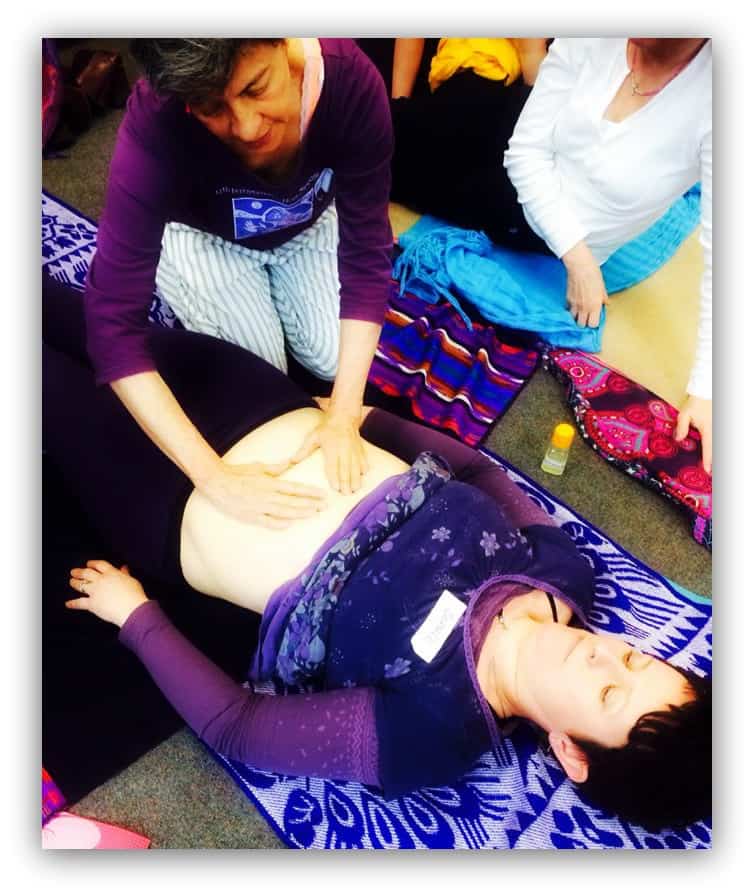
    We learnt to use the manta to rock 5 different parts of the body (which amounted to massaging the whole body). Starting from the shoulders and upper body, we moved onto the chest and abdomen, then the hips, then we worked on the arms, the legs and finally moved onto practising a deep circular abdominal, hips and chest massage with our hands.

    Rocio with Sophie

    Rocio Alarcon demonstrating the abdominal massage on Sophie

    The movements are difficult to describe to someone who hasn’t experienced them. Imagine being enveloped with a cloth and rocked with a jostling movement. Then they are variations to the actual movements, ranging from single to double rocking with an open cloth, to crossing the edges of the cloth, providing a tighter and different rocking motion.

    After a session of shoulders and abdomen rocking, Rocio encouraged us to spend a few minutes writing how we felt and this is what I wrote

    “I feel very warm, loose and mellow, almost in an hypnotic, trance like state. It was so lovely, I didn’t want it to stop. I felt like I was on another planet-the rhythm was lulling, relaxing, liberating”

    I learnt the first level of the Closing the Bones techniques in 2013 with Rocio, and I have been teaching Closing the bones workshops, together with Maddie Mc Mahon, since 2014. We run these workshops regularly in Cambridge, and we are happy to travel for groups (see for dates of future workshops here ). Do get in touch if you would like to organise a workshop in your community. Our goal is to pass on this knowledge so that postpartum women have heard about it and expect it because this is something that our culture has forgotten and that all women should get.

    Maddie and I are meeting next week to discuss how we can incorporate these new techniques into our workshops in the near future. Watch this space!


  • Weaving the cloth of support through a woman’s life, part 4: Closing the bones.

    Weaving the cloth of support through a woman’s life, part 4: Closing the bones.

    sifting modified

    Rocking the hips with a rebozo

    Most cultures around the world have an innate understanding of the vulnerability of a new mother and the need for her to be cared for and nurtured to recover from growing and birthing her baby.

    Many of the postpartum traditions include nourishing foods and a period of confinement, and some kind of bodywork technique, ranging from massage, to binding with a cloth, helping the new mother regain her strength and energy.

    These practises seem so global and multicultural,  surely there is some wisdom in them?  Why have we forgotten them?

    Europe used to have them too, but sadly, because these traditions were passed orally, they got lost within a few generations.

    So today if we want to reclaim this traditions, we have to re-learn these techniques from more traditional cultures around the world.

    Closing the bones is such a technique.

    I learnt closing the bones together with Maddie McMahon, from Dr Rocio Alarcon, an ethnobotanist and Shaman from Ecuador, at a doula retreat in North Wales in 2013. Rocio learnt it from her mother, her grandmother and traditional shamans from the Ecuadorian rainforest.

    Rocio Maddie Cae mabon

    Rocio getting ready to close Maddie’s bones

    Rocio explained that if we did MRI scans of pregnant women we would see how the hips open during the pregnancy, becoming wider and wider, and that after the birth it is paramount to help close them back to their normal width, otherwise mothers suffer from pelvic instability (Rocio attributes the many women suffering from hip issues in our society to the lack of closing the bones massages post birth) and leak energy.

    In traditional cultures, the 40 days of the postnatal period represent a sacred time. In Ecuador, women are given this massage within hours of the birth, and receive it again at least 5 or 6 times during the first 40 days postpartum. The massage stimulates blood flow which in turn cleans, renews, moves fluids (it may also help with milk supply/lochia), stimulates the release and circulation of hormones, stimulates the immune system, and helps tone muscles and tissues.

    According to Rocio, our hips support the weight of the spine and head and they are therefore the seat of unresolved emotions and trauma, which can be felt upon the hips as crystals, that need to be popped and released during the massage.

    Rocio's massage

    Rocio demonstrating part of the abdominal massage

    The closing the bones treatment involves the use of a traditional shawl called a Manta (also known as a rebozo in Mexico) to rock and articulate the mother’s hips and lower spine, followed by a complex abdominal and pelvic girdle massage using a warming oil, and is then finished by tightly wrapping the cloth around the woman’s hips.

    When Rocio taught us, she stressed the importance of passing on this skill, so that it doesn’t become lost. After the retreat, Maddie and I started sharing this knowledge with local doulas. We did a few sharing days, and wrote an article about it for doulaing magazine, This practise obviously resonated a lot with birthworkers because people started asking us to teach them. So we got together and created a workshop and have been facilitating it since 2014. We are delighted to be helping to keep this tradition alive, and we have trained over 150 birthworkers and therapists in this technique. Our hope is that one day enough women around the country will have heard of this lovely and important ritual and expect to receive it after birth.

    Being a scientist by training, whilst the traditional aspect appealed to me, something in me needed the technique to be validated by some kind of “modern” standards.

    I was lucky to be able to gain extra validation of the technique after practising the technique on Cambridge osteopath Teddy Brookes. Teddy was able to validated the effectiveness and gentleness of the closing the bones massage on various joints and organs, which was very reassuring and satisfying for me. Teddy’s comments have been added to the handout we give to people attending our workshop.

    Beyond the physical aspect of closing the bones, there is also a spiritual aspect to the treatment, which provides a safe space/ritual for the mother to feel nurtured and release emotions associated with the birth and motherhood. Having experienced receiving the massage ourselves and given it to many new and not so new mothers, we have both experienced and witnessed how powerful this ritual can be in releasing emotions in a safe way, even many years after the birth itself.

    Maddie and I run Closing the Bones workshops in Cambridge and around the UK-find out more about it here and here.