Category: Doula

  • Why you may want to have a plan C (for caesarean) in your birth preferences

    Why you may want to have a plan C (for caesarean) in your birth preferences

    right way

    When I support couples antenatally, I always encourage them to write a birth preferences document. I do not like the word “plan” because if a plan goes to pot, then you’ve left with nothing (I love this article on the topic).

    I liken writing your birth preferences to going out for diner in a restaurant: you need to see what’s on offer before you can decide whether you fancy a set menu, a la carte, or just a starter and a pudding. If you don’t see the menu, you just get given the dish of the day, which might not suit your tastes at all.

    Similarly, I like to remind parents that the people working in the restaurant are there to serve them, not to serve themselves.

    I sometimes meet resistance from parents who say that you cannot plan birth, and that they would prefer not to have one in case they end up disappointed. I understand that point of view, which is why I like to suggest to parents that they have a plan A, a plan B, and a plan C, as part of their birth preferences. It isn’t a box ticking exercise by the way, it is the process of thinking about all the options and writing them down which is useful. The midst of labour, when you might have been awake for hours and maybe stressed as well as tired, isn’t the best time to weigh up options about interventions you have never heard about.

    menu

    It also helps your medical caregivers, who you will be meeting for the first time during your labour, to establish rapport with you and know how best to support you.

    Again going back to the restaurant analogy, if you came to dinner at my house and you hadn’t told me you were vegetarian, and I had cooked a beef stew, this wouldn’t be great for you, but this wouldn’t be comfy for me either.

    So plan A might be your ideal birth scenario: for example a natural birth, in a low key tech environment (home or a birth centre), using a birth pool and/or relaxation and breathing techniques for comfort (this is just an example by the way-I have been in the birth field long enough to know that birth prefs are like marmite and that one woman’s dream plan may be a low key vaginal birth and another a planned caesarean, and this is totally fine by me).

    Plan B might be looking at things like: what if your labour is induced, what if you have complications that require you to be in the obstetric unit and have constant fetal monitoring, what if you need an epidural, what is your baby needs instrumental help being born. By looking at the interventions and the scientific evidence behind them you will truly be able to make an informed decision about what is right for you.

    Plan C covers what you might want to think about if you baby needs to be born by caesarean, be it planned or during labour (the term “emergency caesarean” is the biggest misnomer of all times-it conjures an imagine of blue lights flashing and medical people running down corridors, when most of the time(crash sections are very rare) is it decided calmly and takes more than 30 min or so to setup-it should really be called an “in labour ” caesarean), what may happen in the few hours after birth and what recovery might look like. Again there are many options, for example you can ask for the cord clamping to be delayed so that your baby received an optimal level of blood, you can have skin to skin in theatre and even feed your baby then if you want to. This is known as a “natural caesarean” (watch the video here, and here is a brilliant natural cesarean birth preferences blog post by doula Lindsey Middlemiss) and if you do not know about it then you might be given the type of caesarean that your obstetrician is used to performing, which might be different.

    It is something I find tricky to navigate and completely follow the couple’s lead, because I am also aware of the school of thought that by talking about interventions, you are also prepping your mind for it (if I say “don’t think of a tree-what pops into your mind?), but I am also aware that our current maternity statistics have very high intervention rates (the UK caesarean rate for 2014/15 is 26.5% which means that 1 in 4 woman is likely to have a caesarean), and that it is therefore realistic to prepare for this eventuality.

    I remember supporting a couple who had planned a birth centre water birth. When after pushing for a long time there was no sign of baby and it became obvious baby needed to be born by caesarean, they had a part of their birth preferences covering that. They had the kindest doctor, who took the time to read their preferences and facilitated most of it. Later on the mother told me how much she had hated writing this part of the document because she didn’t want to entertain the idea that her baby would be born by caesarean , but that when it came to it, she felt that she had a positive birth experience because of it.

    The main reason behind the planning and the thinking is that research shows that it isn’t how the birth unfolds, it isn’t how the baby ends up being born that makes a positive birth experience or not. It is HOW THE PARENTS WERE MADE TO FEEL during the experience. The parents who feel respected, treated with kindness, and with whom the decision making process is shared with their medical caregivers, tend to have a positive birth experience regardless of the process.
    idea

  • The slow disappearance of homebirth services,  the erosion of women’s choices and the need for respect and kindness.

    The slow disappearance of homebirth services, the erosion of women’s choices and the need for respect and kindness.

    change-

    This week I received an invitation to a group called “save our homebirth team”.

    It broke my heart, because this a campaign against the disappearance of the dedicated homebirth team in Peterborough.

    Peterborough is one of the few trusts in the UK that still has a dedicated homebirth team.

    This means that there is a group of midwives there who are not only confident and skilled at supporting homebirths, but when a couple books a homebirth, the team arranges for them to meet every single one of the midwives in the team. This ensures that they actually know the midwives who are going to come and support them during their birth. How awesome is that?

    Nowadays in my antenatal classes, I mostly hear stories of women telling me that they rarely see the same midwife twice during their pregnancy. They say the appointments feel like box ticking exercises, and that they don’t trust the midwives they meet. Why would they? How do you trust someone you don’t know?

    It didn’t used to be like this.

    Ten years ago when I was pregnant with my son, Cambridge used to have a caseloading community midwifery team. During my pregnancy I saw the same midwife at every appointment (and the appointments were about 20 min long). She came to visit me at home a couple of times, and when I was in labour, as she was on call then, she came and supported me through the birth. I didn’t quite realise how lucky I had been to have this kind of continuity of care. My midwife was also very experienced, reassuring, and confident enough in her own practise to fully support my decision to refuse an induction (My son was born at home 16 days after his “due date”).

    Three years later when I was pregnant with my second child, I had started my childbirth educator and doula journey and I felt I couldn’t take the risk of having a stranger turning up at my birth, so I hired independent midwives. It makes me so sad to think that not all the women who psychologically need this kind of care can afford independent midwives.

    We know for a fact that continuity of care leads to better outcomes for mothers and babies. Beside the science backing this up, it makes sense, right? How on earth is a midwife going to know a pregnant mother is out of sorts, or more swollen than usual, or any other mental or physical signs are off, if she has never met her before?

    We know that mothers prefer it, and that staff prefer it too, if they are adequately supported, with caseloads that are appropriately sized.

    The trend towards team midwifery and lack of continuity of care is worrying enough, but I am now seeing a more worrying trend: the looming disappearance of homebirth services.

    Kings Lynn’s hospital stopped providing a homebirth service a few years ago – this has been the object of a campaign called Birthplace Matters (the brainchild of doula Paula Cleary)  which has resulted in the Trust being criticised by the Ombudsman for its inadequate provision for choice of place of birth but has sadly not yet resulted in the reinstatement of services.

    In Cambridge, where I live, we used to have a higher than average homebirth rate. When I started working as antenatal teacher in 2010 it was 6%, well above the 1% national average. In my antenatal classes, I used to have a homebirth couple in almost every class. Now it’s more like one or two per year (running monthly classes).

    Since the local birth centre opened in 2012, the homebirth rate has steadily decreased to about 1%. This is partly due to the birth centre attracting potential homebirth couples, but I believe it’s also down to a lack of commitment to promoting homebirth from the local NHS trust.

    Until last year we were lucky enough to have a fairly healthy homebirth service; whilst we heard stories of women being refused a homebirth in other parts of the country, it didn’t seem to happen here.

    It all started to change last October, when a pilot was put in place at the local hospital. Instead of having two community midwives on call for homebirth at night, there is one, working an ordinary shift in the hospital.

    Since then, several things have happened.

    Couples planning homebirths have received letters telling them that the trust cannot guarantee a midwife will be available to support them at home. Whilst I understand that the hospital needs to be honest with women so they can make informed decisions, women booking hospital births are not being officially notified that the hospital may be short staffed or even closed when they go into labour.

    The trust even has a statement about this on their website

    The maternity service at the Rosie supports home births however it is acknowledged that at times this will not possible due to staffing and/or workload both within the hospital and/ or community. Should it not be possible to support a homebirth then a woman in labour will be asked to attend the Rosie(or if on divert to a neighbouring unit ) where there is a midwife available to care for her. In the event of a labouring woman being unable to make her way in or declining to attend and the unit is unable to attend the birth at home then an ambulance will be sent to facilitate transfer to a unit where a midwife is available to provide care.”

    As you can imagine the recipients of this letter were very distressed, and the statement above doesn’t exactly inspire confidence to potential homebirth parents. You can read more about that here.

    Since the change has happened, I have heard several stories of births for which a midwife wasn’t available and how distressing this was for the mother in labour.

    In my antenatal classes, I have also heard stories of disgruntled couples who were in the birth centre, then their midwife told them she had to leave because she had to attend a homebirth. This gave parents the impression that a homebirth was more important than them.  I wish different language had been used. For example, the midwife could have explained that she was community based and if a call came from the community she may have to go.

    I just do not understand the logic.

    I know the NHS finances are in a terrible state, but when the Birthplace study shows us that homebirths are significantly cheaper than hospital births, (and also that homebirth is very nearly as safe for healthy first time mothers at home than in hospital, and safer for second time mothers), that homebirth are less likely to result in costly interventions, when the NICE guidelines were changed last year to reflect this, surely there should be a concerted effort to INCREASE the homebirth service and to actively promote it rather than trying to scrap it?

    Yet it seems that the opposite is happening.

    I am by no means trying to say that everybody should birth at home by the way. I have been in the birth field for long enough to know individual perceived safety is, and that women should birth where they feel the safest. For some it’s at home, for some in a birth centre, for others in an obstetric unit. I have no issues with that.

    What I have issues with, however, is that women appear to be having their choices restricted.  It is paramount that these choices are respected, not just because many women prefer to birth outside the hospital but because for many women, it really is the only psychologically healthy option for them.

    Asking some women to go to hospital is like asking a soldier to return to the battlefield that caused his shellshock.

    I believe that women cannot make fully informed choices when they aren’t informed of all the options, their pros and cons (teaching antenatal classes for the last 5 years have showed me how many misconceptions people have about the safety of homebirth), and also being confident that the option they choose will be available.

    For homebirth to become normal like it is in some countries like Holland, or even some parts of the UK where the homebirth rate is closer to 10%, there needs to be a concerted effort from the NHS to promote it as a valid choice.

    Legally, where we choose to give birth in the UK doesn’t fall under the remit of maternity care, it falls under the remit of human rights.

    Some countries in Europe, in particular Hungary, have banned homebirth. In 2010, a Hungarian homebirthing woman called Anna Ternovsky challenged her country in the European court of human rights, and won the case. The court ruled that meaningful choice in childbirth is a human rights issue, and that birthing women are the ultimate decision-makers regarding the circumstances in which they birth their babies. You can read more about women’s rights in childbirth on the Birthrights website.

    Beside the decrease of women’s birthing options, I am also seeing a worrying trend towards disrespect of women’s choices within the health system in general. I see a lot of coercion. I hear a lot of “do as you’re told, or else”. This week I was told of a new mother who was threatened with a report to social services when she tried to discharge herself from the hospital against medical advice. Earlier this year a client of mine chose to go home to wait for labour to start on its own rather than consenting to induction, and was told by the midwife as she left “I hope you don’t have a stillbirth during the night”. Another one wanted to wait for labour too and was also told “your baby might die”.

    Health professionals, I just don’t get it.

    I know you want what you think is the best for the mother, but do you think for one second that the mother doesn’t have the best interests of her unborn child at heart?

    Do you think there is any mother in the world who is going to put her unborn baby willingly at risk of injury or death?

    Do you realise you are in breach of your own code of conduct?

    The code of conduct of doctors and midwives in this country is very clear on consent. The GMC guidance states that:

    ” You must respect a patient’s decision to refuse an investigation or treatment, even if you think their decision is wrong or irrational. You should explain your concerns clearly to the patient and outline the possible consequences of their decision. You must not, however, put pressure on a patient to accept your advice.”

    doctor

    Very clear right? Only I wish I witnessed it more often. From time to time I meet a refreshing doctor or midwife who really gets it. But they are a minority. It’s so unusual that I am in awe of them. I always mention it to the person in question how impressed I am by their bedside manner. What I see, most of the time, are various shades of coercion. Sometimes it’s gentle and well meaning, but it’s still coercion. What I believe happens is that most patients are compliant with medical advice and do not question things. Therefore I assume that medical professionals are used to this behaviour, and few get to hone and practise informed decision making on a regular basis. I also believe that the fear of judgement from peers and the fear of litigation, has a lot to answer for.

    The other problem is that clinical guidelines and hospital policies are based on a population. They have to be. But you, an individual pregnant mother, are not the population. You are an individual, and as such you deserve an individualised plan of care.

    I appreciate the words above are potentially upsetting. I am not writing this to cause upset.

    I am writing this because I hope expectant and new mothers read this  and that it helps them make more informed decisions.

    I am writing this because I hope more expectant and new mothers can receive nurturing, individualised care.

    I am writing this because I want to see more respect and kindness within maternity services.

    kindness-620

    I do not believe the system will change through people like me. I have been trying to make positive change happen for the last 5 years, by being a lay member of my local maternity liaison service committee and bending the ear of every health professional who will listen, with little results.

    What I have seen however, is system changes happening when the people who use it (pregnant and new mothers) demanded it.

    If you are pregnant, attend antenatal education, inform yourself about your birth and postnatal options, reach out to other mothers and to birthworkers and build up your knowledge so you can make the truly informed decisions that are right for YOU.

    If you work with expectant parents, help them feel empowered enough to challenge the decisions that don’t feel right for them.

    The more people challenge things, the faster it will change.


  • Advanced closing the bones with Rocio Alarcon

    Advanced closing the bones with Rocio Alarcon

    Rocio with Maddie

    Rocio and Maddie at the Cae Mabon workshop

    Three years ago I was very fortunate to meet Ecuadorian shaman, healer and ethnobotanist Rocio Alarcon at a doula retreat in North Wales. She facilitated a workshop on the closing the bones postnatal treatment and massage This was transformative for me in many ways, not the least because it started me on the journey to share this amazing skill with doulas and birthworkers and therapists (read more about it here)

    This year I was fortunate to attend two more of Rocio’s workshops-learning about advanced closing the bones techniques. The next level of the technique.

    Dr Rocio Alarcon is an Ethnobotanist, healer, shaman and traditional midwife from Ecuador. She lives in the UK and teaches all around the world. She has a PhD in Ethnobotany, but the most valuable part of her knowledge she gained from her mother and grandmother, and from shamans in the rainforest in Ecuador. There is a depth knowledge in her, a wisdom that is the product of many generations of ancestral knowledge. This type of knowledge simply cannot be gained through university training.

    When teaching these techniques, Rocio talks about Western medical knowledge, such as lymph draining, blood flow increase, and hormonal release. But at the root of the treatment is creating a movement of energy inside the new mother’s body. She talks about the opening of energy channels within the birthing woman’s body, moving from the top of the head to the root, and explains that there channels may close by themselves naturally, but that it might take a long time and the process needs to be speeded up and help, lest the woman spends the rest of her life leaking energy and feeling depleted.

    Rocio spent much of the day teaching us how to use a traditional Ecuadorian cloth called a Manta to support the return of a new mother back to her full energy and health.

    rocio matna

    Using the Manta

    Much of what we learnt can be applied to any woman, man or child incidentally, because the techniques help move energy around, stimulate lymphatic and blood flow, relaxing and warming muscles and fascia and stimulating the release of feel good hormones such as endorphins and oxytocin.

    In this respect the techniques can benefit anybody. Rocio explained that these movements would be very beneficial to anybody experiencing depression or anxiety issues in particular.

    Upon hearing this, my scientific mind was reminded that we exist in two primal states: the Rest and Relaxation  state, and the Fight or Flight state. In the R&R state, we can heal and grow, whereas in the F&F state we are in a high alert, survival state, during which all resources are redirected to survival, hence no repair , healing and growth can take place. Having experienced the profound, deep relaxation that manta rocking provides, I can attest that it definitely promotes the R&R state. I felt like I was in a near trance like state after being rocked.

    We learnt to use the manta to rock 5 different parts of the body (which amounted to massaging the whole body). Starting from the shoulders and upper body, we moved onto the chest and abdomen, then the hips, then we worked on the arms, the legs and finally moved onto practising a deep circular abdominal, hips and chest massage with our hands.

    Rocio with Sophie

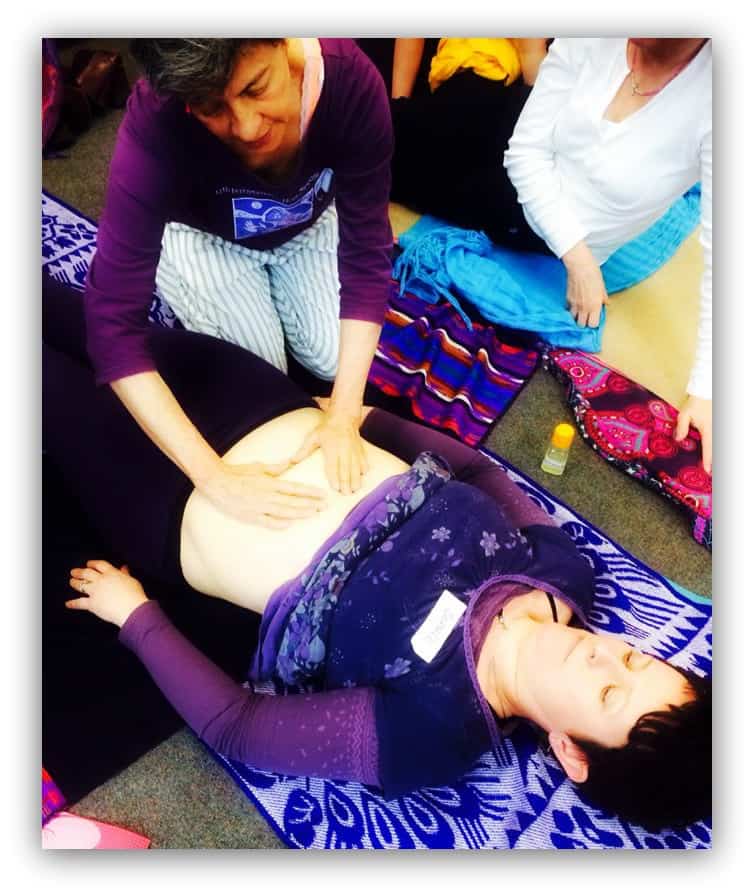
    Rocio Alarcon demonstrating the abdominal massage on Sophie

    The movements are difficult to describe to someone who hasn’t experienced them. Imagine being enveloped with a cloth and rocked with a jostling movement. Then they are variations to the actual movements, ranging from single to double rocking with an open cloth, to crossing the edges of the cloth, providing a tighter and different rocking motion.

    After a session of shoulders and abdomen rocking, Rocio encouraged us to spend a few minutes writing how we felt and this is what I wrote

    “I feel very warm, loose and mellow, almost in an hypnotic, trance like state. It was so lovely, I didn’t want it to stop. I felt like I was on another planet-the rhythm was lulling, relaxing, liberating”

    I learnt the first level of the Closing the Bones techniques in 2013 with Rocio, and I have been teaching Closing the bones workshops, together with Maddie Mc Mahon, since 2014. We run these workshops regularly in Cambridge, and we are happy to travel for groups (see for dates of future workshops here ). Do get in touch if you would like to organise a workshop in your community. Our goal is to pass on this knowledge so that postpartum women have heard about it and expect it because this is something that our culture has forgotten and that all women should get.

    Maddie and I are meeting next week to discuss how we can incorporate these new techniques into our workshops in the near future. Watch this space!


  • Weaving the cloth of support through a woman’s life, part 4: Closing the bones.

    Weaving the cloth of support through a woman’s life, part 4: Closing the bones.

    sifting modified

    Rocking the hips with a rebozo

    Most cultures around the world have an innate understanding of the vulnerability of a new mother and the need for her to be cared for and nurtured to recover from growing and birthing her baby.

    Many of the postpartum traditions include nourishing foods and a period of confinement, and some kind of bodywork technique, ranging from massage, to binding with a cloth, helping the new mother regain her strength and energy.

    These practises seem so global and multicultural,  surely there is some wisdom in them?  Why have we forgotten them?

    Europe used to have them too, but sadly, because these traditions were passed orally, they got lost within a few generations.

    So today if we want to reclaim this traditions, we have to re-learn these techniques from more traditional cultures around the world.

    Closing the bones is such a technique.

    I learnt closing the bones together with Maddie McMahon, from Dr Rocio Alarcon, an ethnobotanist and Shaman from Ecuador, at a doula retreat in North Wales in 2013. Rocio learnt it from her mother, her grandmother and traditional shamans from the Ecuadorian rainforest.

    Rocio Maddie Cae mabon

    Rocio getting ready to close Maddie’s bones

    Rocio explained that if we did MRI scans of pregnant women we would see how the hips open during the pregnancy, becoming wider and wider, and that after the birth it is paramount to help close them back to their normal width, otherwise mothers suffer from pelvic instability (Rocio attributes the many women suffering from hip issues in our society to the lack of closing the bones massages post birth) and leak energy.

    In traditional cultures, the 40 days of the postnatal period represent a sacred time. In Ecuador, women are given this massage within hours of the birth, and receive it again at least 5 or 6 times during the first 40 days postpartum. The massage stimulates blood flow which in turn cleans, renews, moves fluids (it may also help with milk supply/lochia), stimulates the release and circulation of hormones, stimulates the immune system, and helps tone muscles and tissues.

    According to Rocio, our hips support the weight of the spine and head and they are therefore the seat of unresolved emotions and trauma, which can be felt upon the hips as crystals, that need to be popped and released during the massage.

    Rocio's massage

    Rocio demonstrating part of the abdominal massage

    The closing the bones treatment involves the use of a traditional shawl called a Manta (also known as a rebozo in Mexico) to rock and articulate the mother’s hips and lower spine, followed by a complex abdominal and pelvic girdle massage using a warming oil, and is then finished by tightly wrapping the cloth around the woman’s hips.

    When Rocio taught us, she stressed the importance of passing on this skill, so that it doesn’t become lost. After the retreat, Maddie and I started sharing this knowledge with local doulas. We did a few sharing days, and wrote an article about it for doulaing magazine, This practise obviously resonated a lot with birthworkers because people started asking us to teach them. So we got together and created a workshop and have been facilitating it since 2014. We are delighted to be helping to keep this tradition alive, and we have trained over 150 birthworkers and therapists in this technique. Our hope is that one day enough women around the country will have heard of this lovely and important ritual and expect to receive it after birth.

    Being a scientist by training, whilst the traditional aspect appealed to me, something in me needed the technique to be validated by some kind of “modern” standards.

    I was lucky to be able to gain extra validation of the technique after practising the technique on Cambridge osteopath Teddy Brookes. Teddy was able to validated the effectiveness and gentleness of the closing the bones massage on various joints and organs, which was very reassuring and satisfying for me. Teddy’s comments have been added to the handout we give to people attending our workshop.

    Beyond the physical aspect of closing the bones, there is also a spiritual aspect to the treatment, which provides a safe space/ritual for the mother to feel nurtured and release emotions associated with the birth and motherhood. Having experienced receiving the massage ourselves and given it to many new and not so new mothers, we have both experienced and witnessed how powerful this ritual can be in releasing emotions in a safe way, even many years after the birth itself.

    Maddie and I run Closing the Bones workshops in Cambridge and around the UK-find out more about it here and here.

  • Head versus hands knowledge

    Head versus hands knowledge

    I’ve just realised that I don’t value my “hand knowledge” enough

    We live in a culture which values and glorifies “head knowledge” over any other of kinds of knowledge. Intellectual knowledge, academic knowledge, whatever you call it. This is the type of knowledge you get from getting a degree, from getting formal education ,from reading books etc. And it also happens to be the type of knowledge upon which our society places the highest value.

    For years, I also thought about it in this way, that it was the only type of knowledge worth having. I thought that I had to read papers, and cram my head full with facts and figures. I thought I had to know everything, and that if I didn’t, I was incompetent. It wasn’t actually spoken, but it was implied as a rule during my years as a biology and PhD student. Because I was new, I was treated like a young ignorant person (something I often refer to as the ‘young grasshopper’ attitude) by my supervisor and by the other scientists in my PhD lab, and the message implied that I didn’t know enough. This feeling stayed with me for years, so much so that when I was speaking at conferences, it wasn’t delivering my talk that filled me with anxiety, but the questions asked at the end of my talk: what if I couldn’t answer them?

    Yet I wasn’t aware of this, but all this time there was always another kind of knowledge, even in the field of biological research: I did a lot of practical work in the lab, and to become good at it, I had to learn with my hands, with my body. This wasn’t an intellectual process. And yet, although this wasn’t spoken, it was implied that this knowledge was less valuable, because that the people in the lab like technicians, who only did benchwork where considered less valuable than the ones working at their desks. I remember really enjoying switching between bench work  and desk work as a student scientist.  It gave me a good balance of using my hands and using my head. I would have loathed spending all my time at the computer.  I loved spending time at the bench, using my hands, it felt very similar in a way to cooking. I guess I always had that need for that balance in me. But I wasn’t conscious of it, or didn’t put words on it, that realisation came much later.

    The intellectual knowledge came easily to me, so I didn’t value it. I have noticed that we don’t tend to think much of what we can do effortlessly, as if effort and value go hand in hand.

    It was only after I quit science to become a birthworker that I realised I had the same hang up in my early days in my new career as I did in my early days as a scientist. The young grasshopper feeling came back, along with impostor syndrome.  When I started teaching physical skills in my antenatal classes, and also the closing the bones massage, I felt particularly uncomfortable when massage therapists and bodyworkers turned up to learn from me. I felt like a fraud, like a home cook showing a Michelin Star chef their favourite dish. Who was I to teach them anything, and what were they going to think of it? I guess I just didn’t value much of my hand knowledge at that time.

    Interestingly, everyone I taught gave extremely positive feedback. And antenatal classes assessors told me that I was a natural at teaching physical skills.

    Now I realise that I just assumed I was crap at doing stuff with my body, because this isn’t what I had been trained to do, and because the way I learnt it was completely different from my scientific training. The rebozo techniques, the birth positions, the massage, the breathing and relaxation techniques, I learnt them by either teaching myself or from other people, through an informal, apprenticeship type of approach. It wasn’t ratified by a university degree, and often, gasp, horror, there wasn’t even a certificate to prove I had learnt stuff!  So surely this couldn’t be good?

    Interestingly, as part of training for my university diploma in antenatal education, I learnt that we are all kinaesthetic learners : we learn by doing, rather than by listening or watching. Research is clear about this:  for instance, attending a lecture has a learning retention rate of 5 to 10% whereas practising things lead to a retention rate of around 70 to 80%.

    It took a couple of conversation with a massage therapist friend, Stephanie, and my osteopath friend Teddy for me to start shifting my thinking. Within a short time I practised the closing the bones massage on them, they both enjoyed it a lot and praised both the technique and my skills. Only then did I start to reflect on the idea that maybe I was actually ok at doing this stuff with my hands.  I realised I hadn’t reflected on it much until then, and that I had just assumed I wasn’t particularly good at it.

    The crunch came when I told Stephanie that head knowledge came easily to me and hand knowledge didn’t. Stephanie told me she was the opposite. This was a light bulb moment: I had been dismissing my new skills because of how I looked at them through the filter of what I considered to be valuable knowledge. Only then did I start thinking that I could do good things with my hands.


    The shift from scientist to birthworker gave me an very interesting insight on my scientific years. As I trained to become a doula, I learnt a lot about signposting and being non judgemental and positive in my interactions with others. I changed the way I was answering questions as conferences-when asked something I didn’t know about, instead of feeling defensive and uncomfortable, I acknowledged the pertinence of the question and threw it back to the audience-this caused such a positive shift in energy in the room!

    When faced with something we don’t know we can react in either of two ways: defensiveness, or admission of lack of knowledge followed by an expression of wonder. Defensiveness (I’ve never heard about this-therefore it isn’t true), is a fear response. It is a reflection of the recipient feeling incompetent, often followed by dismissing the point of view that is being put forward. Amazement, or wonder, on the other hand, is a love response. “I’ve never heard about this-how interesting” . Guess which of the two attitude fosters connection?

    Today in my work as a doula, I sadly observe many medical professionals behaving in the defensive way described above. I understand that this is the product of education and culture but I wish for more enlightenment and desire for connection.

    This brings me to the third kind of knowledge-that my change of career has taught me much about: heart knowledge. This is more difficult to explain and capture, but I guess some of the concept above illustrate it-connection is key. Heart knowledge is deep knowing. It is compassion, love and connection. I would say head knowledge comes first, then body, then heart, heart being the deepest of the three.

    It is said that knowledge is like the layers of an onion. In my work as a doula I have been humbled to move on from stuff I knew in my head, to stuff I knew in my body, to stuff I knew in my heart. That is what the essence of what the work of a doula is. Heart knowledge.

    True, connected support isn’t about head knowledge, it isn’t about the facts (though this is sometimes important too), and it isn’t about how good you are at giving a massage. It is about how present you are, how you are holding her, with your heart wide open.


  • Doula myths series part 1 "I don’t need a doula because I have my partner"


    There are several myths/misconceptions are doula support. One of them is “I don’t need a doula because I will have my partner to support me through the birth”.

    Sometimes, the partner themselves feels concerned that the doula is going to take their place/make them feel redundant.

    It couldn’t be further from the truth.

    So why do you need a doula even if your partner is there during your labour and birth? Here are my ten reasons why:

    1) Think about the doula like a coach, or a sherpa: if you were going to climb mount Everest, you would take your partner with you, but you’d also hire a guide. Someone who has done it several times before, who knows the mountain inside out, who knows the easy route and the scenic route, who knows how to navigate unexpected weather changes, who can help cheer you on and help carry your bags etc.

    trekkers

    2) During the pregnancy a doula can help you both acquire the knowledge you need to plan the birth environment and location etc that suits you best. Knowledge is power! You wouldn’t turn up at an important business meeting thinking you’re just going to wing it! So having some thinking about the options beforehand will help you and your partner feel more prepared and confident.

    3) Many pregnant women and their partners have fears and anxieties about the birth and about becoming a parent-a doula will help you identify and talk through these, help you find ways of alleviating them, work your way through conflicting advice, and debunk myths.

    4) A doula can help your partner feel more relaxed and safe : having someone you know and trust present in the room, someone who has seen it all before, who isn’t freaked out by it, someone you can ask questions to (“is this normal?), who can reassure you that things are progressing as they should (especially during the earlier part of labour when you are alone at home-this can take up to 2/3 of your labour by the way) can make a world of difference to how calm and confident you both feel. You’ve probably heard that adrenalin and stress are contagious, but so are calm and oxytocin! Having a calmer and more confident birth partner, can in turn help you feel calmer and confident, and can have a significant positive effect on your labour.

    5) Doulas are skilled at providing labour support. So we can help your partner support you better during your labour and birth. We can suggest comfort measures for labour, like breathing techniques, movement, positions, massage and more. We can show your partner how do them during labour, so your partner can support you better, building even more into this confidence thing. This also help increase the feeling of connection between you. Nothing makes a doula happier than hearing a couple say something like “we did it together”.

    relaxation

    6) Team work: birth can take a long time and be a tiring affair for a single birth partner. Having more than one partner in your birth team means that we can tag team, giving each other a break and time to grab a nap, a snack or a drink, or simply time to go for a wee without leaving you without support during a contraction. Sometimes a labouring woman may like to hold onto her partner’s shoulders during contractions, but also needs her lower back massaged at the same time-that is something rather difficult to do on your own!

    7) We know how to pace ourselves-we’ve been there before many times and we have learnt from it. Again back onto a coach analogy, we know how to navigate a long labour, keep both of you as comfortable, rested, relaxed, fed and hydrated as much as possible. We can suggest more restful positions for both of you, feed you snacks and give your drinks, keep you cool, suggest breaks etc.

    8) Doulas are helpful advocates for the two of you. We know the maternity system in and out-so if a curve ball get thrown at you-something unexpected happens, an intervention you didn’t want gets suggested-we’ll help you navigate it, make sure you have asked the right questions, make sure you have all the information you need so you can make the right decision for you.

    9) Doula are impartial-we are often the only person in the room who isn’t bound by other professional obligations than to serve you. We have no clinical responsibilities and no agenda, other than making sure that you are unconditionally supported.

    10) After your baby has been born, we stay for a while and look after the both of you, help you bond and establish feeding with your baby, and make sure you are comfortable and safe and feel ready before we leave.

    father and baby

    And I know that’s ten, but I want to add something else :  when you get home with your new baby-and you’re freaked you out because this feels like a huge responsibility and you don’t feel “qualified” to look after this baby on your own. And then everybody is giving you conflicting advice so it’s hard to listen to your heart and trust yourself? Your doula can come to your home and help you find your feet, and is often the only person listening to you without an agenda, hence helping you find your own ways of doing things.

    If you this resonates with you and you feel draw to work with me- head over here