
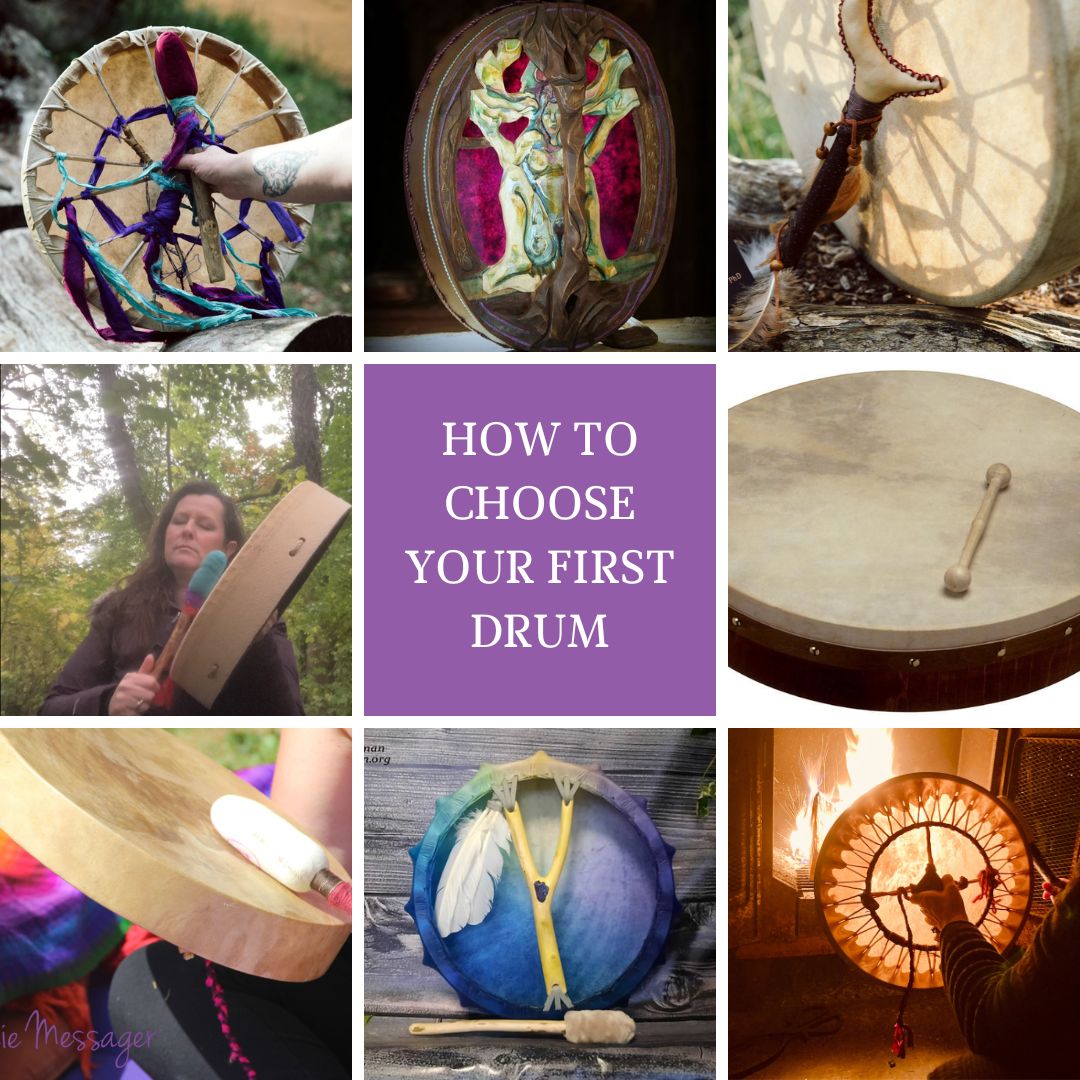
If you’ve been thinking about getting your own drum and don’t know where to start, this is for you.
There is a lot of choice out there, and some of it is genuinely confusing. There are also some real pitfalls worth knowing about before you spend any money. In this article I want to walk you through everything I know, from a £40 second-hand find to a handmade custom drum, so you can make a decision that feels right for you.
What is a frame/shamanic style drum?
The type of drums I use are frame drums, one of the oldest known musical instruments, found across many cultures worldwide and used in spiritual and ceremonial contexts. They are sometimes called shamanic drums.
A frame drum is a simple percussion instrument: a round wooden frame, typically 2 to 4 inches deep, with a single drumhead stretched over one side. The drumhead is traditionally made from animal skin (hide), though synthetic materials are also used. Frame drums produce a warm, resonant tone with a wide range of sounds, from deep booms to higher tones.
In my work I use frame drums with a handle at the back, played by striking the drumhead with a padded beater.
Size matters
Whatever drum you choose, the bigger the drum, the deeper the sound. I recommend starting with something between 14 and 16 inches in diameter. Smaller drums tend to sound high-pitched and tinny; really large drums (20 inches and above) have a beautiful deep resonance but can be unwieldy to hold and carry.
The two main types: synthetic vs. skin
Synthetic drums
Synthetic drums use a plastic or composite drumhead rather than animal hide. The main brand I use and recommend is Remo, specifically the Remo Buffalo drum (16 inches, off-white head) and the Remo Bahia Bass Buffalo drum (16 inches, black head, deeper and more muted sound). These are factory-made, and while all drums have their own spirit, I find synthetic drums carry a little less of that quality than handmade skin drums.
Advantages:
- Reliable, consistent sound (from reputable brands, see the warning below)
- Completely weatherproof, unaffected by cold, moisture or temperature
- Ideal if you play outdoors, especially in the UK climate! I’ve taken mine into sweat lodges and saunas
- Great for people who prefer not to use animal products
- More affordable : a Remo Buffalo 16″ drum costs around £115
Disadvantages:
- Factory-made, less individual spirit and energy than a handmade drum
You can listen to sound samples of Remo drums on the Thomann website before buying.
Skin drums
I own over 30 drums, eight of which I made myself in drum-birthing workshops or by myself. The rest I bought or received as gifts.
Advantages:
- Unique, individual, handmade, no two are the same
- Each carries its own spirit and energy, shaped by the hide, the wood and the maker’s hands
- Different animal hides and wood hoops each carry their own spiritual properties, choose what speaks to you
- Can be bought ready-made, custom-made, or made by your own hands (and you can personalise with symbols, drawings, paintings, crystals…)
Disadvantages:
- Quality varies considerably, and there are fakes (more on that below)
- Sensitive to weather, moisture and temperature. They need warming up in cold weather, can become unplayable in hot and humid weather, and cannot be played in the rain
- Can be damaged by extreme heat (never leave one in a hot car)
- Tend to be more expensive: typically £150 to £300 or more
Skin drum makers whose work I personally know and trust:
- Melonie Syrett —thedrumwoman.com (UK)-get a 10% discount off a drum by mentioning my name.
- Rachael Crow —rachaelcrow.co.uk (UK) get a 10% discount off a drum by mentioning my name.
- Jonathan Weekes at Heron Drums (now based in Ireland)
- The Sea Crow (UK, painted drums)
- Veleslav Voron at Shaman Drums (Ukraine)
- Juha Jarvinen at Yxpila Art (Finland)
I recommend these people because I know their work in person and own drums from them. This does not mean that it is by any means an exhaustive list! Ask in drumming communities (there are many Facebook groups, and you are welcome to join the one I run for women) for local recommendations, there are many wonderful drum makers around, and word of mouth is the best guide.
Drum options by budget
Whether you’re just starting out or looking to upgrade, here’s a simple guide depending on what you want to spend.
Around £40–£80 A second-hand Irish Bodhran (good brands such as Malachy Kearns or Waltons) on Facebook Marketplace or eBay. A bodhran is not officially a shamanic drum, but it works beautifully for this purpose. This is probably my best kept secret tip for beginners.
A note about drum beaters
Bodhrans usually comes with a small wooden stick (called a tipper), and you’ll want a soft beater instead. Beaters are easy to make yourself with a foraged stick, some stuffing and a pair of socks wrapped around the stick and stuffing.
If you’d like to buy a beater for your drum (regardless of whether it is a Bodhran or another type of drum), here are a couple of recommendations:
- Spiritcraft makes beautiful and affordable beaters (and also stunning and unusual rattles), and they have kindly offered a 10% discount to my reader with the code SOPHIE10.
- Another UK beater maker I love, Vicki Yates, makes unusual and beautiful beaters using honeysuckle wood, crystals, and feathers. Vicki is offering a generous 15% discount using the code MESSAGER15%
Around £100–£120
- A Remo Buffalo drum (synthetic, excellent quality, very reliable) in either the off-white version or the Bahia Bass version (black, deeper pitch, more muted tone)
- Some handmade UK drums on Etsy can be found at this price point and still be genuinely good. Always ask for a sound sample before buying, any reputable seller will be happy to provide one
£150–£300
- A handmade shamanic drum, either ready-made or custom-made to your specifications
- A drum-making kit from a drum maker, to make your own at home (usually comes with instruction videos)
- Or, for the ultimate experience, attend a drum-making workshop and make your drum with the guidance of a skilled teacher. This drum will carry your own medicine and the intention you bring to it
For ready-made drums, custom drums and drum-making workshops in the UK, I recommend Melonie Syrett (thedrumwoman.com) and Rachael Crow (rachaelcrow.co.uk). For other makers, ask locally or in online drumming groups for recommendations.
Size matters
The bigger the drum, the deeper the sound. Very small drums tend to have high pitched, tinny sound which isn’t very pleasant to hear.
At a base recommendation, I find that a drum of about 14 to 16 inches diameter is a good size. You can find drums as small as 6 inches and I once found a drum in a music shop that was 30 inches in diameter.
I have some smaller drums to travel with, 10 inches in diameter, and some up to 18 inches, but most of my drums are 16 inches.
For drumming over a person (in therapeutic or ceremonial work), make sure you choose a drum with a handle at the back, as well as one that isn’t too big or heavy (I have learnt this the hard way!), as this makes it much easier to hold.
What to avoid
Quality really matters with drums. If at all possible, listen to the sound before you buy, either in person or by asking for a sound recording.
There are many cheap drums on Amazon and similar platforms that look appealing but sound terrible and won’t last. And unfortunately, there are outright fakes: cheap Chinese-made copies of real artisan drums, often sold for around £30 via Facebook ads or marketplace, eBay Amazon, or Vinted. The people making these drums steal photographs from real artists and use them to pretend to sell the real thing, but it really is a tiny plastic drum with a picture printed on it that bears no resemblance to the real thing. A friend of mine ordered one and received a drum about the size of my hand, with the printed image already peeling off. You can find such copies of Veleslav Voron’s distinctive Ukrainian drums selling for under £10 on Aliexpress.
As always: if it seems too good to be true, it probably is. Get recommendations, seek out trusted drum makers, and ask for a sound sample before you buy.
If this helped you find your drum, I’d love to know what you ended up with. Share it in the comments below, or come and tell us in the Women Drumkeepers Community on Facebook.
And if you’d like to go deeper into how drumming can support your wellbeing, my book The Beat of Your Own Drum is a good place to start. There’s a free sample chapter at the link, and the kindle version is only £5.49 if you want to dip in gently.
If you’d like to find out more about my work, from one-to-one sessions to healing, drum circles, workshops and courses, you can explore everything on this page, or simply contact me.
Happy drumming. 🥁


Leave a Reply
You must be logged in to post a comment.